Showing posts with label Direct Line Ancestors. Show all posts

Friday, September 13, 2013

Mary Wood Conspiracy

Mary Wood is my 10 x Great Grandmother  ...

Fact: She was married to Richard Platt .......

This is where things are iffy.

On one hand ... many trees show that Mary's parents were John Wood and Jane (unknown) ... and that is where things end.  There is documentation naming John and Jane as her parents.

However ..... on other trees, it's Henry Wood and Isabell Goodspeed.

Both Mary Woods from these two sets of parents married Richard Platt.   Both have the same back story.  Both ...... well, they are the same person.  Period.

So which set is her parents?

Let's back up a little bit.  Even if Mary Wood has always given me a bit of a difficult time, it's another one of those "dead ends" that felt like it shouldn't have been.

One of my best friends and I did the whole "Famous" relative thing a long time ago.  We both found out that one of the connections we had was Louisa Alcott.  Ya know, the writer of one of my favorite books of all times, Little Women.

So .... the point where it switched directions was Mary Wood.  According to the links, Mary's Mom's name was Isabell Goodspeed..... but I had it as Jane.

So I was all - what the heck.

Well Ancestry has taken down the "Famous Relatives" thing because of inaccuracy issues.  So at first I'm like... well, there you go.  Inaccuracy.

But then I got to thinking ....  what if .... I'm wrong, and it's right?    Mary Wood and Richard Platt are in my family tree, twice, on the same line.  Yeah - I know ........ INBREEDING.

Um...... HELLO .... if you have English relatives, you probably have inbreeding.  ESPECIALLY if you have English Royalty.  Just sayin ...

So ...... this is how it goes ....


Enoch and Anna Comstock had many children, two of which were Ruth and Cephas ....  Cephas married Nancy, and Ruth married Oliver ....  then Cephas' daughter Caroline married her cousin Samuel who was Ruth's son.  Yep.  Was it acceptable to marry your cousin (not even removed) in the 1800s?

I actually was curious - so I googled it.  I found a few interesting answers ....  here and here.

This depends on the location. Since the discussion seems to be heading in the direction of "cousin marriage" that is what I will talk about. In the West in 1870 it was growing more and more taboo. But cousin marriage is still very widespread among areas in the Middle East and Africa even today and is socially acceptable and is often set up within the family through complicated systems. For instance have you ever heard of cross/parallel cousins and double first cousins? It's super complicated so instead of retyping it all I linked the Wikipedia article. They're short but very interesting. The likeliness that we all have some sort of incest in our family history is very strong. Icky, but true. haha

EDIT:
To address your additions to the question, marrying a direct cousin would not be accepted well in France, however first cousin marriage was and still is legal. Most people have heard of Edgar Allen Poe's marriage to his first cousin Virginia Clemm, this was in the mid 1800's in the U.S., it was tolerated (notice the use of tolerated but not accepted) but thought of as strange to put it lightly. By the mid to late 1800's science was suggesting the effects of incest were higher rates of birth defects, so western society was turning away from the practice of marrying your first cousin. This is true, but by about 2% (Charles Darwin was also married to his first cousin). So, would having direct cousins for parents make you an outcast in the time period? Possibly, but based on cultural norms. Further, it depended on the society you lived in and which class you belonged to. If you were a peasant it might not have mattered due to lack of education/knowledge of genealogy. Or it could be the exact opposite, being a peasant could strengthen ties of genealogy and lineage, since one would rely on those bonds for food, shelter etc. my point, each case is individualistic. Thus cannot be answered in a simple way unfortunately (at least from an anthropological standpoint). :) it's so complicatedddd.

Source(s):


And this one too

Back then science and technology was not advanced and marrying a cousin keeps the family riches in the family.

Now, we realized interbreeding closely can result in disabilities in the child, you know what I mean, like mentally retarded and whatnot. Not many royals and rich people are stingy enough to marry relatives to keep royal and rich blood only.

You can still marry your cousin in all countries, but depends on how close. Most don't allow you to marry first cousins or second cousins. While all allow 3rd, 4th, and so on. Because the blood isn't as close so your child won't have any risks due to relation. Also it's a bit taboo now because of it, and cousins are seen like siblings if you are raised close to each other. It'll be hard for your parents and peers to accept it.


And this one...

It was IN the 1800's that genetics was "discovered" and how it worked regarding biological inheritance of traits from parents to offspring, and it became illegal, based purely on genetic inheritance considerations. Close inbreeding damages the gene pool. Just ask ANY breeder of dogs or horses. The closer the blood relationship between parents, the more likely birth defects in the offspring. It was PRIOR to the 1800's that cousins were acceptable. Back in the days of the Pharaohs in Egypt, it was even OK to marry your sister... Just ask the royal houses in England about the results of inbreeding with cousins...

Now back in the days of English Royalty, you do find some inbreeding -but mostly- it was that they brought in other Royals, from France, Italy, Ireland, etc for marriages.   But - like one of the people stated above, if Royal lines wanted things to stay with in the blood line, it wasn't unheard of.

With all that said, lets move on.


Enoch was the child of Deborah and Abijah Comstock,  Abijah was the son of Abigail and Moses Comstock, Moses the child of Christopher Comstock and Hannah Platt.... and Hannah was the daughter of Deacon Richard Platt and Mary Wood.

This is where the problem rises, going back from Mary Wood.

Birth: 1605 Harwich, England
Death: 1675 Milford New Haven County, Connecticut, USA
The daughter of John & Jane Wood of Roydon, Co. Essex, England. She was baptized on November 10th or 11th in Roydon, Co. Essex, England. Richard Platt and Mary Wood were married on 26 January 1628/1629 in Roydon. On 25 April 1638, Richard & Mary sold their property in Ware (which is four miles southeast of Roydon) in England, and prepared to sail to New England.
The family was first at New Haven and by 1640 were in Milford (lot #38 West Main and Cherry Street). Mary joined the Milford church on 29 January 1639/40 the same year as her husband.

Mary precedeased her husband, and the exact date of her death is unknown, but Milford Church records show that she was buried on March 24, 1675/1676. She isNOT buried a the Founders Memorial Site. Most all of the early settlers were buried in Rev. Peter Prudden's garden until around 1675, and after that they were buried in an extension of his garden which is presently the oldest part of the Milford Cemetery.
The picture of the memorial stone placed on the Founder's Bridge over the Wepawaug River in Milford, CT shows Mary's name along with that of her husband. 


You can see there - that they clearly say that Mary was the daughter of John and Jane Wood.  I have run  into a lot of documentation like that.  But so I wonder....... since John Wood is a dead end ....  because if you look above, John Wood is NOT the son of that John Wood listed as his father, because John Wood with the English Flag would have been UNBORN at the birth of his son John Wood with the tree ...  Yeah, that doesn't work......

And Jane (Unknown) - even with the one surname I found listed for her, is a dead end......

I wonder, what if Henry and Isabell ARE her parents....


So I put it in my tree.....  and this is what happens....  and then it's John and Joan are Henry's parents.. but then I start looking closer....... and
That's not right.  John - Henry's Father - was born - AFTER HENRY????   Um... no, that's not right....  So I go back again ....  

And now ......... I'm just stuck.  Who the hell-o are her parents?  It's so freaking frustrating!  

So I pop a name and date in the trusty Google Search and I get directed to Geni.com and www.myheritage.com

This is what I found there...... 
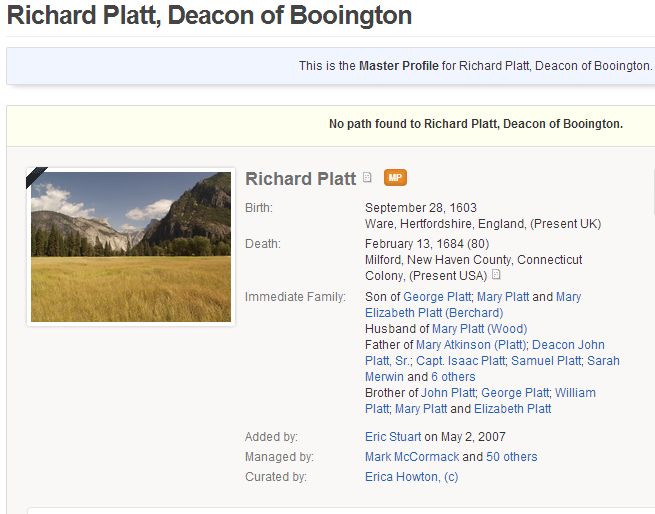

Mary Wood's Parents 

John Wood's Parents


So ..... with all that confusion .....  I will share this note.  I have seen other posts by Dennis and I do tend to know he has some information backing up what he says.... 

Elizabeth Rose Wood married John Potter in England. Elizabeth was born in Chesham, Buckinghamshire, England. William was born in Manchester, England. They were married April 14, 1630 in Chesham, Buckingshire, England. Elizabeth was born February 26, 1605/06 and John born March 24,1605/06. They had four children; Hannah (b. 1631), Elizabeth (b. February 16, 1631/32), John (b. October 17, 1635), and Samuel(b. October 07, 1641).John Potter died August 10, 1643 in New Haven where he had operated a small farm and made and repaired winches. Elizabeth was a midwife. He and Elizabeth lived in New Haven since it was established in 1639. A number of Massachusetts settlers joined the Davenport Group when they set out to settle New Haven and it is likely they were a part of this group. Elizabeth's sister Mary Wood (b. November 10, 1605) was a member of Reverend Peter Prudens' congregation as they sailed on the Hector with the Davenport Company. Prudens' congregation traveled to New Haven to settle there with Davenports' congregation. Mary married Richard Platt and they lived in Milford, New Haven Colony. I don't know when John Potter and Elizabeth arrived in America or what ship they took. I believe they arrived before 1638 when the Hector arrived in Boston Harbor. John Potter's parents were John Potter, Sr. and Hannah Mead. They were likely from Kent, England. I have John Sr. born March 28, 1580 and Hannah born about 1584. John Potter Jr. had a brother named William, born in 1608, who also came to America and lived in New Haven. William was hanged for beastiality June 06, 1662. Beastiality was relatively common in Colonial America despite the drastic sentence it brought. William fully admitted his offense to the court and stated he hated this "affliction". Elizabeth lived after John's death marrying first my ancestor, Edward John Parker who died soon after William on June 27, 1662. I don't know the cause of Edward's death. Their children were; Joseph (b. February 1647/48), Mary (b. April 1648) , John (b. October 08, 1648), Hope (b. April 26, 1650), and Lydia (b. April 14, 1652). We trace our Parker line from John who first married Hannah Bassett (M. November 08, 1670).Elizabeth married a third time to Pequot War hero, Colonel Robert Rose, himself a widower. The marriage lasted a brief three years with Elizabeth also out living him. There were no children of this marriage. I am presently trying to sort out who might be Edwards' father. There was a William Parker who also died in New Haven in 1662 who it is thought might be related. There was also an Abraham Parker who came to Hartford with Reverend Thomas Hooker. This was the beginning of Connecticut Colony. Abraham had William, Ralph, and Edward John as sons. The William Parker who is the son of this Abraham Parker was an original settler of Saybrooke, a satelite colony of Connecticut Colony The Ralph Parker lived in early Wallingford and married into the Ives family who Charles and Burl trace their ancestry.

note: written by Dennis Wright 

It's Elizabeth (Mary's sister) that links back to Lousia M. Alcott  ..... so I know, regardless, I have that connection - REGARDLESS of who Mary and Elizabeth's parents are.  Right?  

Wednesday, October 31, 2012

The Haunted History of Salem, Massachusetts

by Lisa Graves... you can see more of her amazing work HERE

 The Haunted History Of Salem, Massachusetts

Salem is a city in the State of Massachusetts. Known as the “Witch City”, there are many different stories circulating regarding haunted legends, haunted folklore, and more in this historically noted “spooky” city. Several individuals have captured ghost pictures, ghost videos, and even ghostly sounds with digital audio recorders and more! When visiting this haunted town, you will come across a number of bizarre shops, strange and atypical museums, and famous “Salem Witches” who will lead you on a fantastic journey through time, and right to the scariest places on Earth! In this informative guide, you will be introduced to some of the most haunted places in the town of Salem, Massachusetts!

Danvers State Hospital
Danvers State Hospital, a substantial sized building reflecting a gothic design that sits on the top of the ever-popular “Hawthorne Hill” has been called several things throughout history, but one title remains consistent with the structure, and that title is “haunted”. Individuals who are interested in the paranormal are often attracted to this immense structure, its history, as well as the haunting tales that are circulating regarding the spirits that reside in and around the immense structure.
One of the first haunting tales that is told about the hospital has to do with a structure that stood on the grounds before the actual hospital was ever built. It is believed that the judge who oversaw the executions of nearly twenty individuals who were claimed to have been witches in the early history of the town by the name of Jonathan Hawthorne lived in a home on the grounds. Many individuals believe that they have seen shadows and apparitions that strike a resemblance to the judge.
A number of cruel and unusual treatments for psychiatric patients took place at the haunted Danvers State Hospital. In many cases, these experiments were performed in an honest effort to control the symptoms that the patients experienced, and in an effort to “cure” them. However, as time progressed, many patients were issued treatments so that the hospital could control the population that was building in masses at the hospital. It is believed that several of the individuals who died on the grounds still walk the corridors, and are trapped in spirit inside the structure. Many spirits are said to have now found the outside of the building, and walk around here, seeming to search for something, but no one knows what…

The lore, and lure, of Danvers State Hospital
Danvers State Hospital Cemetary (photos)


House of the Seven Gables

The House of the Seven Gables is another structure in Salem that has the reputation of being haunted. Many of the local residents refer to this location as the “Turner-Ingersoll Mansion”. This is because these two names reflected the two families that once resided at the structure. The first family, the Turner family, built the home in the year of 1668. Eventually, the Ingersoll family purchased it due to financial losses suffered by the Turner family. One lady, whose name was Susan Ingersoll, was a cousin to the famous author, Nathaniel Hawthorne who wrote the book on the structure. She remained a resident of the structure until the age of 72.
 Many hauntings have been recorded at the House of the Seven Gables. It is believed that Susan’s spirit remains at the home. In many instances, a female has been seen peering out of the windows, and then disappearing. It is also believed that the spirit of a young male can be heard playing in the area of the attic. Employees and other individuals who have visited this particular home have been rumored to hear strange sounds in the structure, and have even witnessed strange occurrences in the home, such as faucets and lights turning on and off with no explanation….
The Ghosts of Seven Gables
The House of the Seven Gables (Wikipedia)
Grave Addiction: Ghost Stories from The House of the Seven Gables
Haunted Salem

Hawthorne Hotel
In Salem, there is a hotel that is believed to be haunted by the residents, as well as those that have stayed in the structure. This is the Hawthorne Hotel. In the early 1900s, the individuals in Salem saw a need to have a hotel built for those traveling through the city, and those visiting the city. In the year of 1925, the project was completed, and named the “Hawthorne Hotel”. They named the hotel after the famous author named Nathaniel Hawthorne, who had grew up in the area of Salem as a child.
There are many ghostly tales surrounding the Hawthorne Hotel. The first directly relates to a lady by the name of Bridget Bishop. This lady had an apple orchard on the same property where the hotel is located. She was the first to be executed in the ever-famous “Salem Witch Trials”. Today, when one visits the hotel, the smell of fresh apples can often be experienced – despite the fact that there are no apple trees or orchards located anywhere near the structure. In addition to this, paranormal researchers have picked up on energy in the structure with EMF detectors and the KII Meter. Strange sounds, mists, and smells have been experienced by numerous people….
Dark Destinations: Hawthorne Hotel
Haunting Lodging: Hawthorne Hotel

Gallows Hill
by Lisa Graves... you can see more of her amazing work HERE ... Dennis' ancestor Susannah North is in the middle of the women.
 Gallows Hill is an area in haunted Salem where the ever-popular “Bridget Bishop” met her fate by hanging in the year of 1692. She was the first individual to be executed as part of the Salem Witch Trials. In addition to this, eighteen other people were also murdered here as part of the Salem Witch Trials. It was later discovered that these individuals were actually innocent of the crimes that they were charged with. While this area now plays host to a large playing field for schools engaging in certain sports, it is also considered to be an area that is highly haunted.
Gallows Hill - 14Of the 31 condemned to death in 1692, 14 women and 5 men rode in the open cart from nearby Prison Lane, passing this very spot, to Gallows Hill, located about half a mile from here. Two women avoided the execution because they were pregnant. Two dogs were hanged at Gallows Hill, for the girls said that the dogs had given them "the evil eye" and were possessed by the devil.
Many ghost pictures, ghost videos, digital audio recordings, and EMF readings have been taken in the area of Gallows Hills and have revealed apparent apparitions, mists, orbs, and other types of unexplained phenomenon. If you want to experience a true paranormal hot spot as far as spiritual activity is concerned in the haunted ghost town of Salem, Gallows Hill is definitely a location that you are sure to gain an appreciation for!
Gallows Hill, Lost Historic Site
Haunted Salem
The Haunting of Gallows Hills

Joshua Ward House
The Joshua Ward House is another area that is located in the city that is believed to house several different types of spirits. This structure emerged right around the year of 1750. It is believed that the spirit of the Sheriff of the time of the Witch Trials haunts this building. It is also believed that the spirit of the man named Giles Corey also haunts this structure. This is the man that was murdered by stoning. The story of an angry woman in her older years is said to haunt the stairs, and many have felt an extreme uneasiness when entering in the home….
 Haunted Salem
Joshua Ward House
The Witch of the Joshua Ward House
The Joshua Ward House - Salem <~ great blog

Salem Jail
From the year of about 1885 to the year of 1991, the Salem Jail in the ghost town housed a number of criminals. To this day, the prison remained abandoned, and for a very good reason! It is believed to be extremely haunted. It is believed that many of the criminals who were once imprisoned at the Salem Jail remain imprisoned even at the onset of death and their entrance in the spiritual world. You can often hear chains, screams, and crying as you walk in the building…. 
The Great Escape (History and tails from current residents of the site)
The Haunting of Salem Jail and Howard Cemetery

Conclusion

If you want to learn about the haunted town of Salem, Massachusetts,plan your visit to the city of the famous Witch Trails today! It is a trip well worth taking!


This article came from HERE. I added links to the external sites. 

Another interesting Blog I came across on this subject is Salem's Ghosts - The Judges Line ... it has a map of a lot of the local hauntings.  Definitely interesting. Also there is Salem, Massachusetts: Stories of ghost tours and witch trials  ...which was published just a few days ago.....which goes through some of the stories from the Salem Ghost Tour ...

Thursday, June 28, 2012

Salem vs. the Witches .. (part 6) Pardons


SUSANNAH NORTH MARTIN CONCLUSION 

Burying Point Cemetery, Salem
Items reportedly belonging to Susannah (North) Martin on Display at the Macy Colby House


SUSANNA MARTIN AND GOVERNMENT

~~Author Unknown~~

In 1692, the Massachusetts Bay Colony was the site of a major historical event. This infamous event, the Salem Witch Trials, was a major injustice in America’s history. Once the accusations started, all Hell broke lose. By the time the trials were over, nineteen people and two dogs were hanged, and one man was pressed. Of the 150 people imprisoned, fifty-five of them had confessed to witchcraft.

To begin to understand how civilized people could act in such barbaric ways, one needs to know some background information about the village and its citizens. The people who lived in Salem Village were Puritans. They followed and interpreted the Bible literally, and without question. As many people know, the Bible states, "Thou shalt not suffer a witch to live" (Exodus 22.18). To the Puritans, this meant that if there was a witch, they had an obligation to kill him/her. Also, the people of Salem, like the people of Europe, believed that witches existed and that many of them were evil.

People believed in witchcraft, even when it contradicted scientific evidence proving that it did not exist. It is important to note that the magic that was "evil" was black magic, or magic that was used maliciously against another. Black magic witches were

The girls all had the same symptoms (which ranged from becoming mute and blind to having "fits"). On top of that, it was so long ago that their mistakes seem so foreign to us; we can’t really relate to what happened back then. In 1697, the General court proclaimed a fast day, and many of the jurors and judges that convicted "witches" publicly apologized. Many of the accused were easy targets of blame. During Bridget Bishop’s trial, Mercy Lewis screamed, "Oh goody Bishop did you not come to our house the last night?". Lewis was obviously referring to Bishop’s specter, for Bishop was in jail the whole time. As far as the trials having an impact on our lives today, I don’t think it really has one. The adults that led the witch hunts, namely the Putnams, wanted to regain control of Salem Village, and many of the people that were accused were ones standing in the Putnams’ way. If it didn’t happen, we’d still have the McCarthy era, so we didn’t really learn anything from it.

Before that though, in May 1692, the governor appointed the Special Court of Oyer and Terminer, which was comprised of seven judges. By the end of October, he disassembled the court of Oyer and Terminer. After Bridget Bishop was convicted, on June 2, Nathaniel Saltonstall resigned his seat as judge. This is what is believed the girls were doing. Another woman accused, though she admitted to being a witch, was Tituba, who was an easy target. One family, the Porters, who were against the Putnams from the beginning, were staunch objectors to witch trials.

Plaque Reads: "Here stood the house of Susanna Martin. An honest, hardworking, Christian woman. Accused as a witch, tried and executed at Salem, July 19, 1692. A martyr of superstition".
 

 Susanna North Martin – Name Cleared 288 years after being Hung

 It appears to be a copy / paste from a website but unfortunately doesn’t include the original source information or the authors name.  If you know the source, please let me know so proper attribution can be included.

We can interpolate the probable publication date to be 1999 given the number of years mentioned in the first sentence:

“When the chance came 288 years ago to clear Susannah Martin’s name after she had been hanged as a witch, none of the Amesbury woman’s children or grandchildren stepped forward in her defense.
Nine generations later, however, dozens who proudly draw their family roots to her are using the Internet to do what her children did not — convince the Massachusetts Legislature to give Mrs. Martin some long-awaited justice.

One of those descendants is Bonnie Johnson of Columbia, Md., Mrs. Martin’s great-great-great-great-great-great-great-great-granddaughter.

”There’s a lot of people who say, ‘What difference does it make? She’ll never know,”’ said Mrs. Johnson. ”But if you believe in an afterlife, you have to believe that she would know, and that she would care.”

Yesterday, Beacon Hill lawmakers held a hearing on a bill that would officially exonerate Mrs. Martin and four other accused witches of the charges of which they were convicted and executed for in 1692.

Mrs. Martin and the other women were overlooked in 1711, when a backlash against the witchcraft hysteria caused the colonial Legislature to drop the charges against accused witches and pay damages to the survivors of those who were executed.

But the Legislature ignored six women because none of their family members appeared in court.
Another attempt to finally absolve the women was made in 1957, but the law was badly written and only cleared one of them. Paula Gauthier Keene, a Salem, Mass., resident, discovered the error last year and filed a bill to correct it.

After stories about the bill appeared in The Eagle-Tribune and other newspapers and were posted on the Internet, word spread.

Through Internet chat rooms, postings on genealogy Web sites and e-mails, Mrs. Johnson contacted descendants across the nation, informing them an effort was afoot to clear her distant relative’s name.
”I posted information on (two Web sites) where I knew a bunch of folks were descendants of Susannah Martin,” said Mrs. Johnson. ”I also personally contacted 20 to 25 other people, and asked them to spread the word.”

As was the case in 1711, none of Mrs. Martin’s relatives came to the hearing yesterday to ask that her name be cleared. But several had already made their thoughts known through e-mail and letters to the Legislature.

”Some of the people I contacted sent me copies of the letters and e-mails they sent,” said Mrs. Johnson, who also submitted a letter. ”I would have given anything to be there today, but it’s a pretty long way.”

Craig D. Martin of Stow, a direct descendent, also sent a letter urging lawmakers to clear Mrs. Martin’s name.

”It’s hard to imagine the extreme pain and suffering that these women and their families experienced, knowing in their hearts of their innocence, not to mention the descendants who were tied to the stigma of witchcraft for years after the trials,” he wrote.

The Judiciary Committee, which held the hearing, waded through more than 130 bills yesterday and spent little time on the witchcraft bill. The bill is actually a ”resolution,” which the Legislature routinely passes.

Mrs. Martin was one of 20 people executed during the Salem witchcraft trials of 1692.

Like several other women who were accused of witchcraft, she was a strong-willed, outspoken, elderly widow who owned a sizeable amount of land. She had also run afoul of her neighbors in the past.

In 1669, she was accused of witchcraft, but the charges were dropped and her husband successfully sued for slander.

But when the witchcraft hysteria broke in 1692, some of her old enemies resurfaced and provided damaging testimony against her.

Mrs. Martin ridiculed much of the evidence against her, and laughed out loud when the ”afflicted girls” writhed on the floor and screamed — a sight that the judges deemed credible evidence of witchcraft.

Asked why she was laughing, she replied, ”Well, I may at such folly.”

Her vigorous defense and constant denials of witchcraft were ignored by the court, and she was sentenced to death June 26. Less than a month later, she and four other women were taken from their cells, put in a rickety cart, and driven to the gallows.

They were buried in a shallow grave there, and their bodies may still be there.

If the resolution passes, Mrs. Keene plans to hold a memorial service for Mrs. Martin.

Once again, the descendants plan to use the Internet to rally for Mrs. Martin and spread the word, said Mrs. Johnson.

”If the memorial service is held, I definitely plan to attend that,” she said.”

 Salem Memorial for those who died during the Salem Witch Trials


PARDON
31 Oct 2001 | Boston, Massachusetts

On October 31, 2001, acting governor of Massachusetts, Jane Swift, signed a law that formally pardoned Susanna Martin, Bridget Bishop, Alice Parker, Margaret Scott, and Wilmot Redd.

This is the memorial park in Salem, Massachusetts dedicated to those who lost their lives during the persecutions in the early 1690's. Each stone protruding from the walls on the left and right bears the name and date of execution of one of the condemned.


Susannah North Martin Was Not A Witch

While reviewing death certificates in my filing cabinets recently, I found notes about the murder of my ancestor, Susannah North Martin, in Salem during the witch trials of 1692.

I assume that they were accidentally inserted there by one of our granddaughters when I was teaching them how to record and store documents associated with our lineage.

The notes referred to and at least partially quoted a newspaper article that I’d read years before that talked about the exoneration of Susannah and four others who were similarly murdered in Salem as witches in 1692.
The Massachusetts State Legislature in 1999 passed the “Massachusetts House Bill No. 4457 – The witchcraft trial of 1692” that was signed into law by the Governor of Massachusetts to eliminate the stigma associated with the deaths of the final five thus killed.

The text below is obviously a newspaper article but the scrap of paper containing the words does not accredit the author or publisher. We’ll say “Thanks” to them now hoping their words may continue to shed light on this tragic series of events and offer solace to the descendants of these women.

AMESBURY — The wheels of justice sometimes take a long time to grind out the truth. For Susannah Martin, the wait will be more than three centuries. 

The Amesbury woman was hanged as a witch 307 years ago, and her bones long ago moldered into dust. But lawmakers on Beacon Hill are only now preparing to clear her name and right the wrong done during the Salem witchcraft trials of 1692. 

The hysteria claimed 20 lives in all. 

Fifteen of the condemned later had their names cleared when family members petitioned the Legislature. But Mrs. Martin and four others who had no surviving relatives to speak up for them remained branded as witches. 

Paula Gauthier Keene, of Salem, hopes lawmakers will correct that within the next few months. 

”These five women . . . are the last five alleged witches whose souls I believe are still crying out for justice and vindication,” wrote Mrs. Keene in a letter to state Rep. Michael Ruane, D-Salem, who is sponsoring a bill to clear the women. 

Mrs. Keene, who described herself as a reformed witch who is now a Roman Catholic, said she hopes to organize a memorial Mass for the women in Salem once they are cleared. 

Mrs. Martin was a smart woman with a sharp tongue, living when Puritan society expected women to be meek and obedient, and in a world that believed the supernatural lingered behind every good and evil event. Her demeanor was viewed by her enemies as a sure sign that the devil was working inside her. 

According to local history, she was accused of witchcraft in 1660, and again in 1669.
The charges were dropped, in part, because her husband successfully sued for slander.
By 1692, however, her husband was dead and the 67-year-old woman lived alone in a house on Martin Street. 

Today, Interstate 495 passes over the site of the old Martin house, which stood a few hundred yards northeast of the Amesbury Sports Park. A stone memorial marks a spot near where her house stood.
As the witchcraft hysteria mushroomed beyond Salem, Mrs. Martin’s enemies again seized their chance to press charges against her. 

On April 30, 1692, an arrest warrant was issued. The trial continued through June, during which a steady parade of witnesses testified against her. 

One witness claimed that Mrs. Martin walked to Newbury on a muddy day in the 1670s but arrived with her dress unsoiled. 

The court decided Mrs. Martin must have flown there. 

After a spirited self-defense, and showing utter contempt for the charges, Mrs. Martin was found guilty and sentenced to death on June 30. She was hanged July 19. 

Due to throat surgery, Rep. Ruane was unable to comment on his bill to clear Mrs. Martin and the others, but he provided detailed information on why they were mot cleared along with the others. 

In 1711, the colonial General Court, the predecessor of today’s Legislature, set aside the convictions of all but six of the victims who had no family members petitioning to overturn the verdicts. 

Martha Carrier, of Andover, was one of the accused witches whose verdict was overturned. 

Over the next several years, efforts to overturn the remaining six convictions failed, in part because officials feared having to pay damages to descendants. 

In 1948, a Louisiana man who was related to one of the six renewed the effort. Nine years later, lawmakers passed a resolution exonerating the Louisiana man’s relative, Anne Pudeator, and ”others” who were never named. 

”Based on this technicality of omission, the last five alleged witches have never been legally cleared,” said Mrs. Keene. 

Rep. Ruane’s bill will clearly state the names of the other five women, officially ending this final chapter in the witchcraft trials. Besides Mrs. Martin, the women to be cleared are Wilmot Redd of Marblehead, Alice Parker and Bridget Bishop, both of Salem, and Margaret Scott of Rowley.

Wednesday, June 27, 2012

Salem vs. the Witches .. (Part 5) Death

Susanna was baptized in Olney, Buckinghamshire, England September 30, 1621. She was the daughter of Richard and Joan (Bartram) North. While she was still young her mother died. She came to America with her father, stepmother, and at least one sister. She married George Martin, a blacksmith, August 11, 1646 at Salisbury, MA and had eight children. During the first 23 years of her marriage, Susanna's name appears twice in public records. In 1647 or 48 she was fined 20 shillings for an unnamed offense and in 1667 her husband George objected to her seat placement in the meeting house. Perhaps he felt it was below her station. 

In 1669 Susanna was required to post 100 pounds bond to appear in court on a charge of witchcraft, a capital offense. At the same time George Martin sued William Sargent, Jr. for slander for saying that "...said Martyn's wife had a child at Capt. Wiggins and was wringing its neck in Capt. Wiggins' stable, when a man entered, and she took him by the collar and told him she would be the death of him if he told"; he sued William Sargent "...for saying his wife was a witch and he would call her a witch." George also sued Thomas Sargent "...for saying that his son George Marttin was a bastard and that Richard Marttin was Goodwife Marttin's imp," (a witch's familiar.) 

Charges were dropped against Thomas Sargent, William Sargent, Jr.. was found guilty of accusing Susanna of " fornication and infanticide" and George was awarded (in what appears to be a public insult) the amount of "a white wampam peague (colonial currency) or the eighth part of a penny damage" by the magistrates. William Sargent (Sr?) was acquitted of witchcraft slander, although, "the Court did not agree." The records of Susanna's first trial for witchcraft have not survived, but as she was around for another 23 years, we might assume that she was acquitted.

In October, 1669 George Martin was sued by Christopher Bartlett because Susanna had called him a liar and a thief. The verdict was against George and Susanna but they had other problems to deal with. At that same court session, their son Richard was " presented by the grand jury at the Salisbury Court, 1669, for abusing his father and throwing him down, taking away his clothes and holding up an axe against him." The court found him guilty and sentenced Richard to be "whipped ten stripes." 

In 1671, George and Susanna (her sister Mary Jones would join them later) became involved in lengthy litigation over Richard North's estate. In October 1674, their inheritance would be lost when the court found against them. 

Descriptions of Susanna say that she was short, slightly plump, active, and "of remarkable personal neatness." She was also said to be very outspoken, contemptuous of authority, and defiant in the face of slander which had followed her for years. 

The Rev. Cotton Mather said about Susanna, "This woman was one of the most impudent, scurrilous, wicked creatures of this world; and she did now throughout her whole trial discover herself to be such a one. Yet when she was asked what she had to say for herself, her chief plea was that she had led a most virtuous and holy life." Mr. Merrill, in his History of Amesbury described Susanna differently---------- "The idea of snatching this hardworking, honest woman from her home to be tried for her life by those who never knew her , and witnesses who were prejudiced against her....is almost too much for belief. ...Allowed no counsel, she was her own lawyer, and her answers are remarkable for independence and clearness. She showed herself to be a woman of more than ordinary talent and resolution." 

On April 30, 1692 a warrant was issued for Susanna's arrest on a charge of witchcraft and she was arrested an May 2nd. "When she saw Orlando Bagley approaching on the morning of her arrest, little did she dream of his errand. He was a personal friend of long standing, and we can but faintly imagine her surprise when..." he read the warrant.

During her preliminary examination the at same day, she vigorously answered the charges against her. When the " afflicted girls" began having fits, she laughed out loud. When the magistrates asked why she laughed, she responded, "Well I may at such folly." She refused to express any thoughts on what may have ailed the girls but bluntly stated that she didn't think they were bewitched. Her further testimony show that she realized the seriousness of her situation and she adamantly maintained her innocence. 

"The mental anguish and suffering of the two and a half months while she lay in Salem jail...is beyond our power of description." Susanna Martin underwent the indignity of a physical examination on June 2 1692. She examinations were intended to discover whether the accused had any physical abnormalities, especially anything that could be used to suckle a familiar or even the devil himself. Susanna was examined twice during the same day; at neither examination was any abnormality discovered, but at the first her breasts appeared to be full and at the second slack. Doubtless the magistrates found this apparent indication that she had actually suckled even more satisfactory than an abnormal "witch's teat."

On June 26, 1692 her trial began. Susanna pleaded not guilty, but in the end she was found guilty and condemned to death. 

On Tuesday, July 19, 1692 Susanna Martin, Sarah Good, Rebecca Nurse, Sarah Wilde, and Elizabeth Howe were taken from their cells, put into a cart and driven up the rocky road to Gallows Hill. While Rebecca Nurse prayed, Rev. Nicholas Noyes exhorted Sarah Good to confess saying, "You are a witch, and you know you are a witch." She replied, calling him a liar and saying that she was no more a witch than he was a wizard and...if you take away my life, God will give you blood to drink." Tradition says that Rev. Noyes died of an internal hemorrhage, bleeding profusely from the mouth. 

"The bodies...were thrust into a shallow grave in a crevice of felsite." There is historical evidence that the body of at least one of these women, Rebecca Nurse, was secretly removed and given Christian burial; "this was the hour and the power of darkness when a son could not say where he had buried his mother."

In 1711, the General Court granted compensation to many of the victims or their heirs, but Susanna's children made no application to the authorities and they received nothing. Susanna was not among those whose attainder was lifted.

Let Goody Martin rest in peace, I never knew her harm a fly,
And witch or not - God knows - not I?
I know who swore her life away;
And as God lives, I'd not condemn
An Indian dog on word of them.

John Greenleaf Whittier


SUBPEONA
27 Jun 1692 | Salem, Massachusetts
Subpeona for Susanna Martin


EXECUTION WARRANT
12 Jul 1692 | Salem, Massachusetts
Judge William Stoughton

Execution Warrant cover and report.

On Tuesday, July 19, 1692 Susanna Martin, Sarah Good, Rebecca Nurse, Sarah Wilde, and Elizabeth Howe were taken from their cells, put into a cart and driven up the rocky road to Gallows Hill.

EXECUTION REPORT
19 Jul 1692


Salem vs. the Witches .. (part 4) more Testimony


JOSEPH KNIGHT TESTIMONY
29 Jun 1692 | Salem, Massachusetts

JOSEPH KNIGHT v. SUSANNA MARTIN


The Deposition of Joseph Knight aged about 40 years. This Deponent do testify and say that on the 20th day of October or thereabouts in the year of our Lord 1686 Nathaniel Clark Junior of Newbury together with this Deponent going out into the woods together to fetch up horses there met with Suanna Martin of Amesbury with a little dog running by her side and in my sift she took up said dog under her arm, but coming up near to her she had a keg or a half firkin under the same arm. This deponenet then looked her in the face and told her that that keg was a little dog, but now Nathaniel Clark said so it was and then passing from her we found our horses and brought them to a small causeway but could not get them over, but there being a small knoll of land near our horses ran round about it the greatest part of that day we often bringing them up to the Causeway but then they turned to that knoll and ran about it the same way, but at length there came a young man with a yoke of oxen to go over the Causeway who with some difficulty got them over for although the Causeway was very good yet one of the oxen hung back as though he were frightened, but at length were forced over and then we got over our horses.

Joseph Knight owned this his testimony to be the truth on his oath before the Jurors of Inquest this 29 of June 1692.

ELIZABETH CLARK TESTIMONY
29 Jun 1692 | Salem, Massachusetts

ELIZABETH CLARK v. SUSANNA MARTIN

Elizabeth Clark who then was the wife of the abovesaid Nathaniel Clark do testify that when my said husband Nathaniel Clark came home he told me this deponent the matter mentioned in Joseph Knight’s testimony and he related to me the whole of the matter and all the circumstances related in said testimony excepting that my husband told Joseph Knight that the keg undr Goodwife Martin’s arm was or had been a dog. This deponent do further testify that Goodwife Martin abovesaid came to our house the same day mentioned in Joseph Knight’s testimony before my husband came home and coming into the house our dog bit her by the leg as she said whereupon she being angry said that he was a churl like his master.
Elizabeth Clark owned this her testimony to be the truth on the oath which she had taken before the Jury for Inquest this 29 of June 1692.

ROBERT DOWNER TESTIMONY
30 Jun 1692 | Salem, Massachusetts

ROBERT DOWNER v. SUSANNA MARTIN


The deposition of Robert Downer of Salisbury aged 52 years who testify and say, That several years ago Susanna Martin the then wife of George Martin being brought to Court for a witch, the said Downer having some words with her (she at the time attending Mrs. Light at Salisbury). This deponent among other things told her he believed that she was a witch by what was said or witnessed against her at which she seemed not well affected, said that a she devil would fetch him away shortly at which this deponent was not much moved, but at night as he lay in his bed in his own house alone there came at his window the likeness of a cat and by and by come up to his bed took fast hold of his throat and lay hard upon him a considerable while, and was like to throttle him. At length he minded what Susanna Martin had threatened him with the day before. He strove what he could and said avoid thou she devil in the name of the Father and the Son and the Holy Ghost and then it let him go and slumped down upon the floor and went out at window again.
Sworn by Robert Downer June 30 1692.
Before Robt. Pike Assist.
Jurat in Curia
MARY ANDREWS TESTIMONY
30 Jun 1692 | Salem, Massachusetts

MARY ANDREWS v. SUSANNA MARTIN

Mrs. Mary Andrews aged 40 years testify that she did hear the said Susanna Martin threaten or tell the said Robt Downer that a she devil would fetch him away shortly. She further saith that from some of her father’s family she did hear that what the said Su Martin told them how said Downer was served that night that he was afflicted as abovesaid.
Sworn by Mrs. Mary Andrews June 30 1692.
Before Robt. Pike Assist.
Jurat in Curia
MOSES PIKE TESTIMONY
30 Jun 1692 | Salem, Massachusetts

MOSES PIKE v. SUSANNA MARTIN

Moses Pike aged 26 years or more testify that he did hear Susanna Martin tell how Ro Downer was handled and as he remembers it was the next day after it was done at night.
Sworn by Moses Pike June 30 1692.
Before Robt. Pike Assist.
Jurat in Curia
SAM PARRIS – NATHANIEL INGERSOLL – THOMAS PUTNAM TESTIMONY
30 Jun 1692 | Salem, Massachusetts

SAM PARRIS & NATHANIEL INGERSOLL & THOMAS PUTNAM v. SUSANNA MARTIN

The Deposition of Sam Parris aged about 39 years and Nathaniel Ingersoll aged about fifty and eight years and also Tho. Putnam aged about forty years all of Salem, testifieth and saith that Abigail Williams, Mercy Lewis, Mary Walcott, Susanna Sheldon, and John Indian were much afflicted at the examination of Susanna Martin of Amesbury, widow, before the honored Magistrates the 2 May 1692, and that Goody Vibber (who before had not accused her) and some others of the afflicted then and there testified that there was a black man whispering in her ear and also that the said Vibber, Abigail Williams and Mary Walcott and John Indian could not come near said Martin, whereupon in all they were ordered by the magistrates to attempt it and their agonies and tortures they charged said Martin as the cause of and also we further saw that when the said Martin bit her lips they were bitten and when the afflicted were ordered to go towards her they were knocked down.
Jurat in Curia
ABIGAIL WILLIAMS TESTIMONY
30 Jun 1692 | Salem, Massachusetts

ABIGAIL WILLIMS v. SUSANNA MARTIN

The Testimony of Abigail Williams witnesseth and saith that she had several times seen, and been afflicted by the apparition of Susanna Martin Amesbury widow at and before the 2 May 1692.
ANN PUTNAM TESTIMONY
30 Jun 1692 | Salem, Massachusetts

ANN PUTNAM JR. v. SUSANNA MARTIN

The deposition of Ann Putnam Junr who testifieth and saith some time in April 1692 there appeared to me the Apparition of an old short woman that told me her name was Martin and that she came from Amesbury who did immediately afflict me, urging me to write in her book, but on the 2 May 1692 being the day of her examination Susanna Martin did most grievously afflict me during the time of her examination for when she did but look personally upon she would strike me down or almost choke and several times since the Apparition of Susanna Martin has most grievously afflicted me by pinching me and almost choking me urging me vehemently to write in her book. Also on the day of her Examination I saw the Apparition of Susanna Martin go and afflict the bodies of Mary Walcott, Mercy Lewis, Elizabeth Hubbard and Abigial Williams.

JOHN AND MARY PRESSEY TESTIMONY
11 May 1692 | Salisbury, Massachusetts

JOHN PRESSEY & MARY PRESSEY v. SUSANNA MARTIN

The deposition of John Pressey aged 53 and Mary his wife aged 46 or thereabouts testifying saith that some years after that the said John Pressey had given his evidence against the said Susanna Martin she, the said Martin, came and took these deponents to do about it and reviled them with many foul words saying we had took a false oath and that we should never prosper and that we should never prosper for our so doing particularly that we should never have but two cows and that if we were never so likely to have more yet we should never obtain it. We do further testify that from that time to this day we have never exceeded that number, but something or other has prevented it, tho never so likely (to obtain it) though they had used all ordinary means for obtaining it by hiring cows of others that were not their own, this for twenty years’ space. John Pressey made oath to the truth of all that is above written at my house in Salisbury the eleventh day of May Ano Domino 1692

Before Me
Robt. Pike Assist.

Mary Pressey testifieth to all the above Except Susanna her threatening of the not raising above two cows.

Jurat in Curia by both