Any family tree produces some lemons, some nuts and a few bad apples ...
It's always interesting to follow the branches....
Showing posts with label 1800. Show all posts
Sunday, March 5, 2017
Anastasia Romanov
So I'm watching The Young Victoria and I know that I'm (and the Day side of the family) related to basically ALL the British royal line either directly or indirectly (cousins) ... from House of Normandy on (King William I The Conqueror (1066 - 1087)) .... so I thought - I'm gonna look up something about Victoria and I got a super big thrill.
I have always been extremely fascinated with the story of Anastasia. Who? The Russian Tsar's family that was murdered, with the rumor of young Anastasia possibly escaping somehow .. (which was actually proven wrong a few years ago - DNA evidence showed that she was also murdered along with her family.) ANYWAY ...
Nikolai Aleksandrovich Romanov (Nicolas II was the last tsar of Russia under Romanov rule) and his wife Princess Alix of Hesse-Darmstadt (more commonly known as Alexandra) ... they had five children, Olga, Tatiana, Maria, Anastasia, and their son Alexei.
"Nicholas II and his family were murdered by Bolsheviks under Vladimir Lenin, in Yekaterinburg, Russia, thus ending more than three centuries of the Romanov dynasty’s rule."
It's been a rumor - through the years since the murders in 1918 - that Anastasia may have escaped - she was nearly twenty years old. Through the years there have been many movies made that has theatrically explored this theory - a young Anastasia, not knowing who she is, discovers who she is... and the story has always fascinated me. So when they discovered the DNA - it was actually a bit heartbreaking as I really wanted her to have survived.
Anyway - doing this research I discovered this......
"Victoria and Albert had four sons, five daughters and 42 grandchildren who were married to royalty across Europe making her the ‘grandmother of Europe’. Her daughter Victoria was mother of the German Emperor Kaiser Wilhelm II, and her grand-daughter Alexandria was the wife of Nicholas II Emperor and last Tzar of Russia."
And I squealed like a little girl who just got a kitty for the first time after asking for years!
Cuz I'm a genealogy fangirl like that. Especially when it's my own.
Labels:
1800,
1900,
Annissa's Line Mom's Side,
British,
House of Hanover,
Indirect Ancestors,
Royalty and Nobility,
Russian
Friday, April 15, 2016
A Funny Thing Happened on the way to the Hughes ....
So ....... little known fact here.
Adoptions can cause crazy on a family tree....
For example:
My Grandfather was adopted by his Aunt and her husband. His biological father died from Tuberculosis just a few months after my Grandfather's birth. His biological mother had already contracted Tuberculosis and was (from what I've heard) forced to give up her children. Now I don't know how *real* that forces is. As she wasn't put into a ward, she was allowed to marry another man, but she did infact allow her newborn baby to be adopted by her sister-in-law, and her toddler daughter to be adopted by someone else in the family.
I would like to think that she gave them up so there wasn't a chance for her to share that horrible illness with them. As they both lived happy lives, and their mother did infact die from Tuberculosis just a few years later.
Another example:
My husband's grand-whatever-father - I'm not looking at the moment... but be sure to check out the "Robert Lambert Mystery"
He was (rumoredly) adopted by a lovely Irish couple. No clue on the biological information, and a solid - huge - dead end.... this fact has pretty much been confirmed by another relative of Robert Lambert.
D.E.A.D.E.N.D.
So.. did you know?
I have an adoptive son? I have my four biological boys. We moved here from WI. And the first friend I made here, was his mom. She died four years ago... and when I found out he was homeless with his girlfriend, been on the streets several months - he messaged me one night, I told him my husband would be picking him up in a few, and he hasn't left our home since.
Now, those two have a beautiful little 8 month old whom I consider my granddaughter. He also has a (soon-to-be) step-daughter who will be 3 the end of June. I also consider her my granddaughter.
There is family by blood, and there is family by heart. One may not be the same. I know this.
However, where you come from, your DNA - the people who had to be born for you to be born, those don't change. And those are the lines and the links we are so interested in.
So..........
I was working on my son Kale's biological lines, and he asked me a day or two ago, if I had found out if any of his ancestors had fought in the Revolutionary War?
Well I hadn't. I had gotten as far as knowing that he had both Confederate and Union links in the Civil War, however.... hadn't gotten that far. I like to really dig and confirm as much as I can. I will sometimes add something I can't prove, but I will dig later, to make sure.... and sometimes you have to add those links to FIND that they are true.
.... or false.
So in my digging - I found out that his Dad's, dad's, dad's (great grandfather)... Mom's (2x grandmother)... Mom's (3x great grandmother) Dad's, (4x)... Great grandfather (7x Great Grandfather) had been in the Revolutionary War.
Name: William Hughes Military Place: Virginia, USA State or Army Served: Continental Troops Rank: PRIV
The Continental Army was the national army of first the Thirteen Colonies, and then the independent United States, during the American Revolutionary War.
William Hughes was a Revolutionary Soldier, serving in the Continental Army of Virginia in 1777, and served throughout the War, rendering service as a soldier in Capt. Nathaniel Fox's Company, commanded by Lt. Col. Charles Simms. His service took him through most of the major battles in Virginia, North Carolina, and South Carolina, including the Battle of the Guilford Court House. He was present at the surrender of Lord Cornwallis at Yorktown. William Hughes brought his wife Nancy, and their children to Rutherford County, now Cleveland County (formed in 1841), settling on Beaver Dam Creek, near Boiling Springs where they spent the rest of their lives. William is buried in the Blanton-Hughes cemetery, his grave marked by a well-worn fieldstone inscribed "WH, AD 1833." Nancy is probably buried beside him, although no stone has been found for her [Cleveland County, N.C. Heritage Book: pg. 106, article by Hedy Hughes Newton]
All interesting and GREAT information.
DAR Record: HUGHES, WILLIAM
Ancestor #: A059334
Service:
VIRGINIA Rank: PRIVATE
Birth: (ANTE) 1755
Death: 6-17-1833 RUTHERFORD CO NORTH CAROLINA
Pension Number: R5354
Service Source:
NARA, M881, COMP MIL SERV RECS, ROLL # 1009
Service Description:
1) CAPT NATHANIEL FOX, LCOL CHARLES SIMMS
2) 6TH REGT, CL
Comments
1) SON'S PENSION CLAIM REJ AS WM. OR NANCY DID NOT APPLY FOR PENSION IN
2) THEIR LIFETIME.
Residence 1) County: LUNENBURG CO - State: VIRGINIA
Spouse Number Name 1)NANCY BOWERS
I even found this......
Which is all VERY COOL and he was super excited to see all this .... and he's like "I need to know more!"
I told him that I had even seen he was related to Howard Hughes SR & JR through one of his great grandfathers.
And this this BIZARRE story started to unfold. I found the link, although it took me awhile because I didn't make a note of it. And then ... I found it and I was looking at other information, and I'm like.... that doesn't exactly match - I don't... get... it.... Some places, Felix Turner Hughes was listed as Howard Hughes SR's father.... and some places Felix Moner Hughes was listed.
And then I found this..... (HERE)
RIVAL GROUPS OF WOULD-BE COUSINS MAKING THEIR CLAIMS FOR HUGHES ESTATE
By WALLACE TURNER, Special to the New York Times
Published: September 3, 1981
- GOOGLE+
- SHARE
- REPRINTS
HOUSTON, Sept. 2— Six years after Howard R. Hughes died and after his closest relatives agreed to divide his multimillion-dollar estate, two other groups of people named Hughes are trying to persuade a probate court jury that the agreement would deprive them of their just shares.
With the help of a dozen lawyers, a stunning series of stories have been unfolding before the jury of six and an alternate. They seek to disprove the claim of one party to the agreement that would divide the estate.
The party under attack is composed of three sisters in their 50's, who expect to inherit the paternal line's interest under Texas law. The rival claimants' stories seek to prove that the sisters, Barbara Lapp Cameron of Los Angeles, Agnes Lapp Roberts of Cleveland and Elspeth Lapp DePould of Walnut Creek, Calif., are not Howard Hughes's closest surviving relatives on his father's side.
One set of 400 claimants has been gathered by W.A. Jones, 49, proprietor of Heir Finders Service of Nashville. He said that 11 days before Mr, Hughes died April 5, 1976, Jeff Milton Hughes of Houston hired Mr. Jones to draw up a family tree to see how closely he was related to Howard Hughes. Contract to Run a Tree
''We made a contract to run a family tree,'' Mr. Jones said. He talks nonstop, his white teeth sparkling, his blue eyes flashing behind gold framed glasses. ''He gave me $1,000 that day and a contract.''
Then Mr. Hughes died, childless, and a disputed will turned up, and Mr. Jones went on television to challenge its authenticity. ''All the Hugheses across the country began contacting me,'' he said. The interview over lunch in Mr. Jones's hotel a block from the courthouse was constantly interrupted by members of his flock of claimants. He said 70 of them were in the hotel, sleeping sometimes four to a room to save money. Mr. Jones said he had collected $32,421 from them; he said he had spent $1,130,000. ''My deal is 10 per cent and I have to pay attorneys' fees and costs,'' he said.
Although its managers estimate the Hughes estate to be worth $160 million and the Internal Revenue Service estimates it at $460 million, Mr. Jones said he believed it to be worth $2 billion. And if he and his claimants prevail, they will divide half of that, with his end $100 million. He said enemies he did not name have threatened him. Inquiry by Consumer Office
Martha Lehmann, an employe of the Texas Attorney General's Consumer Fraud Division office, said that her office was investigating Mr. Jones's representations to the potential heirs he had lined up.
Mr. Jones's position on how part of the Hughes inheritance is to be won for his backers is straightforward. The Lapp sisters say they are the granddaughters of Rupert Hughes, who was Howard Hughes's uncle. They say that that their mother, Elspeth Hughes Lapp, was Rupert Hughes's only child. One thing that no one disputes is that the three are the daughters of Elspeth Hughes Lapp.
Their lawyers have put into evidence a marriage license between Agnes Hedge and Rupert Hughes, a birth certificate for Elspeth Hughes listing Rupert as father, a decree in which Rupert and Agnes took joint custody of Elsepth when they divorced in New York in 1904. There also were photographs, autographed books and other memorabilia.
There is less here than meets the eye, said Mr. Jones and his counsel, Alex Meacham of Smyrna, Tenn. They assert that Elspeth, who died a suicide in 1946 at the age of 49, was not Rupert's daughter but the child of one of a number of illicit relationships Rupert charged to Agnes in the divorce. 'She Was a Beautiful Thing'
''She was a streetwalker and he proved it,'' Mr. Jones said of Agnes Hughes. ''There was Handsome Jim Beebe in Iowa. She spent three months with him. She was a beautiful thing. I have pictures of her.''
And not only was Agnes Hughes no better than she should be, Mr. Jones said, her husband was physically unable to father children because of mumps in childhood.
The Jones case is now before the court. About 20 witnesses will be called to tell the family stories they have heard about Rupert and Agnes, according to George Parnham, a Houston lawyer who was hired six weeks ago by Mr. Jones because Mr. Meacham is not at home in Texas courts.
Mr. Parnham and his co-counsel, Jacqueline Taylor, won an important ruling from Judge Pat Gregory yesterday that will enable them to present this evidence providing they can qualify their witnesses, one by one, under the strict rules that permit some hearsay.
''If we didn't have that, we might as well quit,'' said Mr. Parnham, who was one of the lawyers who failed to persuade a Nevada jury to accept the disputed will. Now, for a Complicated Tale
The Jones group's claim is clear and simple compared with the story told to the jury Monday and yesterday by the other group seeking to upset the agreement. Robert C. Hughes, 56, a teacher from Columbiana, Ala., tells a tale that begins before the Civil War and includes two switches of persons in the ancestry charts of the Lapp sisters.
Robert Hughes's authority for the crucial elements of his story is a trunk, once owned by his uncle, John Douglas Hughes. The trunk was filled with papers that would show the truth of what he says, he testified, adding that it is a shame it was burned in 1942.
In the early 19th century, Robert Hughes began, two families named Hughes were neighbors in Virginia. They were not related. One was headed by Joshua Hughes and the other by Chesley Hughes. To make it more complex, Robert Hughes said that each family had a son of about the same age. The Chesley Hughes son was named Felix Moner Hughes; the Joshua Hughes son was Felix Turner Hughes.
It has been generally understood that Felix Turner Hughes was Howard Hughes's grandfather. Not so, said Robert Hughes. They Then Switch, He Says
What happened, he said, was that Felix Moner Hughes took to hanging out with the Joshua Hughes family. When the Civil War came, he stayed with them because they were Union supporters while his own family was Confederate, the story goes. Felix Turner Hughes disappeared, perhaps to be killed in the War, and Felix Moner Hughes became known as Felix Turner Hughes and went on to become Howard's grandfather, it is argued.
For the Robert Hughes group, Elspeth Hughes Lapp is still left to be dealt with, because Rupert was Felix Hughes's son and Howard's uncle, no matter who Felix's father was.
Again things are not what they seem, Robert Hughes testified. He said that the real Elspeth drowned in a swimming pool in Los Angeles in 1922. Then, he explained, Rupert's second wife, Eleanor Patterson Dial, substituted her own daughter, who also was named Elspeth, and Rupert went along with it.
Why did Agnes Hughes, then still alive, accept this substitution for her dead daughter? Robert Hughes was asked. ''Probably a financial consideration,'' he testified. A group of 16 of Howard Hughes's relatives from the maternal side have already been designated as the heirs of half his estate. The court action here is over the other half. However, the whole agreement to divide, with its secondary parts, would be inoperative if either challenge succeeds.
Illustrations: Photo of Tom Askins, Charles Ireland and Herbert Askins who claim to be heirs of Howard Hughes
So I posted this to Facebook.....
Clusterfuck of Genealogy ... written word vs. documentation. So doing Kale's genealogy - Cookson side - we ran into a "Your 5x Great Grandfather was the Grandfather to Howard Hughes and Great Grandfather to Howard Hughes Jr." AWESOME, right? WRONG. Now we're in a confused state..... because Howard Hughes' father was Felix Hughes... Felix Turner Hughes ... but... Felix Turner Hughes had an imposter of (I think, a cousin) Felix Moner Hughes. For some reason, Felix Turner Hughes disappeared during war and the other Felix (Felix M. Hughes) took his place. BUT.... one of them had no kids, and the other had a crap load .... so .... where is Maury when I need him to tell me who da daddy is? Seriously ....... (and that wasn't the only cousin to take the place of a cousin in this story of the Hughes.... oye!) Although - it doesn't matter for the fact that Kale's genealogy is intact, because, his 5x Great Grandfather, had his 4x Great Grandfather who was Felix's (the real one's) brother John. Did you follow that? No? Well ... now you know why we're confused....
And I hit epic confusion! I spent a lot of time trying to wrap my head around all this today.
1: Howard R. Hughes, Sr: Wikipedia
2: Twenty-fifth Anniversary Report, 1897-1922
By Harvard College (1780- ). Class of 1897
3: Chesley Woodward Hughes
So I think that .... it's kinda safe to say ...... Howard Hughes biological father was Felix M. Hughes, not Felix T. Hughes the brother of Kale's great-grandfather many years back.
He is however related via the love of one families heart who accepted Felix M. Hughes, even though their own Felix had perished at war....
Added this to my FB post:
I've wrapped my head around it now. It is said (and I have seen it in a few places now) that Felix M. Hughes wasn't a cousin, just a neighbor of the same last name. He took on Felix Turner Hughes name after the real Felix Turner Hughes died during the war. Now, Felix M. Hughes (the real one that turned imposter as Felix T. Hughes) is the one that fathered Howard Hughes (as Felix T. Hughes) ... but it's documented places that it's truly Felix M. Hughes that married and had children. Boo - so - sorry Kale, no relation... I take that back, no biological relation - but an adoptive family way - yeah!
Labels:
1800,
1900,
Ancestors with Stories,
Civil War,
Kale's Line Father's Side,
Revolutionary War,
War
Saturday, October 11, 2014
Yahnke Line .... More Recent Notes ....
My husband says to me "What about my Grandparents?" ..... um.... yeah, I know who it is... ha ha ha ha...
My husband's Dad ... Clyde Martin Yahnke Jr. ...... we won't discuss him too much other than to say he's still alive and I have some photos of him, like two.
These are really the only two photos I have of Dennis' Dad Clyde. This was the day that his Mom & Dad got married in 1966. Next to Clyde is Joan and Jimmy who are Clyde's brother and sister, I believe, and the witnesses for the marriage.
Clyde's parents were Clyde Senior and Verna.
Clyde Martin Yahnke Senior was born and raised in Illinois, in Joliet no less. He lived there all his life. It seems that's the same case for Verna (Lambert)...
Clyde's parents were Martin Henry Yahnke and Grace (Dixon), Verna's were Robert Lambert & Winifred "Winnie" (McNiff)....
Right now. we are going to look at Clyde, and his parents Martin Henry and Grace ...
Clyde was the first son, and second child of Martin and Grace ...
Martin was a boilermaker for the Railroad (as you'll see in the next censuses)
A boilermaker is a trained craftsman who produces steel fabrications from plates and sections. The name originated from craftsmen who would fabricate boilers, but they may work on projects as diverse as bridges to blast furnaces to the construction of mining equipment.
Many boilermakers are employed in repairing, repiping, and re-tubing commercial steam and hot water boilers used for heating and domestic hot water in commercial buildings and multi-family dwellings. Sometimes these boilers are referred to as pressure vessels. Generally, a pressure vessel is a storage tank or vessel that has been designed to operate at pressures above 15 p.s.i.g. The two main tasks of boilermakers involve using oxy-acetylene gas torch sets to cut or gouge steel plate and tubes, followed by gas tungsten arc welding (GTAW), shielded metal arc welding (SMAW), or gas metal arc welding (GMAW) to attach and mend the cut sections of tubes and steel plates.
In 1920 the industry is listed as Steam Railroad ....
In the 1930 Census we find out he works for E, J, & E Railway (Elgin, Joliet and Eastern Railway) We also find out that Clyde (my husband's Grandfather) is also working there as a Machinist
Wikipedia Page on E, J & E Railway
The Elgin, Joliet and Eastern Railway (reporting mark EJE) was a Class II railroad, operating between Waukegan, Illinois and Gary Indiana. The railroad served as a link between Class I railroads traveling to and from Chicago, although it operated almost entirely within the city's suburbs, and only entered Chicago where it served the U.S. Steel South Works on the shores of Lake Michigan. Nicknames for the railroad included "The J" and "The Chicago Outer Belt Line". At the end of 1970, the EJ&E operated 205 miles of road on 985 miles of track, carrying 848 million ton-miles of revenue freight in that year alone.
On September 26, 2007, the Canadian National Railway announced it plans to purchase a majority of the EJ&E, leaving a portion of the line in Indiana to be reorganized as the Gary Railway. The purchase was approved on December 24, 2008 by the U.S. Surface Transportation Board, and the deal was consummated effective February 1, 2009. In the years immediately following the merger, the railroad existed as a subsidiary of Canadian National, and EJ&E locomotives that were repainted into CN colors were sub-lettered for the EJ&E.
On December 31, 2012, Canadian National announced that the merger of the EJ&E into Wisconsin Central Ltd. (Another railroad subsidiary of CN) had been completed, and would take effect the following day. On January 1, 2013, the EJ&E effectively ceased to exist, 124 years to the day it was founded.
The Elgin, Joliet and Eastern was created when several local railroads in Illinois and Indiana merged throughout the end of the 19th century. The systems that would make up the EJ&E included the Joliet, Aurora & Northern Railway (which dates back to 1884) and Elgin, Joliet & Eastern Railway Company of Illinois. The Elgin, Joliet and Eastern Railway began operations on December 4, 1888 through the merger of these two systems.[citation needed] After the creation of the modern day EJ&E the railroad expanded by purchasing several other smaller lines including the Waukegan & Southwestern Railway; Gardner, Coal City & Northern Railway; Western Indiana Railroad; and the Chicago, Lake Shore & Eastern Railway.
The EJ&E moved to serve industries in the Hammond-East Chicago-Whiting industrial district by acquiring trackage rights in 1894. However, construction of the present line to Gary, Whiting and South Chicago was initiated in 1899 by the Griffith and Northern Railway. Connections with the Chicago, Lake Shore and Eastern Railway and the Western Indiana Railway further penetrated the district, although the EJ&E subsequently acquired both lines. In 1901, United States Steel Corporation purchased the railroad.
The railroad's passenger services began with the start of operations in January 1889. :246 The railroad stopped operating passenger trains in 1907, but continued passenger service until 1909. During those two years, passengers would be transported by caboose.
The EJ&E underwent dieselization relatively early. In 1937, the railroad acquired its first diesel-electric locomotive, an EMC SW switcher, which was designated EJ&E #200. Over the next 12 years, the entire steam fleet was replaced with first generation diesels. The first road diesel, Baldwin DT-6-6-2000 #100, was delivered to the railroad in May 1946. The final steam movement occurred in late May 1949, led by a Mikado 2-8-2, EJ&E #740. The locomotive was sold to the scrapper that September.
In 1988, United States Steel and the Blackstone Group formed Transtar Inc. to serve as a shareholder of the EJ&E and several other affiliated railroads and companies. In March 2001, the Blackstone Group ended their ownership interest in Transtar, resulting in its becoming a fully owned subsidiary of United States Steel.
On May 16, 2006, the EJ&E was the recipient of the 2005 Bronze E. H. Harriman Award for employee safety in group C (line-haul railroads with less than 4 million employee hours per year).
Here is some information on Verna and her parents Robert & Winifred ....
Verna was the oldest child of Robert and Winifred. They lived at 302 Fifth Ave. His Father was from Ireland/England and his mother was born in the US. Her parents were both born in Ireland. As for my records, I have her father being born in the US (at the moment) but this could be wrong. Her paternal grandparents are both from Ireland, but I don't know WHEN they immigrated (prior to his birth or after) and the first record I have for her grandfather being in the US was in the 1960's. I switch over to her grandmother and see an arrival date for her in 1848 - and since her father was born in 1849 - that would put his birth just after they immigrated, which would make him US born. So ... that's a mystery to try to solve.
Also, Robert is a "Clerk" (yard?) at the Railroad.
And then on the 1920 Census - in the ten years, they went from one child to 6 children. Now his parents are of "unknown" origins - but later US is put above them. And now her parents are born in Rhode Island and Ireland. So the birth record I have (at the moment) for Verna's Grandad is Massachusetts ...
Robert is still a Clerk at the Railroad.
In 1930 they have a total of 8 kids. The oldest, Verna is age 20 and the youngest is age 5.
Robert's parents are both from Ireland on this one and Winifred's from Rhode Island (Dad) and Ireland (mom)
It's also interesting to note that Verna is also working at the Calender Company now and she's a Stenographer. If you don't know what that is, a Stenographer is one of those Secretaries who can do short hand and transcribe notes/correspondence for you.
Only I can't find any "Calender Company" in Joliet .... sooooo hummmm....
I imagine it looked something like one of these photos ....
Verna's information from the 1930 Census ....
Now, in 1940 - Clyde and Verna were married. I don't have an exact date for their marriage, however, on the 1940 census there is a portion at the bottom where it's stated she was about 22 at the time of their wedding.

Notice that Clyde only completed 9th Grade .. His income was 1089 in 1940 .... which means he got 90 dollars a month, his rent was only 10 dollars...
Just some interesting infromation ........
Verna's information on the 1940 Census ....
Verna completed highschool .... perhaps she had to in order to be a secretary ...
In another part of town ......
Martin only got an 8th Grade Education. And he made 3000, almost triple what his son made at this point in time. And in addition to their youngest two girls living with them, they also had a Boarder in the house named Lowell Martin.
It looks like, at this point ... Grace was doing house work in a private home, and their oldest daughter Lois may have been also? I can't make it out clear. And I definitely can't seem to figure out what the boarder (not that it matters) does....
Grace also only finished the 8th Grade.
Martin, Grace, Clyde and Verna are all buried in this cemetery in Joliet, Illinois
Now, I have talked about Robert and Winifred (Verna's parents) in a previous blog where I was trying to work through some things. That blog can be located HERE .....
My husband's Dad ... Clyde Martin Yahnke Jr. ...... we won't discuss him too much other than to say he's still alive and I have some photos of him, like two.
These are really the only two photos I have of Dennis' Dad Clyde. This was the day that his Mom & Dad got married in 1966. Next to Clyde is Joan and Jimmy who are Clyde's brother and sister, I believe, and the witnesses for the marriage.
Clyde's parents were Clyde Senior and Verna.
Clyde Martin Yahnke Senior was born and raised in Illinois, in Joliet no less. He lived there all his life. It seems that's the same case for Verna (Lambert)...
Clyde's parents were Martin Henry Yahnke and Grace (Dixon), Verna's were Robert Lambert & Winifred "Winnie" (McNiff)....
Right now. we are going to look at Clyde, and his parents Martin Henry and Grace ...
"Morton," Grace, Agatha & Clyde .... on the 1910 Census. Clyde was 8 months old. His (Martin's) parents were from Germany, and hers (Grace's) were from England and Illinois. We also find out that the Martin & Grace Yahnke family lived at 200 Baker Street in Joliet in every census I found.
We also find out that Martin was a Boiler Maker ... what is that?
Martin was a boilermaker for the Railroad (as you'll see in the next censuses)
A boilermaker is a trained craftsman who produces steel fabrications from plates and sections. The name originated from craftsmen who would fabricate boilers, but they may work on projects as diverse as bridges to blast furnaces to the construction of mining equipment.
Many boilermakers are employed in repairing, repiping, and re-tubing commercial steam and hot water boilers used for heating and domestic hot water in commercial buildings and multi-family dwellings. Sometimes these boilers are referred to as pressure vessels. Generally, a pressure vessel is a storage tank or vessel that has been designed to operate at pressures above 15 p.s.i.g. The two main tasks of boilermakers involve using oxy-acetylene gas torch sets to cut or gouge steel plate and tubes, followed by gas tungsten arc welding (GTAW), shielded metal arc welding (SMAW), or gas metal arc welding (GMAW) to attach and mend the cut sections of tubes and steel plates.
In 1920 the industry is listed as Steam Railroad ....
In the 1930 Census we find out he works for E, J, & E Railway (Elgin, Joliet and Eastern Railway) We also find out that Clyde (my husband's Grandfather) is also working there as a Machinist
Wikipedia Page on E, J & E Railway
The Elgin, Joliet and Eastern Railway (reporting mark EJE) was a Class II railroad, operating between Waukegan, Illinois and Gary Indiana. The railroad served as a link between Class I railroads traveling to and from Chicago, although it operated almost entirely within the city's suburbs, and only entered Chicago where it served the U.S. Steel South Works on the shores of Lake Michigan. Nicknames for the railroad included "The J" and "The Chicago Outer Belt Line". At the end of 1970, the EJ&E operated 205 miles of road on 985 miles of track, carrying 848 million ton-miles of revenue freight in that year alone.
On September 26, 2007, the Canadian National Railway announced it plans to purchase a majority of the EJ&E, leaving a portion of the line in Indiana to be reorganized as the Gary Railway. The purchase was approved on December 24, 2008 by the U.S. Surface Transportation Board, and the deal was consummated effective February 1, 2009. In the years immediately following the merger, the railroad existed as a subsidiary of Canadian National, and EJ&E locomotives that were repainted into CN colors were sub-lettered for the EJ&E.
On December 31, 2012, Canadian National announced that the merger of the EJ&E into Wisconsin Central Ltd. (Another railroad subsidiary of CN) had been completed, and would take effect the following day. On January 1, 2013, the EJ&E effectively ceased to exist, 124 years to the day it was founded.
The Elgin, Joliet and Eastern was created when several local railroads in Illinois and Indiana merged throughout the end of the 19th century. The systems that would make up the EJ&E included the Joliet, Aurora & Northern Railway (which dates back to 1884) and Elgin, Joliet & Eastern Railway Company of Illinois. The Elgin, Joliet and Eastern Railway began operations on December 4, 1888 through the merger of these two systems.[citation needed] After the creation of the modern day EJ&E the railroad expanded by purchasing several other smaller lines including the Waukegan & Southwestern Railway; Gardner, Coal City & Northern Railway; Western Indiana Railroad; and the Chicago, Lake Shore & Eastern Railway.
The EJ&E moved to serve industries in the Hammond-East Chicago-Whiting industrial district by acquiring trackage rights in 1894. However, construction of the present line to Gary, Whiting and South Chicago was initiated in 1899 by the Griffith and Northern Railway. Connections with the Chicago, Lake Shore and Eastern Railway and the Western Indiana Railway further penetrated the district, although the EJ&E subsequently acquired both lines. In 1901, United States Steel Corporation purchased the railroad.
The railroad's passenger services began with the start of operations in January 1889. :246 The railroad stopped operating passenger trains in 1907, but continued passenger service until 1909. During those two years, passengers would be transported by caboose.
The EJ&E underwent dieselization relatively early. In 1937, the railroad acquired its first diesel-electric locomotive, an EMC SW switcher, which was designated EJ&E #200. Over the next 12 years, the entire steam fleet was replaced with first generation diesels. The first road diesel, Baldwin DT-6-6-2000 #100, was delivered to the railroad in May 1946. The final steam movement occurred in late May 1949, led by a Mikado 2-8-2, EJ&E #740. The locomotive was sold to the scrapper that September.
In 1988, United States Steel and the Blackstone Group formed Transtar Inc. to serve as a shareholder of the EJ&E and several other affiliated railroads and companies. In March 2001, the Blackstone Group ended their ownership interest in Transtar, resulting in its becoming a fully owned subsidiary of United States Steel.
On May 16, 2006, the EJ&E was the recipient of the 2005 Bronze E. H. Harriman Award for employee safety in group C (line-haul railroads with less than 4 million employee hours per year).
Here is some information on Verna and her parents Robert & Winifred ....
Verna was the oldest child of Robert and Winifred. They lived at 302 Fifth Ave. His Father was from Ireland/England and his mother was born in the US. Her parents were both born in Ireland. As for my records, I have her father being born in the US (at the moment) but this could be wrong. Her paternal grandparents are both from Ireland, but I don't know WHEN they immigrated (prior to his birth or after) and the first record I have for her grandfather being in the US was in the 1960's. I switch over to her grandmother and see an arrival date for her in 1848 - and since her father was born in 1849 - that would put his birth just after they immigrated, which would make him US born. So ... that's a mystery to try to solve.
Also, Robert is a "Clerk" (yard?) at the Railroad.
And then on the 1920 Census - in the ten years, they went from one child to 6 children. Now his parents are of "unknown" origins - but later US is put above them. And now her parents are born in Rhode Island and Ireland. So the birth record I have (at the moment) for Verna's Grandad is Massachusetts ...
Robert is still a Clerk at the Railroad.
In 1930 they have a total of 8 kids. The oldest, Verna is age 20 and the youngest is age 5.
Robert's parents are both from Ireland on this one and Winifred's from Rhode Island (Dad) and Ireland (mom)
It's also interesting to note that Verna is also working at the Calender Company now and she's a Stenographer. If you don't know what that is, a Stenographer is one of those Secretaries who can do short hand and transcribe notes/correspondence for you.
Only I can't find any "Calender Company" in Joliet .... sooooo hummmm....
I imagine it looked something like one of these photos ....
Verna's information from the 1930 Census ....
Now, in 1940 - Clyde and Verna were married. I don't have an exact date for their marriage, however, on the 1940 census there is a portion at the bottom where it's stated she was about 22 at the time of their wedding.

Notice that Clyde only completed 9th Grade .. His income was 1089 in 1940 .... which means he got 90 dollars a month, his rent was only 10 dollars...
Money And Inflation 1940'S
To provide an estimate of inflation we have given a guide to the value of $100 US Dollars for the first year in the decade to the equivalent in today's money
If you have $100 Converted from 1940 to 2005 it would be equivalent to $1433.77 today
In 1940 a new house cost $3,920.00 and by 1949 was $7,450.00
In 1940 the average income per year was $1,725.00 and by 1949 was $2,950.00
In 1940 a gallon of gas was 11 cents and by 1949 was 17 cents
In 1940 the average cost of new car was $850.00 and by 1949 was $1,420.00
A few more prices from the 40's and how much things cost
100 aspirin 76 cents , Philco Refrigerator $239.00 , Pork Loin Roast per pound 45 cents , Nylon Hose 20 cents , New Emerson Bedroom Radio 1938 $19.65 < , Men's Suits from $24.50 , Portable electric heater $42.50 , Ford Super Deluxe Sedan Coupe $1395 , Sealey Mattress $38.00
Just some interesting infromation ........
Verna's information on the 1940 Census ....
Verna completed highschool .... perhaps she had to in order to be a secretary ...
In another part of town ......
Martin only got an 8th Grade Education. And he made 3000, almost triple what his son made at this point in time. And in addition to their youngest two girls living with them, they also had a Boarder in the house named Lowell Martin.
It looks like, at this point ... Grace was doing house work in a private home, and their oldest daughter Lois may have been also? I can't make it out clear. And I definitely can't seem to figure out what the boarder (not that it matters) does....
Grace also only finished the 8th Grade.
Martin, Grace, Clyde and Verna are all buried in this cemetery in Joliet, Illinois
Now, I have talked about Robert and Winifred (Verna's parents) in a previous blog where I was trying to work through some things. That blog can be located HERE .....
Labels:
1800,
1900,
Dennis' Line Dad's Side,
DIXON,
Graves,
Illinois Relations,
LAMBERT,
Notes and Possibilities,
Old Photos,
YAHNKE
Wednesday, September 24, 2014
Dells Mill History & Clark Family
The mill is 150 years old in 2014
Article One found HERE ...
The Colorful Dells Mill
The Dells Mill and Museum near Augusta Wisconsin
Tourist can expect an interesting visit to the Dells Mill and Museum in Augusta Wisconsin. The mill was built in 1864 and is on the American History Registry of Historic Places
From a magazine article by R.K. Martinson
The colorful Dells Mill, painted red, has now been in Clark family ownership through four generations. Gus Clark and his mother, Mrs. Bessie Clark, restored it 11 years ago and they now operate it as a museum. They still put it to its original use sometimes to grind whole wheat flour which they sell to tourists. In springtime they clean seed oats for local farmers.
They take pride in the fact that the mill has been entered in the National Register of Historic Places. In addition to the mill, the property once housed a small community with a school, boarding house and stables, although those structures are gone now.
”Years ago,” Gus told me, “the mill was a center of activity. Farmers came to have their grain ground. Travelers paused for food and lodging and immigrants stopped by to get information.”
For the farmer and his family the mill was more than a place of business. It also supplied a pleasant diversion from backbreaking labor. A trip to the mill was usually an all-day affair starting at dawn and ending well after dark. Some farmers from outlying communities stayed overnight at the boarding house. A journey to the mill was also a recreational occasion. Often farmers fished in the mill pond and enjoyed a picnic lunch beside it. ”
In 1880 there were more than a thousand mills in Wisconsin,” Gus said. ”By 1900, due to the large wheat production in the state, milling had become Wisconsin’s second largest industry.” But those big wheat harvests depleted the soil and crops began to decline. It wasn’t long until many of the flour mills had been abandoned or were converted to grinding feed. The Dells Milling Company is one of the few of those old mills still standing.
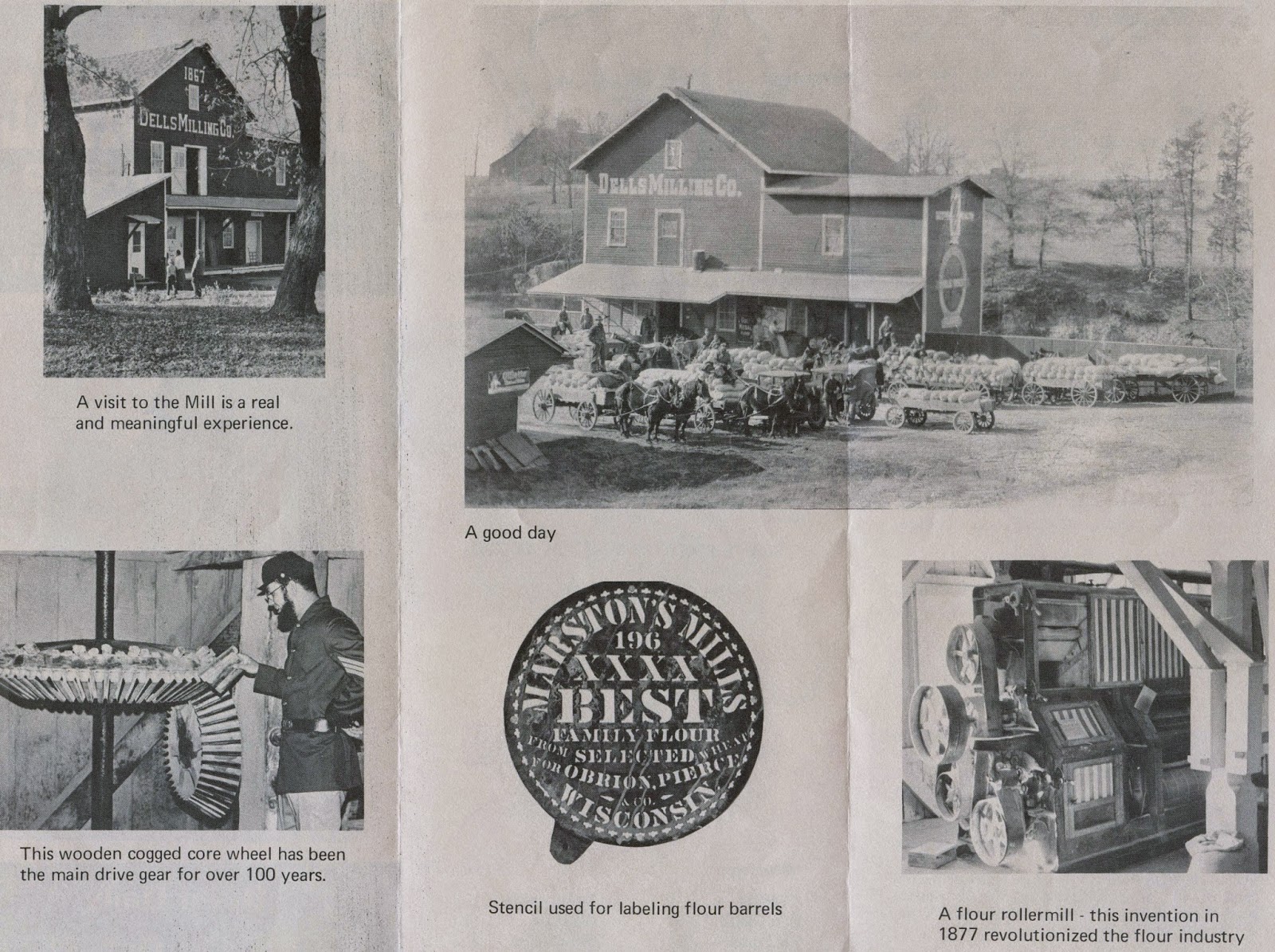
Although there is a large water wheel at the side, the mill has long been powered by a turbine wheel. A larger one was installed in 1955. The main drive gear, equipped with wooden teeth, has lasted through more than a century of use. The teeth, made of hard maple, last from 8 to 10 years under normal usage. Over 3,000 feet of belting and 175 pulleys operate the milling apparatus. The mill also has a flour roller mill – a device which revolutionized the flour industry back in 1877.
Gus Clark has a keen interest in American history as well as in the history of his mill. All this is evident as he conducts his tours and demonstrates for visitors how the machinery works.
Tourists can expect to find him wearing a Civil War Union Army uniform. He has even trimmedDells Mill and Dells Mill Museum Augusta Wisconsin his dark beard in the style of that period. Some years ago he was featured on the front pages of Midwestern newspapers when he saddled up his horse, Clementine, and rode all the way from Augusta to Galena, Ill., to take part in a celebration honoring the memory of General Ulysses S. Grant.
Teachers like to bring school children to the mills for tours, especially in springtime. Gus gladly entertains them with such songs as ”Jimmy Crack Corn” and ”Listen to the Mocking Bird,” accompanying himself on his ” git-fiddle,” a home-made instrument which seems to be a cross between a mandolin and a guitar. He introduces the youngsters to Clementine and highlights his routine by demonstrating his marksmanship with a large, muzzle-loading rifle. Naturally, the kids enjoy every minute of their visit to the Dells Mill museum.
As a sideline, Gus operates, a gun shop on the mill property and his mother runs e’ antique shop there. Antiques aren’t confined to the shop, however. A number of antiques are exhibited inside the mill museum where guests can also see tools which were used in milling, farming and lumbering. Mrs. Clark points ~ collection of old-time barbed wire and says that 300 types were manufactured between 1865 and 1890.
Another section of the museum displays a prairie schooner, buggies, cutters and sleighs. Visitors pause to study a collection of pictures of the mill itself. The Dells Mill has been feature on TV commercials and is a favorite subject for calendar photographs.
Magazine and date of publication is unknown
The SECOND article can be found HERE .....
What is an Old Mill?
From a magazine article by Eliza Lucinda Cubberley
What is an old mill? A place that is hot in summer, frigid in winter? Or a place where the dust motes dance in the sunlight, the tranquilizing music of falling water comes through the open windows, and the good, earthy smell of grain fills the air? Whatever a mill means to you, and especially if you’ve never been in one, you’ll enjoy the one operating mill in Wisconsin that is being preserved as a tourist attraction.
The Dells Milling Company, or Clark’s Mill as it is locally known, is just off Highway 27 three miles north of Augusta in Eau Claire County. The mill was built in 1867 with massive, hand-hewn timbers that were meant to last. They have, and the mill appears as solid as the rock from which its basement is carved.
J. Frank Clark bought the mill in 1917 and today tours are conducted by a descendant. The mill remained in full operation until May of 1968. It was originally a flour mill but its services later included feed grinding.
Except for the sound of water cascading over the 23 foot dam outside, the mill is a quiet pla while visitors listen to the tour guide’s explanation of how it operates, but the moment he engages the water-powered turbine, the mill comes to life with a thunderous rumble. Three thousand feet of belting are instantly on the move, in and out, up and down, through the various levels of the mill. While the mill is running, 250 tons of water every minute power its turbine. (The water wheel on the outside of the building beside the dam, was put there in the 1960s to show how such a mill would have operated in New England. The overshot waterwheel had become old-fashioned by the time mills were being built in Wisconsin, but it has never lost its charm for mill visitors.)
Visitors who go to the mill on a hot day appreciate nature’s air conditioning on the cave-like lower level, part of which has been hewn out of solid rock. If you care to venture still lower, down a curving rock staircase, you can get down to cool water level. As you climb wooden stairs to the upper stories of the mill, the air gets warmer – in fact, hot in summer – but you get to see the interesting hewn beam and wooden peg construction of this century-old structure. The five-level mill is 75 feet high.
In addition to the mill itself and its machinery there are various displays of tools that were used in and around it in the old days. Especially interesting are the rare grain stencils that are hung on the walls.
But best of all is the pleasant scenery of the mill pond, bordered by water-worn sandstone bluffs which are reminiscent of the Dells of the Wisconsin.
Those dells are the reason why Clark’s Mill is also known as the Dells Mill.
Magazine and date of publication is unknown
The THIRD article in this series can be found HERE
Dells Mill Sixty-Five Years Old [1929]
from the Augusta Union Newspaper, November 29, 1929, author unknown, transcribed from the Wisconsin Historical Society archives
No doubt a great many of our older people can recollect with much happiness their cherished memories of the first ride to the old mill. It was way back in the early days when fall work and threshing was done, the your father, realizing the fast approach of the wintry days, would sack up a grist of wheat to be taken down to the mill and made into flour, and it was early the next morning, just as the sun had poked its cheerful face above the horizon, that you were making your first trip down to the mill behind a trudging team of oxen, while in all the glory of an Egyptian Pharaoh you sat perched high upon the sacks of wheat as the clattering high wheeled wagon made its way over the hill, down through the valley to the red mill by the creek.
You remember, of course, as your father drove his yoke of cattle up along the platform opposite the door, how the miller came out with his hearty “Good morning”, and what a friendly feeling you formed for this man, the fellow who was responsible for your bread, in your bread and butter, and perhaps it was after the last sack of wheat was pushed in with the little hand truck that you followed father in, and what a fascinating place you found yourself in.
There were great moving wheels, glimmering belts that raced over big wooden pulleys, and the worlds of hums and rumbles, and in your innocent childish way, you marveled at its greatness. To you it was all a mystery. In one place the miller placed the grain and in another he took off the fluffy white flour into bags that father had brought along for that purpose. To you, milling seemed a black magic. And so this was your first impression of the old mill, and it was perhaps until you grew up and lock the grist in place of your father that you discovered that the old wooden water wheel which creaked under the splashing water of the creek had a greater purpose than serving an inspiration for an artist and the machinery which rumbled inside was not make to make funny noises but to take its part in the task of feeding the hungry mouths of humanity.
It was back in these days of pioneering that the Dells Mill, a land mark in our community was built. It was the year of 1864, the mill was constructed by Wiebber. The millwrighting was carried on by Mr. Gordon, a brother-in-law of Ivory Livermoore.
The first miller was Dan Merriman. At that time, Wiebber, the owner, also ran a boarding house at the Dells, later occupied as a dwelling by J. Frank Clark, which was destroyed in recent years by a fire. Old timers say that at times there were as many as twenty-five men that stopped at this place as they came to and from the woods.
Later Wiebber sold to McCaffery and Marston. From these parties it was transferred to G. W. Paul, who later succeeded by Gessner and Clark. Mr. Clark some years later purchased the interest of Gessner and it was under his ownership that the present dam was build. J. Frank Clark was succeeded by the Dells Milling Company, which is its present owner.
The mill was first built primarily for the purpose of milling flour, but as the wheat belt was gradually pushed back into the west, other lines of grist business took its place. The mill today is considered on of the most up-to-date cereal mills in this part of the country.
It is expected that during this fall there will be milled over 200 thousand pounds of buckwheat flour. In addition to cereal milling, a large business of custom grinding and feed mixing is carried on.
It is a remarkable thing that after sixty-five years you would find a country mill that is still carrying on its work. Many mills built years later have either gone out of business or burned up, but the Dells still continues to be an old land mark and carry on its part in this community by handling the daily grist that is brought to its doors.
I found this too - from Dennis' Occasional Pages located HERE
Remembering of the Dells Mill, The Dells School and the Dells Mill Pond when I was a child
Remembrances
Going to the mill with a wagon and a horse with my Grand Father. The biggest anticipation was getting the work done and having a Dreamsicle as the reward
Swimming in the pond
Floating on the Dells Mill pond, grasping a log as my float and letting the pond, the breeze and the day taking me
Fishing off the concrete walkway just outside the Dells Mill office window, watching the sunfish taking the bait and hoping the mill would wind up to draw the fish to the water intakes
The day I went fishing with a high school friend, and reaching over to boat to bring in the fish as he reeled it in. I startled that fish and gave it the energy to break the line. The fish seemed to be about a ten pound wide mouth bass. I was almost knocked off the boat by my angry friend
Skating on the pond without any snow to impede me. There was no snow on the whole of the pond. We skated for hours. My friends were with me most of the way and most of the day. They had to go, but I stayed and enjoy the solitude of the winter day. I stayed and stayed and almost expired as I realized I was at the far end of the pond and struggled to get back to the house of my friends at the Dells Mill.
Hearing the ice crack and quake in the cold when I skated
Fishing in an ice shack and talking about girls and sex and mostly ignoring the fishing.
Pushing the snow out of the way when it made ice skating impossible
Lighting a wood log fire on the ice
Making a skating rink to the free the ice when the snow came
My parents anticipating the opening of Bass season
Fishing for Crappie's with my Grandmother
Fishing for perch on a midsummer's day
Wading and then getting up over my waist in the warm water, then getting nude to feel the water flow over me.
Swimming and diving from a raft built by the Dells Mill Clark family
Hearing Moon River sung by Nancy Clark while swimming in the pond
Finding a blue bird for the last time just before they all but disappeared from the region because of DTD use
Wanting to dive off the rocks of the Dells into the pond
Challenging the damn as dangerous waters flowed over it
Finding solstice on a summers eve, floating in a boat on the pond
Shopping at the local hardware store with my grandfather to find the right bamboo cane pole to fish in the Dells Pond
Finding the right bait
Camping on the Dells Mill pond island with friend
Smoking for the first time
Losing my glasses in to the pond
From RoadsideAmerica(dot)com
Dells Mill and Museum
Well-preserved 1864 rural flour mill completely intact with original machinery, fabric belts, and lots of misc. artifacts including two cannon, a covered wagon along with other buggies, some period tools, and a shark(!). The proprietor, soft-spoken Gustave (Gus) Clark, has owned and operated the mill as a museum for over 45 years. He is the fourth generation of the Clark family to operate the mill. Gus is elderly and slow, and speaks very softly. You need to stand close to hear him over the waterfalls of the dam. He will greet you, take your admission, escort you into the first room to look around, then give you a brief monologue. Don't ask questions until he is done, as he will just keep talking. Then he will allow you to roam all the floors of the mill to take photos. Gus has a huge amount of knowledge about the place, plus the Civil War era as it relates to Wisconsin. He usually pops on a Civil War hat when you walk in. He is very friendly and can talk for hours about the mill, and about farm life from the 1860s forward. He is also a musician that likes to sing and play his home-made banjo for the ladies after the tour.
There is also a small, dusty gift shop (with unusual items), an antique store, and a blacksmith shop. Be sure to chat with Gus after the tour.
And I found this WONDERFUL information HERE ....
Constructed during the Civil War Era along the dells of Bridge Creek, Dells Mill brought logging industry to the area. This water powered gryst mill ground the wheat that dominated Wisconsin's civil war economy operating until 1968. Fully functional, Dells Mill is one of a handful of national historic mills remaining operational ready. According to a conversation with current owner Gus Clark, "The mill could be ready within 3 days."
Now over 140 years old Dells Mill, like many other mills nationally, served its community both economically and socially. After the wheat production moved westward the mill was adapted to mill flour and grind feed for local farmers. As industry continued to modernize and forestry maximized its resources, mills around the country became cherished historical landmarks.
Dells Mill was entered into the National Registry in 1974. Local school children from Augusta raised money in 2007 to fund a commemorative plaque officially marking Dells Mill as a national historic site.
Converting the historic mill into a museum extended the life of the mill. In a conversation with Gus Clark, owner and operator of the museum, he retold the story of his ride to Galena Illinois in the 1972 for the sesquicentennial celebration of Grant's home. Clark traveled from Augusta, WI to Galena, Illinois in a covered wagon camping along the way. Clad in a civil war uniform at the age of 29, Gus rode into Galena on horseback honoring the memory of Ulysses S. Grant. Gus Clark's trek to Galena, Illinois received television coverage and acclaim. To this day Gus can be found tinkering in his shop from10 am to 5 pm -the mills hours of operation from May to October 31st.
"Nothing makes me feel richer than a woodshed full of wood..." Gus tends to his woodfired stove at the end of a tour. A conversation with Gus reveals a man connected to a family legacy rich in history. His bearded face and skin etched with lines speak of his witness to another era. Gus is a living historian; a witness to Augusta Dells Mill and its surrounding area. He grew up in the house residing at the shores of Dells Mill pond and attended the one room country schoolhouse. Consumed by his stories of yesteryear his audience becomes transfixed by his yarns. It in only after his story has been told that a shift can be felt like a veil lifting -and awareness of the 21st century returns.
The above images were taken from one of the Mill's Pamphlets ... (this is very large image)
Clark Brothers Brand
Dells Mill was entered into the National Registry in 1974. Local school children from Augusta raised money in 2007 to fund a commemorative plaque officially marking Dells Mill as a national historic site.
By the time the Civil War broke out in 1861, the establishment of a community on the Dells Mill site was well under way.
A deed dated 1869, transferred the property from William Weber to Stephen Marston lists the property as consisting of 16 acres and containing "the mill, boardinghouse, school house and other buildings thereon." Of these only the mill remains. The Dells Mill operated as a flour and feed mill for over 100 years. The water from Bridge Creek was the only source of power ever used.
In 1894, the mill was purchased by the Clark Family and has remained in their possession to this day, having passed through four generations. In 1968, Dells Mill was converted into a museum, although grinding is still done on special occasion.
The mill building itself is a five story structure built of hand hewed timbers and held together by wooden pegs. It contains 3,000 feet of belting and 175 pulleys all powered by water.
The growth of wheat production in Wisconsin was tremendous betweeen 1850 and 1880, and this was reflected in the rise of the milling business. In 1840, the area which is now Wisconsin supported a total of 33 flour and grist mills. By 1880, the number was just under 1,000. By 1900, milling was the second largest industry in the state second only to lumber. Shortly after the turn of the century however, the milling industry started its long decline and by 1920, abandoned flour mills could be found throughout the state. Due to the record yield of wheat harvests during the 1800's the soil depleted and could no longer support big crops. Wheat prodcution moved westward and cattle grazed where wheat once grew. Abandoned flour mill became a relic of the past.
By the time the Civil War broke out in 1861, the establishment of a community on the Dells Mill site was well under way. In the 1830's early pioneers found Wisconsin's rich soil ideal for growing wheat. In addition, the state was blessed with hundreds of rivers and streams offering an abundant supply of water power attracting settlers into the area.
A visit to the mill was usually an all day affair starting at 'can see to can't see'. For the farmer and his family, the mill was more than a place of business. Starting at dawn, this pleasuresome occasion was marked with a picnic lunch and a fishing event. The mill provided a day of rest from daily farm work. Orginally named Dells City, the mill was a center of activity providing economic growth for the locals, food and shelter for visitors, work for blacksmiths and a coopery, milling for local farmers, and a school with Sundays services for the area locals.
| Dells Mill and Dells Mill Museum |
Tour the historic Dell's Mill Historical Landmark & Museum from May through Oct. The building is a five story structure made of hand hewn timbers & held together by wooden pegs. It contains 3,000 feet of belting & 175 pulleys. The water from Bridge Creek powered the flour & feed mill, which operated for over 100 years. Relish the sights, sounds and smells of the past, State & National Historic site. The Dells Mill was built in 1864 as a grist mill. It is now over 140 years old. Farmers met and had their grinding done.
The colorful Dells Mill, painted red, has now been in Clark family ownership through four generations. Gus Clark and his mother, Mrs. Bessie Clark, restored it 11 years ago and they now operate it as a museum. They still put it to its original use sometimes to grind whole wheat flour which they sell to tourists. In springtime they clean seed oats for local farmers. They take pride in the fact that the mill has been entered in the National Register of Historic Places.
Teachers like to bring school children to the mills for tours, especially in springtime. As a sideline, Gus operates, a gun shop on the mill property and his mother runs e’ antique shop there. Antiques aren’t confined to the shop, however. A number of antiques are exhibited inside the mill museum where guests can also see tools which were used in milling, farming and lumbering.
Except for the sound of water cascading over the 23 foot dam outside, the mill is a quiet place while visitors listen to the tour guide’s explanation of how it operates, but the moment he engages the water-powered turbine, the mill comes to life with a thunderous rumble.
You will find the Dells Mill be featured in a lot of Calenders .....
And even puzzles... my Mom got one for herself one year ... because it reminds her of home.
Labels:
1800,
1900,
2000,
Ancestors with Stories,
Annissa's Line Mom's Side,
Castles and Buildings,
CLARK,
History Behind It,
My Growing Up,
Personal Memories,
Personal Story,
Wisconsin Relations
Subscribe to:
Posts (Atom)


.jpg)
.jpg)