Showing posts with label Cal and Noah's Dad's Line. Show all posts

Wednesday, October 9, 2013

Richard I "the Fearless" and Gunnora

Richard I, Duke of Normandy
Richard I "the Fearless" or (French) "Sans Peur" 

Richard the Fearless as part of the Six Dukes of
Normandy statue in the town square of Falaise

Richard I of Normandy (933–996), also known as Richard the Fearless (French: Sans Peur), was the Duke of Normandy from 942 to 996.  Dudo of Saint-Quentin, whom Richard commissioned to write his De moribus et actis primorum Normanniae ducum (Latin: On the Customs and Deeds of the First Dukes of Normandy), called him a dux, but this use of the word may have been in the context of Richard's leadership in war, and not a reference to a title of nobility.Richard either introduced feudalism into Normandy, or he greatly expanded it. By the end of his reign, most important landholders held their lands in feudal tenure.

Birth

Richard was born to William I of Normandy, princeps or ruler of Normandy, and Sprota. He was also the grandson of the famous Rollo. He was about 10 years old when his father was killed on 17 December 942.  His mother was a Breton concubine captured in war and bound to William by a Danish marriage.  William was told of the birth of a son after the battle with Riouf and other Viking rebels, but his existence was kept secret until a few years later when William Longsword first met his son Richard. After kissing the boy and declaring him his heir, William sent Richard to be raised in Bayeux. After William was killed, Sprota became the wife of Esperleng, a wealthy miller; Rodulf of Ivry was their son and Richard's half-brother.


Life

When his father died, Louis IV of France seized Normandy, installed the boy Richard in his father's office, then placed him in the care of the count of Ponthieu. The king then split the lands, giving lands in lower Normandy to Hugh the Great. Louis kept Richard in confinement at Lâon, but he escaped with the assistance of Osmond de Centville, Bernard de Senlis (who had been a companion of Rollo of Normandy), Ivo de Bellèsme, and Bernard the Dane (ancestor of families of Harcourt and Beaumont).

In 946, Richard agreed to "commend" himself to Hugh, Count of Paris. He then allied himself with the Norman and Viking leaders, drove Louis out of Rouen, and took back Normandy by 947.


In 962 Theobald I, Count of Blois, attacked Rouen, Richard’s stronghold, but his army was defeated by the Normans and retreated never having crossed the Seine. Lothair king of the West Franks stepped in to prevent any further war between the two.

Afterwards, and until his death in 996, Richard concentrated on Normandy itself, and participated less in Frankish politics and petty wars. In lieu of building up the Norman Empire by expansion, he stabilized the realm, and united his followers into a cohesive and formidable principality.

Richard used marriage to build strong alliances . His marriage to Emma connected him to the Capet family. His wife Gunnor, from a rival Viking group in the Cotentin, formed an alliance to that group, while her sisters form the core group that was to provide loyal followers to him and his successors.  His daughters provided valuable marriage alliances with powerful neighboring counts as well as to the king of England.


He also built on his relationship with the church, restoring their lands and insured the great monasteries flourished. His reign was marked by an extended period of peace and tranquility.


Marriages

His first marriage (960) was to Emma, daughter of Hugh "The Great" of France, and Hedwig von Sachsen.  They were betrothed when both were very young. She died after 19 March 968, with no issue.

According to Robert of Torigni, not long after Emma's death, Duke Richard went out hunting and stopped at the house of a local forester. He became enamoured of the forester's wife, Seinfreda, but she being a virtuous woman, suggested he court her unmarried sister, Gunnor, instead. Gunnor became his mistress, and her family rose to prominence. Her brother, Herefast de Crepon, may have been involved in a controversial heresy trial. Gunnor was, like Richard, of Viking descent, being a Dane by blood. Richard finally married her to legitimize their children:

Gonnor, wife of Richard I, confirming a charter of the abbey
of the Mount-Saint-Michel, from archive of the abbey
Gunnora (or Gunnor) 
(c. 950–c. 1031), Duchess of Normandy, she was the (2nd) wife of Richard I of Normandy.

All that is known of Gunnora's parentage is that she belonged to a family who had settled in the Pays de Caux.  Robert of Torigni wrote she was a forester's daughter from the Pays de Caux and according to Dudo of Saint-Quentin she was of noble Danish origin. Gunnora was probably born c. 950. Her family held sway in western Normandy and Gunnora herself was said to be very wealthy. Her marriage to Richard I was of great political importance, both to her husband and her progeny. Her brother, Herfast de Crepon, was progenitor of a great Norman family.  Her sisters and nieces married some of the most important nobles in Normandy.

Robert of Torigni recounts a story of how Richard met Gunnora. She was living with her sister Seinfreda, the wife of a local forester, when Richard, hunting nearby, heard of the beauty of the forester's wife. He is said to have ordered Seinfreda to come to his bed, but the lady substituted her unmarried sister, Gunnora. Richard, it is said, was pleased that by this subterfuge he had been saved from committing adultery and together they had three sons and three daughters. Unlike other territorial rulers, the Normans recognized marriage by cohabitation or more danico. But when Richard was prevented from nominating their son Robert to be Archbishop of Rouen, the two were married, "according to the Christian custom", making their children legitimate in the eyes of the church.

Gunnora attested ducal charters up into the 1020s, was skilled in languages and was said to have had an excellent memory. She was one of the most important sources of information on Norman history for Dudo of St. Quentin. As Richard's widow she is mentioned accompanying her sons on numerous occasions. That her husband depended on her is shown in the couple's charters where she is variously regent of Normandy, a mediator and judge, and in the typical roll of a medieval aristocratic mother, an arbitrator between her husband and their oldest son Richard II.

Gunnora was a founder and supporter of Coutances Cathedral and laid its first stone. In one of her own charters after Richard's death she gave two alods to the abbey of Mont Saint-Michel, namely Britavilla and Domjean, given her by her husband in dower, which she gave for the soul of her husband, and the weal of her own soul and that of her sons "count Richard, archbishop Robert, and others..." She also attested a charter, c. 1024–26, to that same abbey by her son, Richard II, shown as Gonnor matris comitis (mother of the count). Gunnora, both as wife and countess, was able to use her influence to see her kin favored, and several of the most prominent Anglo-Norman families on both sides of the English Channel are descended from her, her sisters and nieces.  Gunnora died c. 1031.

Richard & Gunnora's children
  • Richard II "the Good", Duke of Normandy
  • Robert, Archbishop of Rouen, Count of Evreux
  • Mauger, Earl of Corbeil
  • Emma of Normandy, wife of two kings of England
  • Maud of Normandy, wife of Odo II of Blois, Count of Blois, Champagne and Chartres
  • Hawise of Normandy m. Geoffrey I, Duke of Brittany
  • Papia of Normandy
  • William, Count of Eu
Illegitimate Children

Richard was known to have had several other mistresses and produced children with many of them.

Known children are:
  • Geoffrey, Count of Eu
  • William, Count of Eu (ca. 972-26 January 1057/58),m. Lasceline de Turqueville (d. 26 January 1057/58).
  • Beatrice of Normandy, Abbess of Montvilliers d.1034 m. Ebles of Turenne (d.1030 (divorced)
Possible children
  • Muriella, married Tancred de Hauteville
  • Fressenda or Fredesenda (ca. 995-ca. 1057), second wife of Tancred de Hauteville.

Death:

Richard died in Fecamp, France, on 20 November 996.


Depictions in Fiction

The Little Duke, a Victorian Juvenile novel by Charlotte Mary Yonge: is a fictionalized account of Richard's boyhood and early struggles.

(source: Wikipedia) 

William "Longsword" and Sprota

William "Longsword" and Sprota are (in the line I am working on) my 34x Great Grandparents....

I found this at http://familypedia.wikia.com .... most the information is taken from there, but I have edited it ...


William Longsword, 2nd Duke of Normandy (893-942)

Birth: 893
Death: 17 December 942
Father: Rollo of Normandy (860-932)
Mother: Poppa van Bayeux (c870-c910)

Spouse:
Sprota (?-?)
Wedding: 932
Spouse (2):
Liutgard (?-?)

Wikipedia Information on Sprota:

Sprota was the name of a Breton captive who William I, Duke of Normandy took as a wife in the Viking fashion (more danico) and by her had a son, Richard I, Duke of Normandy. After the death of her husband William, she became the wife of Esperleng and mother of Rodulf of Ivry.

Life

The first mention of her is by Flodoard of Reims and although he doesn't name her he identifies her under the year as the mother of "William’s son [Richard] born of a Breton concubine". Her Breton origins could mean she was of Celtic, Scandinavian, or Frankish origin, the latter being the most likely based on her name spelling. Elisabeth van Houts wrote "on this reference rests the identification of Sprota, William Longsword’s wife 'according to the Danish custom', as of Breton origin". The first to provide her name was William of Jumièges. The irregular nature (as per the Church) of her relationship with William served as the basis for her son by him being the subject of ridicule, the French King Louis "abused the boy with bitter insults", calling him "the son of a whore who had seduced another woman's husband."

At the time of the birth of her first son Richard, she was living in her own household at Bayeux, under William's protection. William, having just quashed a rebellion at Pré-de Bataille (c.936), received the news by a messenger that Sprota had just given birth to a son; delighted at the news William ordered his son to be baptized and given the personal name of Richard. William's steward Boto became the boy's godfather.

After the death of William Longsword and the captivity of her son Richard, she had been 'collected' from her dangerous situation by the 'immensely wealthy' Esperleng. Robert of Torigni identified Sprota's second husband[b] as Esperleng, a wealthy landowner who operated mills at Pîtres.

Family

By William I ‘Longsword’ she was the mother of:
Richard I, Duke of Normandy
By Esperling of Vaudreuil she was the mother of:
Rodulf, Count of Ivry
several daughters who married Norman magnates


William I, 2nd Duke of Normandy, AKA: William Longsword:

(French: Guillaume Longue-Épée, Latin: Willermus Longa 

Spata, Old Norse: Vilhjálmr Langaspjót)

Vital Statistics
Son of Rollo of Normandy - Viking Warrior and 1st Duke of Normandy and his wife Poppa
Born ca 893 C.E.
930-935 : 1st Marriage to Sprota
936-942 : 2nd Marriage to Liutgard
942-Dec-17 : Assassinated -

Biography

Longsword was the second Duke of Normandy from his father's death until his own assassination. The title dux (duke) was not in use at the time and has been applied to early Norman rulers retroactively; William actually used the title comes (count).

Little is known about his early years. He was born in Bayeux or Rouen to Rollo and his wife Poppa. All that is known of Poppa is that she was a Christian, and the daughter to Berengar of Rennes, the previous lord of Brittania Nova, which eventually became western Normandy. According to the William's planctus, he was baptised a Christian.

Between 935 and 939, William was married to Leutgarde, daughter of Herbert of Vermandois. He had no legitimate children and his successor, Richard was the son of Sprota who he had apparently married in 930 ‘more danico’.

William succeeded Rollo sometime around 927. It appears that he faced a rebellion early in his reign, from Normans who felt he had become too Gallicised. Subsequent years are obscure. In 939 William became involved in a war with Arnulf I of Flanders, which soon became intertwined with the other conflicts troubling the reign of Louis IV. He was killed by followers of Arnulf while at a meeting to settle their conflict. His son Richard the Fearless, child of his first wife, Sprota, succeeded him. William also left a widow, Liègard (Liutgard), who died in 985.


Assassination of William Longsword

In 939, Herbert supported by Arnulf of Flanders besieged Montreuil and its capture gave him all of Ponthieu and Vimeu between the rivers Somme and Bresle. Herluin II sought the support of Hugh the Great to regain his lands but Hugh refused because he already had an alliance with Arnulf. Herluin then turned to William Longsword for help. Troops from the Cotentin attacked and recaptured Montreuil, slaughtering most of Arnulf’s garrison. But at a price. Herluin had placed his lands under the protection of the Normans and performed homage to William for his help. The Normans were now assured of a buffer between their borders and those of Flanders.

For Arnulf, Hugh the Great and other Carolingian lords the Normans remained undesirable intruders in France and they decided to eliminate William who was becoming too powerful and was increasingly playing a role in the politics of the French monarchy. It was at this moment that Arnulf sent messengers to William Longsword, saying that he wanted to settle their conflict over Montreuil. William went to the meeting on an island in the river Somme at Picquigny, where he was murdered by Arnulf’s men on 18th December 942.

Residence at Falaise

In Falaise France, is a series of statues that pays tribute to the six Norman Dukes from Rollo to William Conqueror. The castle here was the principal residence of the Norman Knights.
Château Guillaume-le-Conquérant

Lineage 

The Funeral Monument - Tomb Effigy 
located in the Cathedral of Rouen


The Planctus of William Longsword
This is a poem, although it survives only in corrupt and incomplete versions and is largely hagiographic in content, nevertheless is a critical source for early Norman history. It is by far the earliest work written about the Normans from a Norman point of view, and some historical nuggets can be gleaned from it.

References
Wikipedia for William Longsword
From Stewart Baldwin on Guillaume "Longue Épée" of Normandy
FMG on GUILLAUME I "Longuespee" Comte de Normandie
History of William Longsword  <-- A Blog with a lot of House of Normans information

Sources and notes
Category: Of Normandy (surname)

Château Guillaume-le-Conquérant 
History of on Wikipedia 


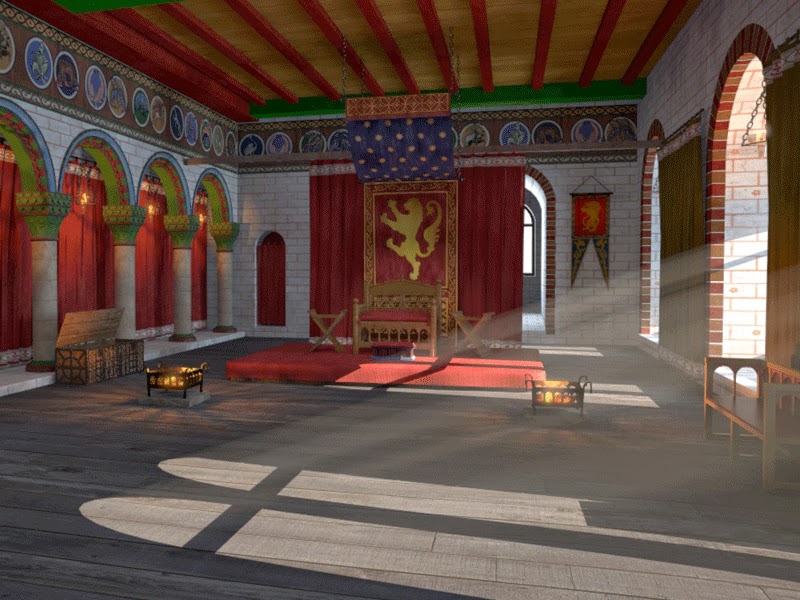
Throne Room recreation?


The Story of King John (the first) Plantagenet

(Ancestor says he's my 24 x Great Grandfather - by my calculations, he's my 26 x Great Grandfather, at least on this particular line I am looking at, but I know he's in my tree more than once.)

King John

1199-1216

The Early Life of John

King JohnWhen John, the last child of the great Henry II and Eleanor of Aquitaine was born on Christmas Eve, 1167 at Beaumont Palace in Oxfordshire, his father jokingly nick-named him Sans Terre or Lackland, as there was no land left to give him. It seems ironic then, that John Lackland was eventually to inherit the entire Angevin Empire.
A born cynic, with a puckish sense of humour, feckless, treacherous and entirely without scruple, he was possessed of some of the restless energy of his father and was prone to the same violent rages but unlike his father, John was unstable and cruel and a thoroughly flawed character. His deep distrust of others sometimes verged on paranoia. After eight hundred years, John remains the maverick of the House of Plantagenet.
Originally brought up for a career in the church, he had been placed at the Abbey of Fontevrault in Anjou, as an oblate, while still in early childhood, to which the young John reacted rebeliously. He was educated by Ranulf de Glanvill, his father's Chief Justiciar. Henry II hoped to improve his youngest son's prospects, by betrothing him, at the age of nine, to a wealthy heiress, his second cousin, Isabella of Gloucester. Isabella was the granddaughter of Robert, Earl of Gloucester, the illegitimate son of Henry I. The couple were duly married when John was 21 but the marriage failed to produce children.
Henry II attempted to make his favourite son King of Ireland. The adolescent John and his companions alienated the Irish chieftains who came to pay him homage, mocking their clothes and pulling their beards, resulting in rebellion against his rule and he was forced to leave Ireland. A fickle character, in his youth John conspired against both his father and his brother Richard for his own gain. During Richard's absence on the Third Crusade, John had attempted to overthrow his justicar, William Longchamp. In the course of returning from his crusade, Richard was captured by Leopold V, Duke of Austria, and imprisoned by the Holy Roman Emperor, Henry VI. England had to raise a huge ransom for the return of its king. On his release in 1194, Richard readily forgave his younger brother for plotting his overthrow.

John's appearance

In appearance, John was nothing like his tall and majestic brother Richard. He was five feet five inches in height, as opposed to Richard's six feet four inches. Although his height may be considered short by modern standards, it was not considered so in his own time, when men were considerably shorter. He was stockily built as his father had been. He is reputed to have spent a fortune on rich clothing and jewels.

Reign

John succeeded to the throne at the age of thirty-two, on the death of Richard the Lionheart in 1199. Arthur of Brittany, the son of his deceased elder brother, Geoffrey, had an arguably better claim, but Richard was reported to have announced John his heir on his deathbed. John acted promptly, siezing the royal treasury at Chinon. His coronation took place on Ascension Day, 1199. The shrewd Phillip Augustus, in accordance with his policy of weakening the Angevin Empire by creating division amongst the Plantagenets, supported Arthur's claim and attacked Normandy.
King John tomb effigy at WorcesterJohn incurred further opposition through his infatuation with Isabella of Angouleme, the twelve year old daughter of Count Aymer of Angouleme and Alix de Courtenay. She had been betrothed to Hugh de Lusignan, although the marriage had been delayed because of her extreme youth. The unprincipled John stole the enchanting Isabella from under Hugh's very nose.
His first marriage to Isabella of Gloucester had been declared invalid, since they were related within the prohibited degrees. Hugh de Lusignan, incensed, joined forces with Phillip and Arthur, forming a coalition against the King of England. It was said that John was so besotted with his young bride that he refused to rise from bed until well after noon.

The Rebellion of Arthur of Britanny

True to his policy of causing dissension amongst the Angevins, Phillip Augustus recognised Arthur's claim in May 1200 Treaty of Le Goulet. In attempt to take Anjou and Maine, the teenage Arthur of Brittany besieged his octagenarian grandmother, Eleanor of Aquitaine, at Mirabeau. Eleanor sent an urgent message for aid to her son John and succeeded in drawing out the negotiations for as long as possible. John responded with uncharacteristic speed and came to her rescue, in the process taking both Arthur and Hugh prisoner. Arthur was imprisoned at Falaise Castle in Normandy.
King John attempted to make peace with his young nephew, on a visit to Rouen in 1203, he promised Arthur honours if he would separate himself from Phillip Augustus and adopt his uncle's cause. Arthur, proud, indignant and unbowed by his imprisonment, responded by demanding his rightful inheritance and unwisely warned John that he would never give him a moments peace for the rest of his life.
John "much troubled", responded by ordered him to be blinded and castrated, an order which Hubert de Burgh, Arthur's custodian, refused to carry out. By late 1203 rumours were circulating that the young Duke was dead. Phillip, seeing an opportunity to create further trouble, demanded that Arthur be produced. It appears that by this time Arthur was already dead, said to have been killed by John himself in a drunken rage. A contemporary chronicler states 'After King John had captured Arthur and kept him alive in prison in the castle of Rouen....When John was drunk and possessed by the devil, he slew (Arthur) with his own hand and tying a heavy stone to the body, cast it into the Seine.'
John also imprisoned Arthur's sister, Eleanor, known as the Fair Maid of Brittany. She was to remain a prisoner for the rest of her life. She died in 1241, during the long reign of John's son, Henry III.

The Loss of the Angevin Empire

Hugh de Lusignan, the slighted fiancee of Isabella of Angouleme had sought redress from his overlord Phillip Augustus, who promptly summoned John to the French court to answer for his actions. John refused to comply and accordingly, Phillip, acting under feudal law, claimed those territories ruled by John as Count of Poitou and declaring all John's French territories except Gascony forfeit, he invadedNormandy. Chateau Gaillard, Richard's impregnable castle, fell to the French after a long siege in 1203, it was followed by the rest of Normandy. John, his resources exhausted, was forced to flee the smoking rubble of his father's once great French Empire.
Eleanor of Aquitaine entered the Abbey of Fontevrault, where she took the veil. She died there on 1st April, 1204, aged eighty-two, a remarkable age for the time. Eleanor had slipped into a coma, according to the annals of Fontevrault she 'existed as one already dead to the world'. She was buried at Fontevrault beside the tombs of the husband who had imprisoned her and whom she had hated and her beloved and favourite son, Richard.

Welsh Affairs

Llywelyn the Great
In 1205 whilst he was fighting to recover his French territories, the King married his illegitimate daughter, Joan, then aged around fifteen, to Llywelyn the Great, or Llywelyn ap Iorwerth, Prince of Gwynedd (circa 1173-1240) An astute political manipulator, Llywelyn then did homage to John for all his Welsh possesions. Joan was John's daughter by a mistress known only as Clemence.
In 1209 Prince Llywelyn accompanied John on his campaign into Scotland. Llywelyn went on to steadily increase his influence in Wales and conquered southern Powys in 1208. John became concerned at the growth of his son-in-law's power and viewed it as a theat to his own authority in the province. When Llywelyn attacked the lands of the Earl of Chester in 1210, John threw his support behind the latter.
The king marched into Wales with an army, receiving the support of many of the other Welsh princes, he marched toward Deganwy. Llywelyn's army employed the classic guerilla tactic of retreating to the hills, and taking the supplies with them. John had made no provision for supplying Deganwy Castle by sea, and was therefore forced to return to England or face starvation.
John returned to Wales within three months, with a well provisioned army, crossing the River Conway, he encamped on the Menai Strait, penetrating deep into the heart of Gwynedd. Llywellyn sent his wife, Joan, John's daughter, to sue for peace. The king imposed humiliating terms on his son-in-law, and annexed the area of North Wales known as the Four Cantrefs, installing Gerard d'Athée and two other mercenary captains into the southern marches.
Llywelyn capitalized on growing Welsh resentment against John, and led a revolt against him, which received the blessing of Pope Innocent III. By 1212 Llywelyn had regained the Perfeddwlad and burned a castle erected by John at Ystwyth.
Llywelyn's revolt delayed John's planned invasion of France, Llywelyn formed an alliance with John's enemy, King Phillip Augustus of France, later allying himself himself with the discontented English barons who were in rebellion against him. In 1215 he marched on Shrewsbury and captured the town with little resistance. Over the following three years Llywelyn extended his power base into South Wales, becoming without doubt the single most powerful figure in Wales.
John's daughter, Joan died in 1237 at Garth Celyn and Llywelyn suffered a paralytic stroke later in the same year. He died at the Cistercian Abbey of Aberconwy, his own foundation, on 11th April, 1240 and was buried there. His stone coffin was later removed to the parish church of Llanwrst, where it can still be seen.

Magna Carta

Magna CartaThe King turned his attention to administration and justice in England, having inherited some of his famous father's administrative ability and restless energy. Pope Innocent III was annoyed at John's interference in the election of an Archbishop of Canterbury in 1205, a quarrel ensued, resulting in England being placed under an interdict, no church services could be held for six years. In 1209, the difficult John himself was excommunicated. The English barons were entering into plots against him, and John wisely made peace with the Pope. In May, 1213 he agreed to hold England as a fief of the papacy.
Eventually, John was met with the full force of his baron's grievances, they demanded their "ancient liberties" and the renewal of Henry I's Coronation Charter.
King JohnFaced with an armed revolt which may have cost him his kingdom, the king was forced into compliance. At Runnymede, near Windsor, on 15th June 1215, he signed the historic Magna Carta or Great Charter. The Charter curtailed royal power in matters of taxation, justice, religion and foreign policy.

The Death of John

Disputes with the barons, however, continued and they again rose in rebellion, they incurred the aid of Phillip Augustus of France, who sent his son, the Dauphin Louis (later Louis VIII), to attack England in support of the barons. While retreating before this incursion, King John attempted to avoid East Anglia, which was rebel territory and safely negotiated a route around the Wash, his baggage train, however, famously lost his treasure, including the Crown Jewels, in The Wash, due to an unexpected incoming tide.
Aggrieved and depressed at the loss, mourning his ill fortune and suffering severely from dysentery, he was carried to Newark Castle in a litter and a physician was sent for. He consoled himself with a "surfeit of peaches". John's condition worsened rapidly and he died at Newark on the wild stormy night of 18th October, 1216, leaving England in a state of anarchy and civil war. Rumours abounded at the time that the king had been poisoned. Matthew Paris was later to comment that "Foul as it is, Hell itself is defiled by the presence of John". Despite his obvious failings, evidence exists that John was not as bad as his posthumous reputation would seem to suggest.
King John was buried at Worcester Cathedral by the shrine of his favourite saint, the Saxon, St. Wulfstan, becoming the first of the Angevin kings to be buried in England. He was succeeded by his nine year old son who became Henry III. King Henry III later raised an effigy over his father's tomb.
When John's body was exhumed in 1797, he was found to have been buried in a damask robe and wearing gloves with a sword in his hands. The skeleton was measured at five feet, six inches and a half inches.

Isabella of Angouleme

Three years after his death, King John's widow, Isabella of Angouleme, married the fiancee of her youth, Hugh de Lusignan and they produced a large family.

The tomb of Isabella of Angouleme at Fontevrault Abbey

Isabella of Angouleme
Isabella died in 1246 and as an act of contrition for misdeeds, was buried, of her own violition, in the churchyard at Fontevrault. Her son, King Henry III, on a later visit to Fontevrault, was shocked that she had been buried outside the Abbey. He ordered that her body be translated into the Abbey itself, where she was finally laid to rest by his grandparents, Henry II and Eleanor of Aquitaine.


Copied from HERE .... 

Thursday, October 3, 2013

Back to Rollo and Poppa....

I first mentioned my 35 x Great Grandfather Rollo Rolf in this blog ..... Introduction to Rollo "Duke of Normandy" .......... and the confusing union of "more danico" of which he had with his wife/mistress/concubine Poppa de Bayeux.

Poppa de Bayeux, was the "captured" wife of Rollo.  She was (thought to be) the daughter of a count named Berenger, captured at Bayeux by Rollo in 885 or 889.  Speculation claims her as the daughter of Berengar II of Neustria.

(from Wikipedia) Poppa of Bayeux was the mistress or wife[1] (perhaps by more danico)[2] of Norman conqueror Rollo. She was the mother of William I, Duke of Normandy, and Gerloc. Chronicler Dudo of Saint-Quentin relates that she was the daughter of a count named Berenger, captured at Bayeux by Rollo in 885 or 889. This has led to speculation that she was the daughter of Berengar II of Neustria. A statue of Poppa stands at Place de Gaulle in Bayeux.
ROLLO ROLF STATUE
French: translation to English:  
WE REMAIN MASTERS AND LORDS - 25 July 885
Statue of Rollo in Rouen. There are two bronze replicas of this statue : one at Ålesund (Norway) and the other one at Fargo, North Dakota

Now, Rollo has some questionable linage also, as I stated in the last blog about him.   To make things more simple and less long winded ....  this is the short version.

Rollo Rolf was baptized Robert.   He is sometimes called "Robert I" to make it "less confusing" with his descendants.  HOWEVER; his Great-Great Grandson is also known as "Robert I" so in serious less confusing fashion, I will just call him Rollo.

Rollo was of Norwegian and Danish descent.  He was a Norse Nobleman.   He is also known to be the founder and first ruler of the Viking principality.

There are two versions of this linage ...

Denmark claims Rollo was the son of a King of Denmark.  This King had two sons, Rollo and Gurim. Upon the death of said King, Rollo was expelled and his brother Gurim was killed.

Norway fights that his name is Ganger Hrolf "Hrolf the Walker" ...  the son of Rognvald Eysteinsson, Earl of More, in western Norway.  Hrolf found "foul" of the Norwegian King, Harald Fairhair, and became Jarl in Norway.  The nickname "the Walker" or "Ganger" in Norse, came from being so big that no horse could carry him.

I already talked about Poppa ...  Rollo had another wife.  He next married Gisela, daughter of Charles III "the Simple," King of France. They had no children.
14th century depiction of the marriage of Rollo and Gisela (2nd wife or first wife with Poppa as mistress)

This bit of information came from HERE ....
Rollo, also called Rolf or Rou, French Rollon, Old Norse Hrólfr   (born c. 860—died c. 932), Scandinavian rover who founded the duchy of Normandy.
According to later Scandinavian sagas, Rollo, making himself independent of King Harald I of Norway, sailed off to raid Scotland, England, Flanders, and France on pirating expeditions. Early in the 10th century, Rollo’s Danish army attacked France, and he established himself in an area along the Seine River. Charles III the Simple of France held off his siege of Paris, defeated him near Chartres, and negotiated the treaty of Saint-Clair-sur-Epte, giving him the part of Neustria that came to be called Normandy; Rollo in return agreed to end his brigandage. He gave his son, William I Longsword, governance of the dukedom (927) before his death. Rollo was baptized in 912 but is said to have died a pagan.
And this came from HERE ....

Vikings in France: 9th - 12th century

As elsewhere in northwest Europe, Viking raids on the coast of France gradually evolve into settlement. During the last decades of the 9th century, Danes are in possession of the territory round the lower reaches of the Seine. Early in the 10th century they are joined by a Norwegian who has already distinguished himself adventuring in Scotland and Ireland. His name is Hrölfr. He is known in western history as Rollo the Ganger.

Rollo becomes leader of the Seine Vikings and by 911 he is strong enough to besiege the French city of Chartres. The siege ends when the Frankish king, Charles III, agrees at St. Clair-sur-Epte to grant Rollo feudal rights over the territory round Rouen.

The Viking word for a Scandinavian is Northman, which in medieval French becomesNormand. Rollo the Viking and his successors, rapidly expanding their territory beyond his original feudal grant, are known therefore as Normans. Their dukedom, in its larger boundaries, becomes and remains Normandy.

Rollo's descendants rule Normandy for two centuries, until the male line dies out in 1135 with the death ofHenry I. Meanwhile they have become keen Christians (Rollo is baptized, though his son William I is the first Norman duke fully committed to the religion). But they lose nothing of their Viking restlessness, which finds expression inadventures outside Normandy.

Read more:http://www.historyworld.net/wrldhis/PlainTextHistories.asp?ParagraphID=eic#ixzz2giiUwQMo

And this from HERE ....

Raids along the Seine[edit]

In 885, Rollo was one of the lesser leaders of the Viking fleet which besieged Paris under Sigfred. Legend has it that an emissary was sent by the king to find the chieftain and negotiate terms. When he asked for this information, the Vikings replied that they were all chieftains in their own right. In 886, when Sigfred retreated in return for tribute, Rollo stayed behind and was eventually bought off and sent to harry Burgundy.[a]
Later, he returned to the Seine with his followers (known as Danes, or Norsemen). He invaded the area of northern France now known as Normandy. In 911 the Vikings under Rollo again launched an attack on Paris before laying siege toChartres. The Bishop of Chartres, Joseaume, appealed for help, which were answered by Robert, Marquis of Neustria, Richard, Duke of Burgundy and Manasses, Count of Dijon. On 20 July 911, at the Battle of Chartres, Frank forces defeated Rollo despite the absence of many French barons and also the absence of the French King Charles the Simple.[4]

The Principality of Normandy[edit]In the Treaty of Saint-Clair-sur-Epte (911) with King Charles, Rollo pledged feudal allegiance to the king, changed his name to the Frankish version, and converted to Christianity, probably with the baptismal name Robert.[5] In return, King Charles granted Rollo land between the Epte and the sea as well as parts of Brittany [b] and according to Dudo of St. Quentin, the hand of the King's daughter, Gisela, although this marriage and Gisela herself are unknown to Frankish sources. He was also the titular ruler of Normandy, centered around the city of Rouen. There exists some argument among historians as to whether Rollo was a "duke" (dux) or whether his position was equivalent to that of a "count" under Charlemagne.

According to legend, when required to kiss the foot of King Charles, as a condition of the treaty, he refused to perform so great a humiliation, and when Charles extended his foot to Rollo, Rollo ordered one of his warriors to do so in his place. His warrior then lifted Charles' foot up to his mouth causing the king to fall to the ground.[6]
After 911, Rollo stayed true to his word of defending the shores of the Seine river in accordance to the Treaty of Saint-Clair-sur-Epte. However, he also continued attacks on Flanders.
After Charles was deposed by Robert I in 922, Rollo considered his oath to the King of France at an end. It started a period of expansion westwards. Negotiations with French barons ended with Rollo being given Le Mans and Bayeux and continued with the seizure of Bessin in 924. The following year saw the Normans attack Picardy.
Rollo began to divide the land between the Epte and Risle rivers among his chieftains and settled there with a de facto capital in Rouen. Eventually[when?] Rollo's men intermarried with the local women, and became more settled as Normans.[clarification needed]


He is buried here ....  at Rouen Cathedral ....


Grave of Rollo of Normandy, duke of Normandy, at the cathedral of Rouen, Seine-Maritime


Maps

Rouen