Friday, September 13, 2013

Notes on Mary (Wood) Line (Following the Wood Line)

Okay ...... so  ......  here are some various notes for Mary Wood and their lines that I wanted to make sure I can go back and look at.
Taken From: HERE:  Source: Lineage Papers of Robert Forsyth Little, Jr. for the Society of the Colonial Wars.
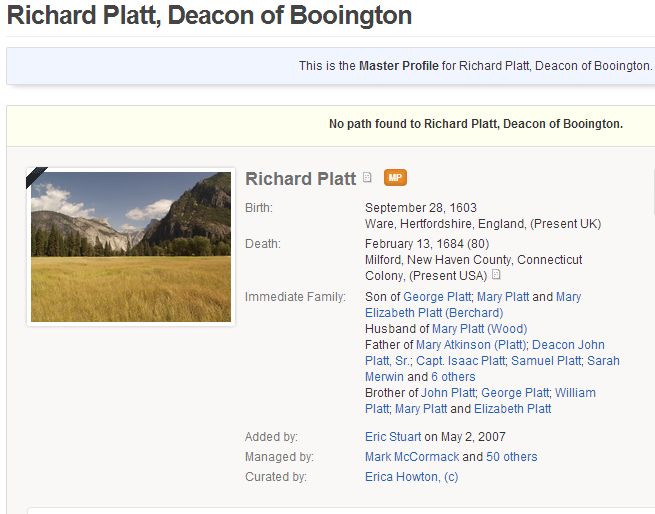
The first ancestor of the name in the United States, was Richard Platt.
"Richard Piatt, son of Joseph Piatt, was baptized Sept. 28, 1603." This is claimed as an extract from the parish records of Bovingdon, a village near Hertford, England.
The Platt progenitor, Richard Platt left England in 1638, and landed at New Haven
Richard Piatt had eighty-four acres of land in and around New Haven. His name is on the list of free-planters made out in 1646 ; he was chosen a deacon in the first church in Milford in 1669.
It is recorded that his wife, Mary, died in January, 1676. He made his will in 1683.
Okay .. so Mary Wood Platt from my written notes:
10 Nov. 1605 - 24 Mar 1676(70)


Possible:
F: John Wood (#1) : 13 Apr 1566 - 7 Dec 1635(69) - both Roydon, Essex, England
M: Jane (unknown)  

Possible:
F: John Wood (#2) : 1578-1605(27)
M: Isabel Wood : 1582-1649(67)
           both born and died in : Roydon, Essex, England


     John Wood (#2) parents :  F: Edmund Wood SR.  6 Mar 1546 - 1614(18)
                                              M: Janet Hurst : 1550-1583  .........................  m: 4 Apr 1573

NOTE ON EDMUND AND JANET

This one was taken from HERE
Edmond WOOD [Parents] 1 was born on 6 Mar 1546 in Northorum, Yorkshire, England. He was christened on 6 Mar 1546 in Sowerby, Halifax, Yorkshire, England. He died in 1614/1618. He married Janet HURST on 4 Apr 1573 in Shelf(n Oram), Halifax, Yorkshire, England.
Janet HURST [Parents] 1 was born about 1550 in Of, Northorem, Yorkshire, England. She was christened on 4 May 1545 in , Dewsbury, Yorkshire, England. She died in 1583 in Hamlet Of Shelf, Halifax Parish, Yorkshire, Eng.. She married Edmond WOOD on 4 Apr 1573 in Shelf(n Oram), Halifax, Yorkshire, England.
They had the following children:
  • M i Humphry WOOD 1 was born on 19 Sep 1574 in Hamlet Of Shelf, Halifax Parish, Yorkshire, Eng.. He was christened on 19 Sep 1574 in Northorem, Yorkshire, England.
  • M ii Richard WOOD
  • M iii Edmund WOOD
  • M iv John WOOD 1 was born on 25 Dec 1580 in Hamlet Of Shelf, Halifax Parish, Yorkshire, Eng.. He was christened on 25 Dec 1580 in Northorem, Yorkshire, England.
  • F v Grace WOOD 1 was born on 9 Sep 1581 in Hamlet Of Shelf, Halifax Parish, Yorkshire, Eng.. She was christened on 9 Dec 1581 in Northorem, Yorkshire, England.
  • M vi John WOOD
  • M vii Thomas WOOD 1 was born in 1586 in Hamlet Of Shelf, Halifax Parish, Yorkshire, Eng.. He was christened on 29 Jan 1586 in Northorem, Yorkshire, England.
  • M viii Robert WOOD 1 was christened on 29 Jan 1586 in Northorem, Yorkshire, England.
  • F ix Susan WOOD 1 was born in <1588> in <Northorem, Yorkshire, England>.
I am going to continue down from Janet/Judith Hurst on another blog...... 


From HERE and HERE  *notice Richard Wood JR was married twice*
Wood, Richard, Jr
b. 1510
Sowerby Yorkshire UK
m. Longbotham, Elizabeth 
30 Sep 1600
m. Ambler, Margaret
26 Jul 1540
d. 06 Dec 1549
Estimate of birth from the last will of his farther Richard Wood born about 1480.

Richard Wood, Jr. 

Birth:1515 
Sowerby, Halifax Parish, Yorkshire, England
Death:1549 (34)
Halifax, West Riding, Yorkshire, England
Immediate Family:


Annie Joanna Roper 

Birth:circa 1523
Death:December 6, 1549 (26)
Immediate Family:
Ambler, Margaret
b. 1517
Halifax
d. 06 Dec 1549
Halifax
m. Wood, Richard
26 Jul 1540

Margaret Anne Wood (Ambler) 

Birth:circa 1523 
Northowram, , Yorkshire, England
Death:circa 1600 (77)
Sowerby, Halifax, Yorkshire, England
Immediate Family:


If both Richard and his first wife died the same year???   But these are just notes....  Maybe Annie and Margaret are the same person?
I'm going to continue Margaret's on another blog .... 


Notes for RICHARD WOOD SR. From HERE and linked off there after


Richard Wood, Sr. 

Birth:circa 1480 
Sowerby,Halifax,Yorkshire,England
Death:July 8, 1553 (73)
Sowerby,Halifax,Yorkshire,England
Immediate Family:
Wood, Richard, Sr
b. 1484
Sowerby Yorkshire UK
d. 18 Mar 1552
Sowerby Yorkshire UK
m. Not Found2, Christabel
1508
About Wood, Richard, Sr
This Richard Wood was a handloom weaver of woollen goods.His Will. March 14 1552 Richard Woode of Souerbye in the countie of Yorke,clother.I ordayne and make Christabell my wif,and Margaret,Anges,Thomas,and Rycharde,my children,myne executors to resayve suche thinges as be owynge to me and also to paye my dettes,whiche dettes beyonge paid,Igiue the residue of all my goodes to my said wif and children;and that this my will maye the better be accompleshed I desire my brother John Wood,and Thomas Fournes to be ouersears of the same.Thes wittenesses,John Woode,Edmunde Wood,Sir John Hilton,preist.Pr.Jul.8.1553,by Xpabell.mrelict,Margaret and Agnes,daughters,power being reserved to Thomas and Richard,children." (Sourse:Halifax Parish Wills P, 82.Note the will has been copied with the spelling as found in the original soure.)
WOOD (Yorkshire)
Richard Wood (1480-1553) married Christable. He and his younger brothers John and Edmund were cloth weavers in Sowerby, Halifax, Yorkshire, "on the bleak, treeless moorlands of the Pennine Hills, where fertile soil was at a minimum."
. 1. Margaret Wood (c.1509)
. 2. Agnes Wood (c.1511)
. 3. Thomas Wood (c.1513)
. 4. Richard Wood (c1515) married Margaret Annes Ambler
WOOD (Yorkshire)
Richard Wood (1480-1553) married Christable. He and his younger brothers John and Edmund were cloth weavers in Sowerby, Halifax, Yorkshire, "on the bleak, treeless moorlands of the Pennine Hills, where fertile soil was at a minimum."
. 1. Margaret Wood (c.1509)
. 2. Agnes Wood (c.1511)
. 3. Thomas Wood (c.1513)
. 4. Richard Wood (c1515) married Margaret Annes Ambler

Christabell Washburn (Umn)   (END)

Birth:circa 1485 
Sowerby,Halifax,Yorkshire,England
Death:circa 1598 (113)
Sowerby,Halifax,Yorkshire,England
Immediate Family:


Christopher Wood 

Birth:circa 1459 
Halifax, West Riding, York, England
Immediate Family:

Margaret C. Wood (Umn) 

Birth:circa 1457
Immediate Family:
Wife of Christopher Wood
Mother of Richard Wood, Sr.

John Atte Atte Wode 

Birth:circa April 4, 1400 
Sanderstead, Surrey, England
Death:1459 (59)
Sanderstead, Surrey, England
Immediate Family:
Knight of the Shire in 1459 means he was called to Parliament. This Parliament deposed King Henry, was a member of Parliment in 1459 and built Sanderstead Court about that time

Isabella Atwood (Mulys) 

Birth:circa 1405 
Sanderstead, Surrey, , England
Death:1499 (94)
Sanderstead, Surrey, , England
Immediate Family:
Daughter of James de Mules and Margaret Upton
Wife of John Atte Wode
Mother of Thomas Wood,John Atwood andAnne Atwood
Half sister of Thomas Upton

Isabelle Atte Wode (DeMules) 

Birth:1405
Death:1499 (94)
South Croydon, Greater London, UK
Immediate Family:
Wife of John Atte Wode
Mother of Christopher Wood
I will continue down from Isabelle in another blog.... 


John Atte Wode 

Birth:circa 1360 
Sanderstead, Surrey, England
Death:1404 (44)
Surrey, , England
Immediate Family:
Sanderstead Court was a country house most often associated with the Atwood family of Sanderstead, Surrey, England. It was located next to the All Saint’s Parish Church (c. 1230) in Sanderstead. This manor house evolved over the centuries to become a significant country house and the seat of power of the Atwood family.
The first mention of the Atwood family in Sanderstead is in 1346 when Justice Peter Atte Wood (Atte Wode) and his wife Laurencia purchased land there (Lewis 1894, p. 338). The Atte Wode’s had originally lived nearby in Coulsdon, first at Hooley House and then at Wood Place. Some time in the 15th century they moved to Sanderstead and began improving the property there. By the time John Atwood died in 1525, the family seems to have made the transition to Sanderstead, and he mentions Sanderstead manor in his will (Atwood 1928).
The Atwood family were benefactors to the Sanderstead Parish Church which was adjacent to their home, and John Atwood (Atwodde) and his wife, Denys, have a brass plaque in the church dated 1525. John’s grand son, Nicholas Wood, who died in 1565, is identified as “of Sandersted Corte who served quene Elizabeth sens the second yearr of her rayne” on his brass in the church (Stephanson 1919).
Several secondary sources repeat the tradition that Queen Elizabeth I once spent the night at Sanderstead Court while Nicholas Wood was the owner. His service to the queen included being a Sergeant of the Queen's Carriages. There has been no independent corroboration of the Queen's presence at Sanderstead Court, however, so the story remains an undocumented tradition.
Nicholas Wood lost a portion Sanderstead to Sir John Gresham, Lord Mayor of London, when King Henry VIII dissolved the monasteries in 1536 and conveyed their property to some of his favorites.
After a series of complicated transactions and inheritances, the Atwood’s regained control of Sanderstead Court, and Nicholas Wood's son, Harman Atwood, Jr., transformed Sanderstead into a significant country house in the 1670’s.
Harman Atwood was finished his renovations to Sanderstead Court in 1675. The completed house was a three story, red brick mansion comprised of a central core with two large wings at either end which were adorned with decorated chimneys. The central portion of the house had a great room, two stories in height, supported by fluted columns with Corinthian capitals; this great room was probably originally constructed by an earlier Atwood in the 16th century. Many of the rooms in Sanderstead Court were panelled with wood. The Atwood shield with a lion rampant between three acorns, the initials “H.A.” (Harman Atwood) and the date “1675” were once were carved in stone over the main entry to Sanderstead Court.
Harman Atwood, Jr. (1608-1676) was an attorney (solicitor) in London and Sanderstead was at the center of his vast holdings of real estate. Harman appears to have been a patron of the arts and had a friendship with John Oldham (poet). Oldham's poem, Pindarique, was written "to the memory of Harman Atwood upon his death." According to Charles Atwood "in a short biography of John Oldham prefixed to his poems...Harman Atwood was his liberal patron, that he died in 1676, that he was of Sanderstead, in Surrey County, England, where the name and family had been of long duration in a lineal descent"(Atwood 1888).
Harman Atwood died childless in 1676 and left Sanderstead Court to his sister Dame Olivia Atwood (1614-1681). Olivia also died childless, and the house passed through a succession of distant Atwood relations until it passed out of the family line entirely in 1759. Later owners included members of the Wigsell family.
John Preston Neal provides a description of Sanderstead Court's grounds as they existed in 1818:
"The site of the Court House is on an eminence, having in front a spacious lawn, skirted by a shrubbery of rich and varied foliage, separated from the adjoining pleasure grounds by a light range of iron palisades. The Park was enlarged by the addition of an Estate, called Place House; and the whole now forms quite a sequestered residence; the grounds, which are extensive, admit the most beautiful prospects: on one side are seen the counties of Buckinghamshire and Berkshire; and on the other, a fine open coutnry for many miles, over all Bansted Downs" (Neal 1818).
In the early 20th century, Sanderstead Court was converted to a hotel and renamed “Selsdon Court.” During World War II it was used by the Royal Air Force. Sadly, Sanderstead Court burned, leaving only the outside walls in 1944. As of 1947 the mansion was still standing but reduced to ruins, probably never to be repaired, left in the edge of a little village in what is now the outskirts of London.

Petronilla Atte Wode (atte-wode)   END

Birth:circa 1364 
Sanderstead, Surrey, England
Death:1459 (95)
England
Immediate Family:

Peter Att Atte Wode (atte-wode) 

Birth:1360 
Sanderstead Surrey England
Death:1404 (44)
Surrey, UK
Immediate Family:
About Peter Atte Wode Genealogy & History: The surname came from ancient Anglo-Saxon culture. An older form of the name is de Wyckhurst, recorded in 1204, according to family history. Atte wode means at the wood, and those bearing the name would have lived at the edge of a forest. In 1279 Peter Atte Wode purchased a 220-acre estate known as Wood Place, and the Atte Wodes joined the influential class of yeomen who became prominent landowners. Atwood genealogy from the 1300s includes Sir William Atte Wode, who was Captain of the King's Guard at the Palace of Westminster under King Edward III.


Peter Atte Wode 

Birth:circa 1321 
Woods Place, Surrey, England
Death:November 30, 1382 (61)
Sanderstead, Surrey, England
Immediate Family:
About Peter Atte Wode He was probably born in Coulsdon in Surrey (now Greater London) according to Manning and Bray's History of Surrey. The precise date of his birth is not known, but it is presumed to have been sometime before 1325. His father was Geoffrey Atte Wode (Abt 1297-1346), a Sergeant at Arms to Edward III and his mother was Anisia. Peter and his wife, Laurencia, had at least one son who was also named Peter Atte Wode (Bef 1363-aft 1384) who was a Knight of the Shire and married Petronilla. On 15 Mar 1351 Peter Atte Wode and John De Roulegh along with seven others were appointed as "keepers" to the "joint commission for the peace and for labourers" in Surrey. This commission was formed in several counties in England to provide an enforcement enforcement for new laws that had been enacted to regulate labor and provide for peace after the Black Death decimated the population in 1348-49. On 15 Sep 1351 de Roulegh and Peter Atte Wode were removed from their positions on the commission as a result of complaints of impropriety by fellow commissioners. They were both tried and Peter Atte Wode was found to be innocent of the charges. De Rouglegh, however, was found guilty of extorting money from laborers, sent to prison and fined heavily. Peter became associated with William of Wykeham (1320-1404). His association with Wykeham undoubtedly enhanced his stature and helped increase his wealth. Jean Froissart (1337-1405), the famed chronicler of medieval England and France, says in his Chronicles (1395): "At this time reigned a priest called William of Wykeham. This William of Wykeham was so much in favor with the King of England, that everything was done by him, and nothing was done without him." Peter was jointly appointed a Justice in Eyre south of the Trent along with Wykeham on 13 Jul 1361, a position he held until about 1367. The Eyre Court was created to hear cases involving forest law in the Royal Forests of England. Wykeham eventually became the Bishop of Winchester, and was also the Chancellor of England under both Edward III and Richard II. William of Wykeham was appointed the King's Commissioner in charge of rebuilding Windsor Castle and Clerk of all the King's Works in his Manors of Henley-on-Thames (Oxfordshire) and Easthampstead (Berkshire). E. F. Atwood has found a reference in the Rotulorum to Peter acquiring a commission to rebuild a portion of Windsor Castle during this period (there is no indication which Rotulorum records were used by Atwood during his research). The Atte Wode's had been in the employ of King Edward III since at least 1341. By 1346 three members of the Atte Wode family were serving in his royal bodyguard as Sergeants-at-Arms, including his father Geoffrey Atte Wode, his grand father Sir William Atte Wode (who had been knighted by the king), and his uncle Richard Atte Wode. Jesse's Memorials of London describes his grandfather's service to Edward III as Captain of the Guard, and The London Letter Books describe Richard's role in moving the invasion fleet down the Thames in 1345 during the Hundred Years' War with France. Based on Peter's land transactions after the successful campaign in 1346, the Atte Wode's seem to have acquired a considerable amount of wealth during this time. E. F. Atwood speculates that this family's treasure was gained as a result of the English success during the war. Froissart makes this observation in his Chronicles: After the battle of Caen "the Englishmen were lords of the town three days and won great riches, the which they sent by barks and barges to Saint-Saviour by the river of Austrehem, two leagues thence, whereas all their navy lay." In 1346 Peter Atte Wode and his wife Laurencia recorded the first of many land transactions in Sanderstead in Surrey (now Greater London) and surrounding counties. This would begin a long association with the Atwood family in Sanderstead. While he owned land in several locations (including Woodmansterne acquired in 1360 and Chipstead Manor acquired in 1364), it seems likely that Peter lived at Wood Place in Coulsdon, the ancestral home; in 1350, he was licensed by the Bishop to maintain an oratory (a private chapel) at Wood Place. On 20 Dec 1382 Laurencia, now a widow, founded a chantry at Newark Priory (which was dissolved in 1538) and endowed a mass for the soul of Peter Atte Wode. Peter amassed a sizeable estate during his lifetime as the scattered records demonstrate, and he stands an example of the emerging new class of wealthy land owners in England who were not members of the aristocracy but grew wealthy through their association with the royal family. His ancestors would continue to acquire land, particularly in Surrey, construct the large manor house known as Sanderstead Court which is depicted in Neal’s Views, continue serve the royal family in a variety of positions, and also become elected as Knights of the Shire.

Laurencia Atte Wode (?)   END

Birth:1324 
Surrey, England, United Kingdom
Death:1419 (95)
Surrey, England, United Kingdom
Immediate Family:
Wife of Peter Atte Wode
Mother of Peter Atte Wode

Anisia Atte Wode  END

Birth:estimated between 1285 and 1323 
Immediate Family:
?????????????????????????????????????????????/

Geoffrey Richard Atte Wode 

Birth:1297 
The Woods, Colsdon, Surrey, England
Death:August 26, 1346 (49)
Crécy-en-Ponthieu, Picardie, France
Immediate Family:
Assumed to be eldest son because of his connection with Hooley House as possessor of the estate. A Sergeant of Arms to the King.
-------------------- GEOFFREY ATTE WODE(1) was born about 1297 in COULSDON, SURREY, ENGLAND. He died on 26 Aug 1346 in COULSDON, SURREY, ENGLAND. HIS ESTATE WAS HOOLEY HOUSE, WHICH IN 1360 WAS FINED 46 POUNDS IN ADDITION TO A REGULAR TAX ON ONE 40TH OF A KNIGHT'S PAY, BECAUSE IT WAS PURCHASED WITHOUT CONSENT OF THE KING (A SORT OF EX POST FACTO SCHEME OF THE KING TO RAISE MONEY), IN 1346, IN THE YEAR OF THE REIGN OF EDWARD THE THIRD, "INQUISTIO POSST MORTEM GALFRIDUS (GEOFFREY) ATTE WODE" ...... LAND IN MANOR OF "GULLESDEN" (COULSDON). THE LATIN MEANS THAT THE FINE WAS PAID AFTER THE DEATH OF GEOFFREY ATTE WODE, PROBABLY IN 1360 AS STATED ABOVE.
THERE IS A NOTE THAT STATES GEOFFREY MIGHT HAVE BEEN KILLED OR FELL AT THE BATTLE OF CRECY. FELL ? DOES THIS MEAN WOUNDED AND THEN DIED LATER ON, ON DATE THAT IS NOTED. BATTLE OF CRECY TOOK PLACE IN FRANCE AROUND 1345, WHEN THE KING INVADED FRANCE. Parents: SIR WILLIAM ATTE WODE and JULIANA.

Yvonne Anisia Atte Wode (Livingstone)   (END)

Birth:1299 
Woods Place, Coulsdon, Surrey, England
Death:circa 1328 (29)
South Croydon, Greater London, England, United Kingdom
Immediate Family:
Wife of Geoffrey Atte Wode
Mother of Peter Atte Wode


William Geoffrey Atte Wode, Sir 

Birth:circa 1270 
Hooley House, Colsdon, Surrey, England
Death:1345 (75)
Woods Place, Surrey, England
Immediate Family:
Sir William Atte Wode (bef. 1270 – c. 1346) was Captain of the King's Guard at the Palace of Westminster under King Edward III of England.
He was probably born sometime before 1300 in Coulsdon, Surrey, England. He was the son of Peter Atte Wode and Alice, who owned both Hooley House and Wood Place in Surrey. Sir William married a woman named Juliana, and they had at least three children: Geoffrey Atte Wode, Richard Atte Wode, and William Atte Wode.
While we do not know when he was knighted, it was at least by 1341, because by that time he is referred to as Sir William and is Captain of the King's Guard at the Palace of Westminster, the King's royal residence in London; members of parliament also met at Westminster Palace at this time. As a Sergeant at Arms, Sir William was part of the royal body guard that was composed of about thirty men at that time. It is not known what events occurred to bring William to King Edward III's attention for this position, but he must have had some connection through either friendship or family relations to the royal family.
An interesting anecdote about Sir William's life is recorded in John Heneage Jesse's Memorials of London (1341):
"In the 14th year of the reign of Edward III, John de Stratford, Archbishop of Canterbury, with a great number of London bishops, clergy, soldiers, came to the gate of Westminster Palace and demanded admittance to the chamber where Parliament was assembled. He was forbidden to enter in the King's name by Sir William Atwood, Captain of the King's Guard. The Archbishop was stopped because the followers were not members. The Archbishop was a member, but the King commended Sir William."
The Atte Wode lineage can be traced back to about 1204 when Peter de Wyckhurst (an older form of the name Atte Wode) purchased 'Hooley House' from the Bertan Marten, the Abbot of Chertsey Abbey. Over the next hundred years, the family added to its land holdings in Surrey and his father, Peter Atte Wode, purchased the 220-acre (0.89 km2) estate known as 'Wood Place' in 1279. The Atte Wode's emerged as one of the new influential class of yeomen who were becoming substantial land owners in England. In 1318 Sir William and Juliana added to the family's fortune by purchasing another estate known as 'Beckenham' in Kent.
Two of Sir William's sons, Geoffrey and Richard, also became Sergeants at Arms to the King. Richard is mentioned in the London Letter Books for his role in moving the fleet being assembled at London down the Thames to invade France during the 1346 campaign in the Hundred Years' War.
E. F. Atwood asserts that Sir William and both of his sons accompanied the army on their invasion of France, however, his source for this information is not given. It does seem likely, however, given their positions as body guards to King Edward. Based on subsequent land transactions in England, it appears possible that both Sir William and his son Geoffrey were killed in the French campaign in 1346, (possibly at the Battle of Crecy), however, this is not certain.
Sir William's grandson, Peter Atte Wode, continued to expand both the family’s land holdings and its influence by being appointed a Justice in Eyre; Peter's association with William of Wykeham who became the Bishop of Winchester and the Chancellor of England undoubtedly also helped to increase the family's influence.
The Atte Wode family name underwent a number of changes through the centuries with numerous variations in spelling: in the earliest records they are known as de Wyckhurst, by about 1300 they were commonly known as Atte Wode, a name that evolved into the modern version, Atwood, and finally, some (though not all) family members adopted the surname Wood in the 1500s.

Juliana Juliana Atte Atte Wode (William)   END

Birth:1274 
Woods Place, Sanderstead, Cour., England
Death:1302 (28)
Coulsden, Surrey, England
Immediate Family:

Peter Atte Atte Wode 

Birth:circa 1245 
Hooley House, Coulsdon, Surrey, England
Death:circa 1313 (68)
Hooley House, Coulsdon, Surrey, England
Immediate Family:

Alice Atte Wode   END

Birth:circa 1254 
Coulsdon, Greater London, England, United Kingdom
Death:1313 (59)
Stevington,,Bedfordshire,England
Immediate Family:

William Wyckhurst (Atte Wode) 

Birth:circa 1220 
Hooley House,Coulsdon,Surrey,England
Death:circa 1278 (58)
Coulsden, , Surrey, England
Immediate Family:

Wyckhurst means "house of Wood", and in later years the the owners of "The Hooley House" were "Atte Wodes". Bought Hooley House, Conlsdon, surrey in 1204. A 40 Acre estate. Wyck means dwelling on wooded knoll.

Alice Wyckhurst (Fosse) 

Birth:1224 
Coulsdon, Surrey, England
Death:1245 (21)
England (Complications of child birth)
Immediate Family:
Wife of William Wyckhurst
Mother of Peter Atte Wode

Alice Atte Wode (Umn) 

Birth:1235
Immediate Family:

Peter de Wyckhurst (DeWyckhurst) 

Birth:circa 1180 
Hooley House, Coulsdon, Surrey, England
Death:Coulsden,,Surrey,England
Immediate Family:
About Peter de Wyckhurst (DeWyckhurst) 'Ye Atte Wode Annals' says: 'The first mention I find of the name Attwood is of an 'ancient family' at Wynolverley,' Worcestershire. Indeed, legend says this family was originally of Gael-Brython stock. When armorial bearing came into use, this family took a red field, sown with golden acorns and bearing a silver rampant lion. These arms, with often a variation to the number of acorns, are to be found in several other English counties. In Suffolk, the acorns are six; in Surrey, three. 'I find at least five other families with landed estates, named Atwood, whose arms show independent origin. But every Attwood in encyclopedias and histories at hand, who were of note as mathematicians, composers, lawyers, members of Parliament and professors in English Universities, are of a stock whose arms show them to trace from the family at Wolverley. More than half the English Attwood yeomanry were of this stock. 'A. D. 1203, one Peter de Wyckhurst bought outright from the Abbey of Chertsey, the 40 acre Estate in Coulsdon Parish, County Surrey, now known as Hooley House. Wick means dwelling and hurst is a wooded knoll, so Peter may well have been of 'Wood House,' and perhaps from Suffolk. 'The owner of so small an estate would not naturally make much of a mark in history and we would not know his successor, except that William Attewode, in 1278, signed a surety bond, as a yeoman of this parish. 'This is the first appearance of this surname in Surrey. The very next year finds Peter Atte Wode and wife Alice suing to record title to a 220 acre tract nearby, which is known today as Wood Place. Peter doubtless lived at Hooley House, for in 1313, he had the buildings and part of the land of Wood Place leased to one Roger de Bosco, or de Wood. It is merely assumed William was the son of Peter de Wyckhurst. He was the first one in Surrey to carry the name Attewode. The name Wyckhurst translated would mean "house of Wood", and in later years the owners of "The Hooley House" were Atte Wodes. The Hooley House estate was purchased in 1203 by Peter de Wyckhurst from the Abbey of Chertsey. William being an adult in 1278 problably with several years of maturity would be in the correct generation to be a son of Peter. PETER DE WYCKHURST was born about 1160 and married to UNKNOWN. HE WAS GRANTED A 36 ACRE TRACT OF LAND IN 1203, KNOWN AS HOOLEY HOUSE, FROM THE ABBEY OF CHERTSEY IN COULSDON PARISH. "WYCK", MEANT DWELLING PLACE OR HOME AND "HURST", WAS A WOODS, HENCE PETER OF THE HOME IN THE WOODS, AN EARLY FORM OF ATWOOD. THIS LAND IS LATER FOUND IN ATWOOD WILLS. THE NAME ATWOOD IS BELIEVED TO HAVE BEEN OF SAXON ORIGIN. RELIABLE SOURCES PLACE ITS BEGINNING AT COULSDON, A PARISH IN SURREY COUNTY, 12 MILES SOUTH OF LONDON AND ADJOINING CROYDON AND SANDERSTEAD. THE UNUSUAL COMPOUNDING OF THE PREPOSITION (ATTE) WITH THE NOUN (WUDU) DISTINGUISHES THE ATWOOD NAME FROM OTHER LOCAL NAMES. IN THE MAJORITY OF ENGLISH SURNAMES, THE PREPOSITION IS DISGUISED, UNLIKE THOSE OF FRENCH ORIGIN IN WHICH IT IS OBVIOUS AND FOUND IN NAMES LIKE DUBOIS AND DUPONT. THE FIRST RECORD OF THE NAME APPEARS IN THE 12TH CENTURY PIPE ROLLS AND IS SPELLED ATTEWODE. THESE ROLLS GIVE A DETAILED ACCOUNTING OF THE KING'S RECEIPTS AND RENTS, FINES AND PRIVATE EXPENDITURES AND IS ONE OF OUR MOST VALUABLE SOURCES OF NOMENCLATURE OF THE MIDDLE AND UPPER CLASSES OF ENGLISH CITIZENS. SINCE THERE WAS NO STANDARDIZED SPELLING OF THE ENGLISH LANGUAGE UNTIL AFTER THE 17TH CENTURY, ANCIENT RECORDS SHOW THE NAME IN MANY FORMS: ATTE WODE, DE WOODE, DEBOIS (FRENCH), DE BOSCO (LATIN), ATTE WOODD, ATTWOOD AND ATWOOD. IN CERTAIN DOCUMENTS OF WILLIAM PRYNNE (1600 TO 1699), AN ENGLISH PURITAN, THERE IS EVIDENCE OF REPEATED INTERCHANGE OF "WOOD" AND "ATWOOD" AS THE NAME OF ONE OF HIS CONSTITUENTS AT BATH. THE ATWOODS OF WORCESTERSHIRE OF SAXON TIMES, THE ATWOODS OF SUFFOLK OF EARLY NORMAN TIMES, THE ATWOODS OF GLOUCESTERSHIRE AND THE ATWOODS OF SURREY AND KENT, OUR LINE, ALL HAVE SIMILAR COAT OF ARMS, EXCEPT FOR THE NUMBER OF ACORNS IN THE FIELD. THUS IT WOULD SEEM THAT THERE MAY STEMMED FROM A COMMON ANCESTOR BACK IN THE DIM PAST WHERE RECORDS DO NOT REACH AND THE DIFFERENT NUMBER OF ACORNS WERE USED TO DESIGNATE THE COUSIN LINES OF THE FAMILY. IN ALL, 15 COAT OF ARMS WERE GRANTED TO THE ATWOOD NAME. THE "O" DOES NOT SEEM TO HAVE BEEN DOUBLED BEFORE THE 16TH CENTURY. IT WAS ALWAYS WRITTEN "WODE" WHEN DESIGNATED A "FOREST" IN POETRY AS WELL AS WHEN APPLIED TO ONE WHO LIVED NEAR OR "AT" A FOREST IN PROSE DOCUMENTS. IN THE TIME OF JOHN HEWSON ATWOODE (1520 TO 1562) THERE AS A WM. DE WODE OF KENT WHO WAS ALSO KNOWN AS WM. DE WUDE. COUNTY SURREY IS, ACCORDING TO THE ENCYCLOPEDIA BRITANNICA, AN AREA OF FOREST, SWAMP, HEATH AND OPEN DOWNLAND. THE ROMANS PASSED THROUGH THE AREA AT THE TIME OF THE INVASION BY JULIUS CAESAR (55 BC). PERHAPS USING THE ANCIENT TRACT ALONG THE DOWNS, LATER KNOWN AS THE PILGRIM WAY. ROMANIZATION, HOWEVER, DIDN'T COME UNTIL THE TIME OF CLAUDIUS (43 AD) FOR THE NEXT FOUR CENTURIES SURREY WAS RULED BY THE ROMANS AND THOUGH ROMAN REMAINS ARE RELATIVELY FEW, LARGE SETTLEMENTS APPEAR TO HAVE BEEN AT SOUTHWORK, KINGTON UPON THAMES, PARLEY HEATH NEAR ALBURY AND AT WOODCOTE NEAR CROYDON. NO ROMAN TOWN SURVIVED THE SETTLEMENT OF SURREY BY THE SAXONS AND THERE ARE FEW PLACE NAMES OF ROMAN ORIGIN. SURREY WAS NEVER AN INDEPENDENT SAXON KINGDOM. THE NAME MEANS SOUTHERN DISTRICT. NEARLY ALL PLACE NAMES ARE OF SAXON ORIGIN, A LARGE PROPORTION ARE PAGAN. THE AREA HAD A VERY SMALL POPULATION COMPARED WITH NEIGHBORING COUNTIES. AS LATE AS THE 13TH AND 14TH CENTURIES THERE MUST HAVE BEEN A STRONG CONTRAST BETWEEN THE ECCLESIASTICAL DIGNITARIES, SHARING IN THE LIFE OF THE METROPOLITAN CITY. THE TOWN OF CHERTSEY, 22 MILES SOUTHWEST OF LONDON, IS SITUATED ON THE RIGHT BANK OF THE THAMES RIVER. CHERTSEY ABBEY WAS FOUNDED IN 666 A.D. BY ST. ERKENWALD WHO BECAME ITS FIRST ABBOT. BURNED DURING THE DANISH WARS, ABOUT 871 A.D. AND THE MONKS KILLED, IT WAS RE-ESTABLISHED FOR BENEDICTINES IN THE 10TH CENTURY. IT MAINTAINED A PROMINENT POSTION AND HELD MANY MANORS INCLUDING CHERTSEY, EGHAM, THORPE, CHOBHAM, EPSON, SUTTON AND COULSDON UNTIL IT WAS DISSOLVED IN 1537. DURING THE REIGN OF EDWARD THE CONFESSOR, GODWIN, EARL OF WESSEX, AND MEMBERS OF HIS FAMILY INCLUDING HAROLD, HELD MANY MANORS IN SURREY. AFTER THE BATTLE OF HASTINGS IN 1066, WILLIAM I, TOOK THESE FOR HIMSELF OR HIS NORMAN FOLLOWERS. FOLLOWING THE INSURRECTION OF THE 15TH CENTURY, SURREY UNDER THE TUDORS BECAME A COUNTRY OF ROYAL RESIDENCES. HENRY VII, REBUILT THE PALACE AT SHEEN, RENAMING IT RICHMOND. HENRY VIII AND ELIZABETH I, RESIDED THERE AND HENRY VIII RECIEVCED HAMPTON COURT FROM CARDINAL WOLSEY, JUST ACROSS THE THAMES. THIS BROUGHT COURT OFFICIALS TO THE VILLAGES, TO THE SURREY SIDE. AFTER THE DISSOLUTION OF THE MONASTERIES (1536\1539), HENRY BEGAN TO BUILD A FLAMBOYANT HUNTING LODGE IN SURREY, CALLED NONSUCH (LOCATED NEAR EWELL). THIS WAS BUILT PARTLY OF MATERIALS FROM THE DISSOLVED MONASTERY, MERTON, AND ON THE SITE OF THE VILLAGE OF CUDDINGTON WHICH HE HAD DESTROYED. STONES FROM WAVERLY ABBEY WERE USED IN BUILDING LOSELEY HOUSE. OATLANDS PALACE (WEYBRIDGE) HAD STONES FROM CHERTSEY ABBEY. THE REMAINS OF CHERTSEY ABBEY FELL INTO DECAY IN THE 17TH CENTURY AND FOR MANY YEARS ONLY THE GROUND PLAN WAS TRACEABLE. DURING SHAKESPEARE'S TIME, THE COUNTY OF SURREY COULD BOAST OF THE GLOBE THEATRE AT SOUTHWARK, AND TODAY OF RACECOURSES AT EPSON DOWNS, SANDOWN PARK AND LINGFIELD PARK AND OF THE ALL ENGLAND LAWN TENNIS CLUB AT WIMBLETON. BIRTH RECORDS WERE NOT KEPT IN THOSE DAYS EXCEPT TO PRESERVE TITLES OF KINGS AND OTHERS. HOWEVER, LAND TITLES, WILLS AND OTHER RECORDS HAVE BEEN FOUND. THE LAND WAS OWNED BY THE KING AND PUT UNDER THE CONTROL OF A LORD OR MEN OF OTHER TITLES OR WAS OWNED BY THE CHURCH UNDER THE CONTROL OF A BISHOP. THIS WAS THE MANOR SYSTEM. TO BECOME A YEOMAN OR A FREEHOLDER OF A SMALL PIECE OF LAND ONE HAD TO BE OF SOME SERVICE TO THE KING OR THE BISHOP. OVER THE YEARS THE ATWOODS SEEM TO HAVE SERVED BOTH. WHEN THE ATWOODS BEGAN TO ACQUIRE THEIR ESTATE, LONDON WAS A TOWN OF ABOUT 350,000 AND THE POPULATION OF ALL ENGLAND WAS NOT OVER THREE MILLION. TODAY MOST OF THAT ESTATE LIES WITHIN GREATER LONDON, BUT IN THE BEGINNING IT WAS JUST SOUTH ACROSS THE THAMES IN THE COUNTIES OF SURREY AND KENT. THEY HAD A HOME IN THE PARISH OF ST. MARTIN IN THE FIELDS, THEN A SUBURB OF LONDON, AND WENT OUT TO SANDERSTEAD IN SURREY, TO THEIR HOME IN THE COUNTRY. THE NAMES SANDERSTEAD, SANDERSTEAD MANOR, SANDERSTEAD COURT AND SANDERSTEAD PLACE ARE NOT EASILY IDENTIFIABLE IN THE SOURCES USED TO COMPILE THIS VOLUME AS A BEST GUESS, IT APPEARS THAT SANDERSTEAD MANOR CONSISTED OF MANY HYDES (FARMS), BUILDINGS AND DWELLINGS. IT WA CHURCH PROPERTY AT ONE TIME, BUT NOT NECESSARLILY A MONASTERY. SANDERSTEAD COURT WAS A LARGE MANSION AND PROBABLY WAS PART OF THE MANOR. ONE SOURCE STATES THAT IT WAS BUILT IN 1676 BY HARMAN ATWOOD, BUT OTHER SOURCES CLAIM THAT "SANDERSTEDE CORTE" EXISTED AS EARLY AS 1586. PERHAPS IT WAS REBUILT OR ADDED ONTO IN 1676. SANDERSTEAD PLACE WAS YET ANOTHER PRINCIPAL DWELLING ATTACHED TO THE MANOR. IT WAS BUILT ABOUT THE TIME HENRY CONFISCATED SOME OF THE CHURCH PROPERTY AND WA TORN DOWN NEAR THE END OF THE 19TH CENTURY. 871 A.D. ... THE EARLIEST MENTION OF SANDERSTEAD IS FOUND IN SAXON CHARTERS AND IS MENTIONED IN THE WILL OF THE DUKE ALFRED (?AELFRID), WHERE IT IS SPELLED "SONDERSTEDE". THE ORIGIN OF THE NAME IS FROM "SOUDE" OR "STEDE" MEANING SANDY PLACE. THE CHARACTER OF THE SOIL IS OF A SANDY NATURE, A FEATURE VERY UNCOMMON TO THE AREA. 944\977 A.D. ... DURING THE REIGN OF KING EDGAR, ATHELFIEDA, WIFE AND QUEEN, DAUGHTER OF EARL ORDMAR, MOTHER OF ST. EDWARD, KNIG AND MARTYR, GAVE "SANDELSTEDE", WITH 18 HYDES AND CHURCH TO THE ABBEY OF HYDES. 1085 A.D. ... SHORTLY AFTER THE CONQUEST OF ENGLAND, WILLIAM THE CONQUEROR ORDERED AN INVENTORY OF ALL LANDS AND PROPERTIES FOR TAXTION. THIS RECORD IS KNOWN AS THE DOMESDAY BOOK. HERE "SANDESTEDE" CONTAINS ONLY 5 HYDES. 1536 A.D. ... HENRY VIII, AS HEAD OF THE CHURCH, DISSOLVED THE LESSER MONASTERIES AND CONFISCATED CHURCH LANDS INCLUDING SANDERSTEAD WHICH CONTAINED SANDERSTEAD MANOR OWNED THEN BY JOHN HEWSON WOOD OR ATWOOD. THE MANOR WAS THEN DEEDED TO SIR JOHN GRESHAM, UNCLE OF SIR THOMAS GRESHAM, FOUNDER OF THE LONDON EXCHANGE. ALTHOUGH THE ATWOODS REMAINED IN POSSESSION OF PART OF THE MANOR, THEY LIVED IN THE PARISH OF ST. MARTIN MOST OF THE YEAR. 1556 ... UPON HIS DEATH, SIR JOHN GRESHAM WILLED SANDERSTEAD MANOR TO HIS WIFE, KATHERINE, FOR HER LIFE, WITH THE REMAINDER OF HIS PROPERTY TO HIS THIRD SON, EDMOND. 1576\77 ... KATHERINE GRESHAM DIED AND HER SON, EDMOND, INHERITED THE MANOR. HE WAS OF THORPE MARKET IN NORFOLK, AND A MERCER (TEXTILE MERCHANT) OF LONDON. 1586 ... EDMOND GRESHAM DIED AND WILLED SANDERSTEAD MANOR TO HIS SON, RICHARD. 1591\92 ... JOHN OWNSTEAD, ESQ. (1534\1600), SON OF JOHN OWNSTEAD AND AGNES WOOD (ATWOOD) AND THE GRANDSON OF JOHN WOOD (DIED IN 1525), BOUGHT SANDERSTEAD MANOR FROM RICHARD GRESHAM. 1600 ... JOHN OWNSTEAD DIED, AUGUST 09, 1600, WITHOUT ISSUE. 1604 ... HARMAN WOOD PROBABLY REMAINED IN LONDON UNTIL AFTER THE DEATH OF JOHN OWNSTEAD, AS THE BAPTISM OF HIS OLDEST CHILD DOES NOT APPEAR IN THE SANDERSTEAD REGISTER. HE RESUMED THE OLD FAMILY NAME OF "ATWOOD" AT THE BIRTH OF HIS THIRD CHILD. THE SIZE OF THE ESTATE WAS APPROXIMATELY 3,000 ACRES AT ONE TIME. COULSDON: A FEW MILES SOUTH OF CROYDON AND ADJOINING SANDERSTEAD ON THE SOUTHWEST. COULSDON IS THE ONLY PLACE IN SURREY WHERE RECORDS OF THE ATWOOD NAME IS FOUND BEFORE ABOUT 1400. THE MANOR OF COULSDON BELONGED TO THE ABBEY OF CHERTSEY AS DID THE ESTATES OF HOOLEY HOUSE AND WOOD PLACE. 1203 ... IN THE 4TH YEAR OF THE REIGN OF JOHN, THE ABBOTT OF CHERTSEY, THEN LORD OF THE MANOR, GRANTED A MESSUAGE (DWELLING HOUSE WITH BUILDINGS, CURTILAGE AND ADJOINING LANDS), CALLED HOOLEY HOUSE, AND 30 ACRES OF LAND AND 4 ACRES OF WOOD TO PETER DE WYCKHURST AND HIS HEIRS. THEY PAYING FULL VALUE OF THE LAND. 1313 ... IN THE 6TH YEAR OF THE REIGN OF EDWARD II, A MESSUAGE, CALLED WOOD PLACE, VALUED AT TWO SHILLINGS A YEAR AND ABOUT 20 ACRES OF LAND, 60 ACRES WORTH 20 SHILLINGS, 15 ACRES OF WOOD WORTH 7 SHILLINGS 6D, HELD BY PETER ATTE WODE BY SERVICE OF 13 SHILLINGS 4D, A YEAR CAME INTO THE KING'S HANDS BY REASON OF IDIOCY OF JOHN, SON OF ROGER DE BOSCO, LUCY HIS SISTER BEING HIS NEXT HEIR. 1347 ... IN THE 20TH YEAR OF THE REIGN OF EDWARD III, HOOLEY HOUSE WAS FOUND DEVOLVED ON GEOFFERY ATTE WODE, WHO HAD LICENSE TO HOLD SAME OF THE KING BY SERVICE OF ONE 40TH PART OF A KNIGHT'S FEE, AS PARCEL OF THE MANOR OF COULSDON. 1357 ... PETER ATTE WODE HAD THE BISHOP'S LICENSE FOR A PRIVATE CHAPEL IN HIS HOUSE AT LA WODE IN COULSDON. THE 4 ACRES OF WOOD AT HOOLEY HOUSE OR THE 15 AT WOOD PLACE ARE PROBABLY THE SAME AS LA WODE OF PETER'S LICENSE. Children were: ATTE WODE.

Unknown de Wyckhurst 

Birth:1184 
Coulsdon, Surrey, England
Death:England
Immediate Family:
THEY ARE ACTUALLY LISTED AS THE PARENTS BUT THE DATES ARE THE SAME AS THEY ARE .........

Peter de Wyckhurst 

Birth:circa 1180 
Hooley House,Coulsdon,Surrey,England
Death:1203 (23)
Coulsden, Surrey, , England
Immediate Family:

Alice Atte Wode (unknown) 

Birth:1184 
Hooley House,Coulsdon,Surrey,England
Death:1203 (19)
England
Immediate Family:


Atte Wode 

Birth:1160 
England
Immediate Family:
Husband of Unknown Atte Wode
Father of Peter de Wyckhurst

Unknown Atte Wode 

Birth:estimated between 1122 and 1180 
Immediate Family:
Wife of Atte Wode
Mother of Peter de Wyckhurst


There are suppose to be mentions of John Wood (Mary Wood's Father)

Source: Lineage Papers of Robert Forsyth Little, Jr. for the Society of the Colonial Wars.

Will be continuing on other blogs!!! 


Mary Wood Conspiracy

Mary Wood is my 10 x Great Grandmother  ...

Fact: She was married to Richard Platt .......

This is where things are iffy.

On one hand ... many trees show that Mary's parents were John Wood and Jane (unknown) ... and that is where things end.  There is documentation naming John and Jane as her parents.

However ..... on other trees, it's Henry Wood and Isabell Goodspeed.

Both Mary Woods from these two sets of parents married Richard Platt.   Both have the same back story.  Both ...... well, they are the same person.  Period.

So which set is her parents?

Let's back up a little bit.  Even if Mary Wood has always given me a bit of a difficult time, it's another one of those "dead ends" that felt like it shouldn't have been.

One of my best friends and I did the whole "Famous" relative thing a long time ago.  We both found out that one of the connections we had was Louisa Alcott.  Ya know, the writer of one of my favorite books of all times, Little Women.

So .... the point where it switched directions was Mary Wood.  According to the links, Mary's Mom's name was Isabell Goodspeed..... but I had it as Jane.

So I was all - what the heck.

Well Ancestry has taken down the "Famous Relatives" thing because of inaccuracy issues.  So at first I'm like... well, there you go.  Inaccuracy.

But then I got to thinking ....  what if .... I'm wrong, and it's right?    Mary Wood and Richard Platt are in my family tree, twice, on the same line.  Yeah - I know ........ INBREEDING.

Um...... HELLO .... if you have English relatives, you probably have inbreeding.  ESPECIALLY if you have English Royalty.  Just sayin ...

So ...... this is how it goes ....


Enoch and Anna Comstock had many children, two of which were Ruth and Cephas ....  Cephas married Nancy, and Ruth married Oliver ....  then Cephas' daughter Caroline married her cousin Samuel who was Ruth's son.  Yep.  Was it acceptable to marry your cousin (not even removed) in the 1800s?

I actually was curious - so I googled it.  I found a few interesting answers ....  here and here.

This depends on the location. Since the discussion seems to be heading in the direction of "cousin marriage" that is what I will talk about. In the West in 1870 it was growing more and more taboo. But cousin marriage is still very widespread among areas in the Middle East and Africa even today and is socially acceptable and is often set up within the family through complicated systems. For instance have you ever heard of cross/parallel cousins and double first cousins? It's super complicated so instead of retyping it all I linked the Wikipedia article. They're short but very interesting. The likeliness that we all have some sort of incest in our family history is very strong. Icky, but true. haha

EDIT:
To address your additions to the question, marrying a direct cousin would not be accepted well in France, however first cousin marriage was and still is legal. Most people have heard of Edgar Allen Poe's marriage to his first cousin Virginia Clemm, this was in the mid 1800's in the U.S., it was tolerated (notice the use of tolerated but not accepted) but thought of as strange to put it lightly. By the mid to late 1800's science was suggesting the effects of incest were higher rates of birth defects, so western society was turning away from the practice of marrying your first cousin. This is true, but by about 2% (Charles Darwin was also married to his first cousin). So, would having direct cousins for parents make you an outcast in the time period? Possibly, but based on cultural norms. Further, it depended on the society you lived in and which class you belonged to. If you were a peasant it might not have mattered due to lack of education/knowledge of genealogy. Or it could be the exact opposite, being a peasant could strengthen ties of genealogy and lineage, since one would rely on those bonds for food, shelter etc. my point, each case is individualistic. Thus cannot be answered in a simple way unfortunately (at least from an anthropological standpoint). :) it's so complicatedddd.

Source(s):


And this one too

Back then science and technology was not advanced and marrying a cousin keeps the family riches in the family.

Now, we realized interbreeding closely can result in disabilities in the child, you know what I mean, like mentally retarded and whatnot. Not many royals and rich people are stingy enough to marry relatives to keep royal and rich blood only.

You can still marry your cousin in all countries, but depends on how close. Most don't allow you to marry first cousins or second cousins. While all allow 3rd, 4th, and so on. Because the blood isn't as close so your child won't have any risks due to relation. Also it's a bit taboo now because of it, and cousins are seen like siblings if you are raised close to each other. It'll be hard for your parents and peers to accept it.


And this one...

It was IN the 1800's that genetics was "discovered" and how it worked regarding biological inheritance of traits from parents to offspring, and it became illegal, based purely on genetic inheritance considerations. Close inbreeding damages the gene pool. Just ask ANY breeder of dogs or horses. The closer the blood relationship between parents, the more likely birth defects in the offspring. It was PRIOR to the 1800's that cousins were acceptable. Back in the days of the Pharaohs in Egypt, it was even OK to marry your sister... Just ask the royal houses in England about the results of inbreeding with cousins...

Now back in the days of English Royalty, you do find some inbreeding -but mostly- it was that they brought in other Royals, from France, Italy, Ireland, etc for marriages.   But - like one of the people stated above, if Royal lines wanted things to stay with in the blood line, it wasn't unheard of.

With all that said, lets move on.


Enoch was the child of Deborah and Abijah Comstock,  Abijah was the son of Abigail and Moses Comstock, Moses the child of Christopher Comstock and Hannah Platt.... and Hannah was the daughter of Deacon Richard Platt and Mary Wood.

This is where the problem rises, going back from Mary Wood.

Birth: 1605 Harwich, England
Death: 1675 Milford New Haven County, Connecticut, USA
The daughter of John & Jane Wood of Roydon, Co. Essex, England. She was baptized on November 10th or 11th in Roydon, Co. Essex, England. Richard Platt and Mary Wood were married on 26 January 1628/1629 in Roydon. On 25 April 1638, Richard & Mary sold their property in Ware (which is four miles southeast of Roydon) in England, and prepared to sail to New England.
The family was first at New Haven and by 1640 were in Milford (lot #38 West Main and Cherry Street). Mary joined the Milford church on 29 January 1639/40 the same year as her husband.

Mary precedeased her husband, and the exact date of her death is unknown, but Milford Church records show that she was buried on March 24, 1675/1676. She isNOT buried a the Founders Memorial Site. Most all of the early settlers were buried in Rev. Peter Prudden's garden until around 1675, and after that they were buried in an extension of his garden which is presently the oldest part of the Milford Cemetery.
The picture of the memorial stone placed on the Founder's Bridge over the Wepawaug River in Milford, CT shows Mary's name along with that of her husband. 


You can see there - that they clearly say that Mary was the daughter of John and Jane Wood.  I have run  into a lot of documentation like that.  But so I wonder....... since John Wood is a dead end ....  because if you look above, John Wood is NOT the son of that John Wood listed as his father, because John Wood with the English Flag would have been UNBORN at the birth of his son John Wood with the tree ...  Yeah, that doesn't work......

And Jane (Unknown) - even with the one surname I found listed for her, is a dead end......

I wonder, what if Henry and Isabell ARE her parents....


So I put it in my tree.....  and this is what happens....  and then it's John and Joan are Henry's parents.. but then I start looking closer....... and
That's not right.  John - Henry's Father - was born - AFTER HENRY????   Um... no, that's not right....  So I go back again ....  

And now ......... I'm just stuck.  Who the hell-o are her parents?  It's so freaking frustrating!  

So I pop a name and date in the trusty Google Search and I get directed to Geni.com and www.myheritage.com

This is what I found there...... 


Mary Wood's Parents 

John Wood's Parents


So ..... with all that confusion .....  I will share this note.  I have seen other posts by Dennis and I do tend to know he has some information backing up what he says.... 

Elizabeth Rose Wood married John Potter in England. Elizabeth was born in Chesham, Buckinghamshire, England. William was born in Manchester, England. They were married April 14, 1630 in Chesham, Buckingshire, England. Elizabeth was born February 26, 1605/06 and John born March 24,1605/06. They had four children; Hannah (b. 1631), Elizabeth (b. February 16, 1631/32), John (b. October 17, 1635), and Samuel(b. October 07, 1641).John Potter died August 10, 1643 in New Haven where he had operated a small farm and made and repaired winches. Elizabeth was a midwife. He and Elizabeth lived in New Haven since it was established in 1639. A number of Massachusetts settlers joined the Davenport Group when they set out to settle New Haven and it is likely they were a part of this group. Elizabeth's sister Mary Wood (b. November 10, 1605) was a member of Reverend Peter Prudens' congregation as they sailed on the Hector with the Davenport Company. Prudens' congregation traveled to New Haven to settle there with Davenports' congregation. Mary married Richard Platt and they lived in Milford, New Haven Colony. I don't know when John Potter and Elizabeth arrived in America or what ship they took. I believe they arrived before 1638 when the Hector arrived in Boston Harbor. John Potter's parents were John Potter, Sr. and Hannah Mead. They were likely from Kent, England. I have John Sr. born March 28, 1580 and Hannah born about 1584. John Potter Jr. had a brother named William, born in 1608, who also came to America and lived in New Haven. William was hanged for beastiality June 06, 1662. Beastiality was relatively common in Colonial America despite the drastic sentence it brought. William fully admitted his offense to the court and stated he hated this "affliction". Elizabeth lived after John's death marrying first my ancestor, Edward John Parker who died soon after William on June 27, 1662. I don't know the cause of Edward's death. Their children were; Joseph (b. February 1647/48), Mary (b. April 1648) , John (b. October 08, 1648), Hope (b. April 26, 1650), and Lydia (b. April 14, 1652). We trace our Parker line from John who first married Hannah Bassett (M. November 08, 1670).Elizabeth married a third time to Pequot War hero, Colonel Robert Rose, himself a widower. The marriage lasted a brief three years with Elizabeth also out living him. There were no children of this marriage. I am presently trying to sort out who might be Edwards' father. There was a William Parker who also died in New Haven in 1662 who it is thought might be related. There was also an Abraham Parker who came to Hartford with Reverend Thomas Hooker. This was the beginning of Connecticut Colony. Abraham had William, Ralph, and Edward John as sons. The William Parker who is the son of this Abraham Parker was an original settler of Saybrooke, a satelite colony of Connecticut Colony The Ralph Parker lived in early Wallingford and married into the Ives family who Charles and Burl trace their ancestry.

note: written by Dennis Wright 

It's Elizabeth (Mary's sister) that links back to Lousia M. Alcott  ..... so I know, regardless, I have that connection - REGARDLESS of who Mary and Elizabeth's parents are.  Right?  

Saturday, September 7, 2013

The Mystery of Robert Lambert

Do you know how annoying it is to hit a brick wall and just keep beating your head against it until someone literally has to pull you away before you crack your head open?

Yeah - that was me the other night - trying to figure out the mystery of Robert Lambert.

Robert is my husband's Great Grandfather ...


So ...  Verna is his paternal Grandmother.  Robert and Winnie were her parents.  But see, already I am running into a brick wall.  We know that Robert's mom's first name was Mary.

So I start to check out the leaves ...

I find a 1900 Census that looks promising....  so I open it up .......


Seems right.   I see his parents were both born in Ireland.  I see he has a sister named Mary.  Also - there are a bunch of men living with them.  Interesting.   So I open up the census to get a closer look......


I actually cut the top of the page to show over their particular information.

So this is what I learned from this.  Mary Lambert owned her house free and clear, and she was housing some male boarders.  She doesn't work, I'm sure she tends to the house.  She came to the Americas from Ireland in 1860, and had been here for 40 years for this 1900 census, however, it doesn't seem as if she ever became "nationalized"..   She could neither read or write.  She didn't work; however, it looked like Robert worked on the Railroad somehow - I cannot read for the life of me what it says, and I spent hours trying to figure it out.  It looks like Eliminator but it doesn't....  ugh, I quit.  Best guess ..... "Enumerator" ... what the heck is that?
So does that mean he was a Rail Road Census Taker at the age of 19?

Mary, his sister was working as a servant at the time.  Both Robert and Mary were born in Illinois... and Mom Mary was born in Ireland, and her parents were born in Ireland.   Robert is 19, and Mary is 17.  Neither of them were going to school.  But they could both read and write English.  One of the most important things I noticed is that Mother Mary was already WIDOWED in 1900.

The next census I found him on was the 1910 one.  But now he was married to Winnie and they had their first daughter.  They had only been married a year... so they got married in 1908 or 1909 sometime.  Mother Mary is not with him, so has she died?  Is she maybe living with Sister Mary?  What happened to Sister Mary???  I cannot find ANY information on her what so ever!  Other than the 1900 census.

And who the HECK was his father????

Okay ....
 Okay .... so now Mary is from the US?   Now I found a Mary Lambert that was born in Massachusetts - so make up your ever loving mind!!!

So looking at the new census .......  They are now living at 302 Fifth Ave.  This is 302 Fifth Ave today ....
Um .......  Yeah.


So ....  in 1910 he is listed as being a Railroad Yard Clerk.   He owned but had a mortgage on his home.

In 1920 ..........

The only thing that I can think of is that either Winifred forgets?  Or maybe one of the kids is talking?  I'm just not sure how to explain this...

They are still at 302 Fifth Ave.  It's still mortgaged.   They have had a few more kids now, and he is still working as a Clerk at the Railroad.  The oldest four kids are going to school too...

The last census I found him on was the 1930 census.  I'm not sure why I didn't find them on the 1940 census ...  I may have to manually look.  But according to the record I have, he didn't die until 1950.  I'm not even sure when Winifred died.  For some reason I don't have a lot of information on her.


Notice, both of Roberts parents are from Ireland again ....

It looks like they have moved now.   To 319 South Eastern Ave.

Looking it up on Google Maps ........

This is the even side of the street ... 312, 314 South Eastern Ave ...

You look on the Odd side of the street and..........

So..... modern road systems have really taken a toll on the homes that Robert Lambert lived in....

So we are pretty sure that Unknown Father Lambert and Mother Mary Lambert immigrated here from Ireland.  And it's really really sad that this is where this line is ending, because I feel as if I should be able to figure it out.   So ...... I went to the 1880 Census.....  this is what I found ........

Mary Lambert is widowed in 1880 .....  but Mary wasn't born until 1881 or 1882 ....  and Robert was born in 1880 ... so he wouldn't be 4.  Plus, they weren't in Bloomington ... right?   And who where these older kids?  So I'm going to say this isn't them.  Things fit, but more importantly - things just don't fit.   Our Mary Lambert only had two children.  It's on the 1900 census that she had two children, and both were living, and both were on the census.

I went back to the 1900 Census ...  This is my thought process .....  the upper left corner is the street name on the page that the Lamberts are on.  WTF does that say???  The neighbor is at 117 for the house number and the Lamberts are at 188?  But it looks like a 1 was put through that middle 8, so 118?   So I go to the following page to look at the street, and it looks like "Chaes"  Maybe Chase - right?

Can I just say that a pre-requisite to being an ENUMERATOR should have been clear and NEAT handwriting.  

So I started to go through some of the other information out there, and as I was checking out a directory ... I found this......

So does that make Thomas ... Robert's father?

The year is 1891 ..... Robert would have been about 11, and Mary about 9 or 10.  Back then, I'm sure they would only list the father... or "head of household" ....   And he worked at the Illinois Steel Company.

So does that mean that sometime between 1891 and 1900 Thomas died ...  provided that this IS the correct information.   Because by 1900 - Mary was WIDOWED.  So Mother Mary's husband died prior to 1900.

So ....  looking around... one of my BFF's who jumped on the ...  lets make ourselves CRAZY with this stupid line of Robert Lambert ....  bandwagon.

And she found this Thomas Lambert on Find A Grave ...

So ....... he died about the right time, between 1890 and 1900 ...  but aged 62 years means he would have been born around 1832 ...  Mother Mary was born about 1845 (we think) ...  that's ... 13 years age difference?  And very much not unheard of then.

So could it be?  Maybe?   I think I may message Nancy (listed) and ask her if there was a matching gravemarker by this Thomas - because if there was a "Mother" gravemarker and not listed... than... maybe?  If there was, and it's not "Mary" then probably not?   I don't know... I just don't.

The search continues.

****  August 2014 Addition ****

Talking to one of my husband's cousins, I find out that there is a good chance (from her recollection) that Robert was adopted.  An Irish couple adopted him, and that could be why in some census reports that some list them from Ireland, and some from the US.  Seems we may never truly solve the mystery ...

Thursday, September 5, 2013

Christopher Martin

So …  I’m addicted to genealogy … ancestry (dot) com baby …  but one thing that I have to say is that the false leads are so effin frustrating….

So last night, I’m tracing back some of the people I haven’t looked at yet.  So …  I’m looking at my husband’s line .. Susannah North Martin was one of the “witches” hung during the Salem Witch Trials.

Course, I am a witch … So I tease DB saying that my ancestors hung his ancestors (because my family was in Salem too but no one was even involved in the trials) …  to keep the heat off the real witches in the area.

Muahahahaha ….

One of my Kings hung one of his Nobility too…  Ha ha ha …

My family likes to hang his family … ha ha …

Anyway - back to my point.  Susannah was married to a man named George Martin.  He died prior to the Salem Witch Trials - HOWEVER - Susannah was accused TWICE of being a Witch.  The first time, her husband George fought tooth and nail for her. .

Anyway - first thing I do is go through the “Family Trees” on Ancestry to get ideas … then I back up and research … well people on Ancestry had George Martin connected to a Christopher Martin - as George’s father - and Christopher’s wife (who’s name currently escapes me) …  So I’m getting all these hints that Christopher came over on the Mayflower and I’m all excited, this is crazy this is awesome…. OMG ….. historically it’s gold.

And I’m reading and researching and then…. I read this……

Christopher Martin, his wife, and his son (not named George) all perished in the horrible first winter they where around for.  Wiping out his ENTIRE line.

And I thought ……. now wait a minute….

That means………

That’s right folks, Christopher Martin is NOT George Martin’s father.

So I dig deeper into George - trying to find some link to his family line.

Turns out - he came to America as another man’s servant.  There still may be a connection, but it’s not a direct connection.

So I had to delete all this fun and interesting and exciting research I did… because it wasn’t connected.

Blows…….