Showing posts with label Castles and Buildings. Show all posts

Wednesday, September 24, 2014

Dells Mill History & Clark Family

The mill is 150 years old in 2014


Article One found HERE ...

The Colorful Dells Mill

The Dells Mill and Museum near Augusta Wisconsin

Tourist can expect an interesting visit to the Dells Mill and Museum in Augusta Wisconsin. The mill was built in 1864 and is on the American History Registry of Historic Places

From a magazine article by R.K. Martinson

The colorful Dells Mill, painted red, has now been in Clark family ownership through four generations. Gus Clark and his mother, Mrs. Bessie Clark, restored it 11 years ago and they now operate it as a museum. They still put it to its original use sometimes to grind whole wheat flour which they sell to tourists. In springtime they clean seed oats for local farmers.

They take pride in the fact that the mill has been entered in the National Register of Historic Places. In addition to the mill, the property once housed a small community with a school, boarding house and stables, although those structures are gone now.

”Years ago,” Gus told me, “the mill was a center of activity. Farmers came to have their grain ground. Travelers paused for food and lodging and immigrants stopped by to get information.”

For the farmer and his family the mill was more than a place of business. It also supplied a pleasant diversion from backbreaking labor. A trip to the mill was usually an all-day affair starting at dawn and ending well after dark. Some farmers from outlying communities stayed overnight at the boarding house.  A journey to the mill was also a recreational occasion. Often farmers fished in the mill pond and enjoyed a picnic lunch beside it. ”

In 1880 there were more than a thousand mills in Wisconsin,” Gus said. ”By 1900, due to the large wheat production in the state, milling had become Wisconsin’s second largest industry.” But those big wheat harvests depleted the soil and crops began to decline. It wasn’t long until many of the flour mills had been abandoned or were converted to grinding feed. The Dells Milling Company is one of the few of those old mills still standing.

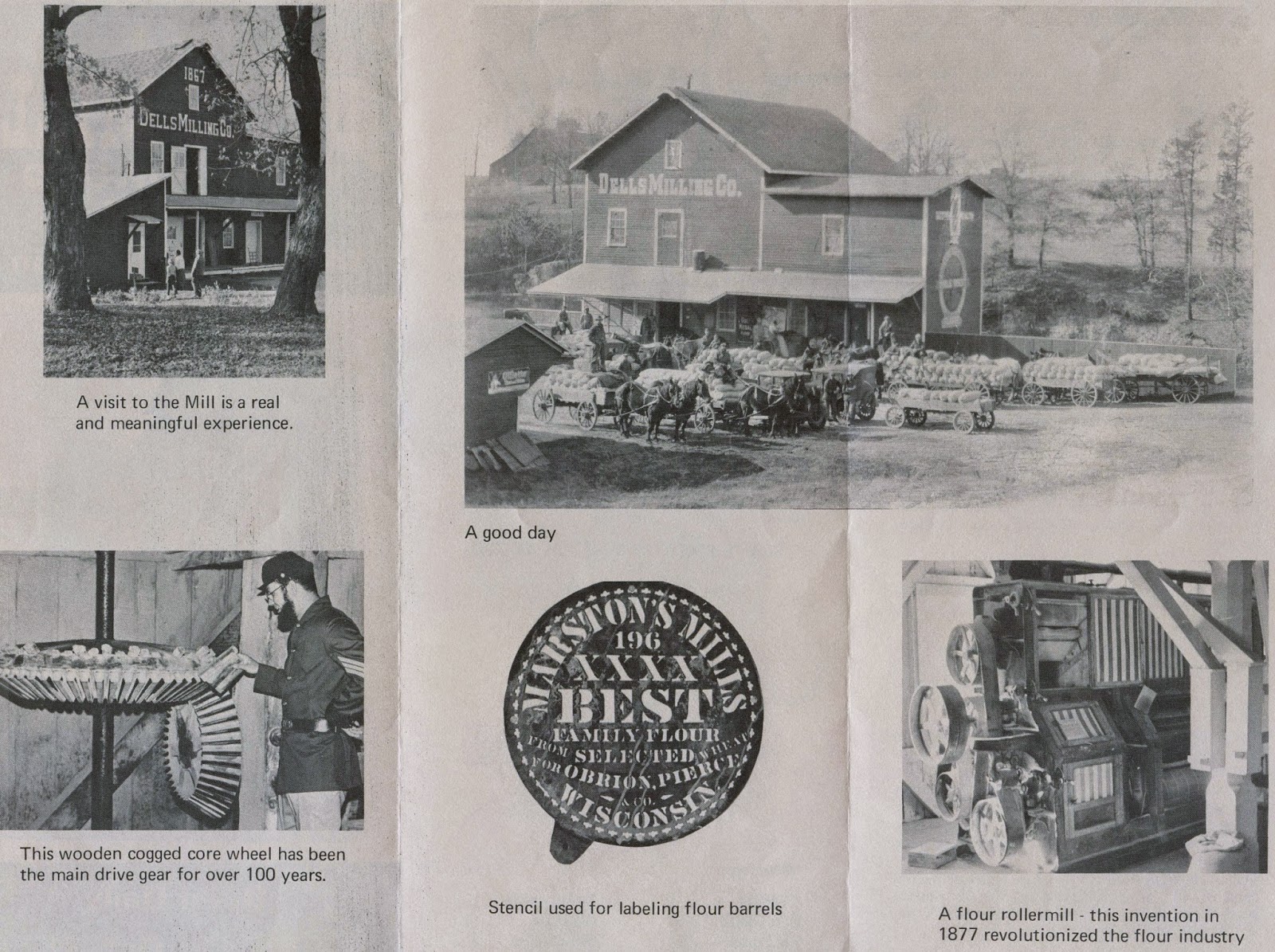
Although there is a large water wheel at the side, the mill has long been powered by a turbine wheel. A larger one was installed in 1955. The main drive gear, equipped with wooden teeth, has lasted through more than a century of use. The teeth, made of hard maple, last from 8 to 10 years under normal usage. Over 3,000 feet of belting and 175 pulleys operate the milling apparatus. The mill also has a flour roller mill – a device which revolutionized the flour industry back in 1877.

Gus Clark has a keen interest in American history as well as in the history of his mill. All this is evident as he conducts his tours and demonstrates for visitors how the machinery works.

Tourists can expect to find him wearing a Civil War Union Army uniform. He has even trimmedDells Mill and Dells Mill Museum Augusta Wisconsin his dark beard in the style of that period. Some years ago he was featured on the front pages of Midwestern newspapers when he saddled up his horse, Clementine, and rode all the way from Augusta to Galena, Ill., to take part in a celebration honoring the memory of General Ulysses S. Grant.

Teachers like to bring school children to the mills for tours, especially in springtime. Gus gladly entertains them with such songs as ”Jimmy Crack Corn” and ”Listen to the Mocking Bird,” accompanying himself on his ” git-fiddle,” a home-made instrument which seems to be a cross between a mandolin and a guitar. He introduces the youngsters to Clementine and highlights his routine by demonstrating his marksmanship with a large, muzzle-loading rifle. Naturally, the kids enjoy every minute of their visit to the Dells Mill museum.

As a sideline, Gus operates, a gun shop on the mill property and his mother runs e’ antique shop there. Antiques aren’t confined to the shop, however. A number of antiques are exhibited inside the mill museum where guests can also see tools which were used in milling, farming and lumbering. Mrs. Clark points ~ collection of old-time barbed wire and says that 300 types were manufactured between 1865 and 1890.

Another section of the museum displays a prairie schooner, buggies, cutters and sleighs. Visitors pause to study a collection of pictures of the mill itself. The Dells Mill has been feature on TV commercials and is a favorite subject for calendar photographs.

Magazine and date of publication is unknown


The SECOND article can be found HERE .....

What is an Old Mill?

From a magazine article by Eliza Lucinda Cubberley

What is an old mill? A place that is hot in summer, frigid in winter? Or a place where the dust motes dance in the sunlight, the tranquilizing music of falling water comes through the open windows, and the good, earthy smell of grain fills the air? Whatever a mill means to you, and especially if you’ve never been in one, you’ll enjoy the one operating mill in Wisconsin that is being preserved as a tourist attraction.

The Dells Milling Company, or Clark’s Mill as it is locally known, is just off Highway 27 three miles north of Augusta in Eau Claire County. The mill was built in 1867 with massive, hand-hewn timbers that were meant to last. They have, and the mill appears as solid as the rock from which its basement is carved.

J. Frank Clark bought the mill in 1917 and today tours are conducted by a descendant. The mill remained in full operation until May of 1968. It was originally a flour mill but its services later included feed grinding.

Except for the sound of water cascading over the 23 foot dam outside, the mill is a quiet pla while visitors listen to the tour guide’s explanation of how it operates, but the moment he engages the water-powered turbine, the mill comes to life with a thunderous rumble. Three thousand feet of belting are instantly on the move, in and out, up and down, through the various levels of the mill. While the mill is running, 250 tons of water every minute power its turbine. (The water wheel on the outside of the building beside the dam, was put there in the 1960s to show how such a mill would have operated in New England. The overshot waterwheel had become old-fashioned by the time mills were being built in Wisconsin, but it has never lost its charm for mill visitors.)

Visitors who go to the mill on a hot day appreciate nature’s air conditioning on the cave-like lower level, part of which has been hewn out of solid rock. If you care to venture still lower, down a curving rock staircase, you can get down to cool water level. As you climb wooden stairs to the upper stories of the mill, the air gets warmer – in fact, hot in summer – but you get to see the interesting hewn beam and wooden peg construction of this century-old structure. The five-level mill is 75 feet high.

In addition to the mill itself and its machinery there are various displays of tools that were used in and around it in the old days. Especially interesting are the rare grain stencils that are hung on the walls.

But best of all is the pleasant scenery of the mill pond, bordered by water-worn sandstone bluffs which are reminiscent of the Dells of the Wisconsin.

Those dells are the reason why Clark’s Mill is also known as the Dells Mill.

Magazine and date of publication is unknown


The THIRD article in this series can be found HERE

Dells Mill Sixty-Five Years Old [1929]

from the Augusta Union Newspaper, November 29, 1929, author unknown, transcribed from the Wisconsin Historical Society archives

No doubt a great many of our older people can recollect with much happiness their cherished memories of the first ride to the old mill. It was way back in the early days when fall work and threshing was done, the your father, realizing the fast approach of the wintry days, would sack up a grist of wheat to be taken down to the mill and made into flour, and it was early the next morning, just as the sun had poked its cheerful face above the horizon, that you were making your first trip down to the mill behind a trudging team of oxen, while in all the glory of an Egyptian Pharaoh you sat perched high upon the sacks of wheat as the clattering high wheeled wagon made its way over the hill, down through the valley to the red mill by the creek.

You remember, of course, as your father drove his yoke of cattle up along the platform opposite the door, how the miller came out with his hearty “Good morning”, and what a friendly feeling you formed for this man, the fellow who was responsible for your bread, in your bread and butter, and perhaps it was after the last sack of wheat was pushed in with the little hand truck that you followed father in, and what a fascinating place you found yourself in.

There were great moving wheels, glimmering belts that raced over big wooden pulleys, and the worlds of hums and rumbles, and in your innocent childish way, you marveled at its greatness. To you it was all a mystery. In one place the miller placed the grain and in another he took off the fluffy white flour into bags that father had brought along for that purpose. To you, milling seemed a black magic. And so this was your first impression of the old mill, and it was perhaps until you grew up and lock the grist in place of your father that you discovered that the old wooden water wheel which creaked under the splashing water of the creek had a greater purpose than serving an inspiration for an artist and the machinery which rumbled inside was not make to make funny noises but to take its part in the task of feeding the hungry mouths of humanity.

It was back in these days of pioneering that the Dells Mill, a land mark in our community was built. It was the year of 1864, the mill was constructed by Wiebber. The millwrighting was carried on by Mr. Gordon, a brother-in-law of Ivory Livermoore.

The first miller was Dan Merriman. At that time, Wiebber, the owner, also ran a boarding house at the Dells, later occupied as a dwelling by J. Frank Clark, which was destroyed in recent years by a fire. Old timers say that at times there were as many as twenty-five men that stopped at this place as they came to and from the woods.

Later Wiebber sold to McCaffery and Marston. From these parties it was transferred to G. W. Paul, who later succeeded by Gessner and Clark. Mr. Clark some years later purchased the interest of Gessner and it was under his ownership that the present dam was build. J. Frank Clark was succeeded by the Dells Milling Company, which is its present owner.

The mill was first built primarily for the purpose of milling flour, but as the wheat belt was gradually pushed back into the west, other lines of grist business took its place. The mill today is considered on of the most up-to-date cereal mills in this part of the country.

It is expected that during this fall there will be milled over 200 thousand pounds of buckwheat flour. In addition to cereal milling, a large business of custom grinding and feed mixing is carried on.

It is a remarkable thing that after sixty-five years you would find a country mill that is still carrying on its work. Many mills built years later have either gone out of business or burned up, but the Dells still continues to be an old land mark and carry on its part in this community by handling the daily grist that is brought to its doors. 


I found this too - from Dennis' Occasional Pages located HERE

Remembering of the Dells Mill, The Dells School and the Dells Mill Pond when I was a child

Remembrances 

Going to the mill with a wagon and a horse with my Grand Father.  The biggest anticipation was getting the work done and having a Dreamsicle as the reward
Swimming in the pond
Floating on the Dells Mill pond, grasping a log as my float and letting the pond, the breeze and the day taking me
Fishing off the concrete walkway just outside the Dells Mill office window, watching the sunfish taking the bait and hoping the mill would wind up to draw the fish to the water intakes
The day I went  fishing with a high school friend, and reaching over to boat to bring in the fish as he reeled it in.  I startled that fish and gave it the energy to break the line. The fish seemed to be about a ten pound wide mouth bass.  I was almost knocked off the boat by my angry friend 
Skating on the pond without any snow to impede me.  There was no snow on the whole of the pond.  We skated for hours.  My friends were with me most of the way and most of the day.  They had to go, but I stayed and enjoy the solitude of the winter day.  I stayed and stayed and almost expired as I realized I was at the far end of the pond and struggled to get back to the house of my friends at the Dells Mill.
Hearing the ice crack and quake in the cold when I skated
Fishing in an ice shack and talking about girls and sex and mostly ignoring the fishing.
Pushing the snow out of the way when it made ice skating impossible
Lighting a wood log fire on the ice
Making a skating rink to the free the ice when the snow came
My parents anticipating the opening of Bass season
Fishing for Crappie's with my Grandmother
Fishing for perch on a midsummer's day
Wading  and then getting up over my waist in the warm water, then getting nude to feel the water flow over me.
Swimming and diving from a raft built by the Dells Mill Clark family
Hearing Moon River sung by Nancy Clark while swimming in the pond
Finding a blue bird for the last time just before they all but disappeared from the region because of DTD use
Wanting to dive off the rocks of the Dells into the pond
Challenging the damn as dangerous waters flowed over it
Finding solstice on a summers eve, floating in a boat on the pond
Shopping at the local hardware store with my grandfather to find the right bamboo cane pole to fish in the Dells Pond
Finding the right bait
Camping on the Dells Mill pond island with friend
Smoking for the first time
Losing my glasses in to the pond


From RoadsideAmerica(dot)com

Dells Mill and Museum
Well-preserved 1864 rural flour mill completely intact with original machinery, fabric belts, and lots of misc. artifacts including two cannon, a covered wagon along with other buggies, some period tools, and a shark(!). The proprietor, soft-spoken Gustave (Gus) Clark, has owned and operated the mill as a museum for over 45 years. He is the fourth generation of the Clark family to operate the mill. Gus is elderly and slow, and speaks very softly. You need to stand close to hear him over the waterfalls of the dam. He will greet you, take your admission, escort you into the first room to look around, then give you a brief monologue. Don't ask questions until he is done, as he will just keep talking. Then he will allow you to roam all the floors of the mill to take photos. Gus has a huge amount of knowledge about the place, plus the Civil War era as it relates to Wisconsin. He usually pops on a Civil War hat when you walk in. He is very friendly and can talk for hours about the mill, and about farm life from the 1860s forward. He is also a musician that likes to sing and play his home-made banjo for the ladies after the tour.
There is also a small, dusty gift shop (with unusual items), an antique store, and a blacksmith shop. Be sure to chat with Gus after the tour.


And I found this WONDERFUL information HERE .... 


Constructed during the Civil War Era along the dells of Bridge Creek, Dells Mill brought logging industry to the area.  This water powered gryst mill ground the wheat that dominated Wisconsin's civil war economy operating until 1968.  Fully functional, Dells Mill is one of a handful of national historic mills remaining operational ready.  According to a conversation with current owner Gus Clark, "The mill could be ready within 3 days."

Now over 140 years old Dells Mill, like many other mills nationally, served its community both economically and socially.  After the wheat production moved westward the mill was adapted to mill flour and grind feed for local farmers.  As industry continued to modernize and forestry maximized its resources, mills around the country became cherished historical landmarks.

     Dells Mill was entered into the National Registry in 1974.  Local school children from Augusta raised money in 2007 to fund a commemorative plaque officially marking Dells Mill as a national historic site.


Converting the historic mill into a museum extended the life of the mill.  In a conversation with Gus Clark, owner and operator of the museum, he retold the story of his ride to Galena Illinois in the 1972 for the sesquicentennial celebration of Grant's home.  Clark traveled from Augusta, WI to Galena, Illinois in a covered wagon camping along the way.  Clad in a civil war uniform at the age of 29, Gus rode into Galena on horseback honoring the memory of Ulysses S. Grant.  Gus Clark's trek to Galena, Illinois received television coverage and acclaim.  To this day Gus can be found tinkering in his shop from10 am to 5 pm -the mills hours of operation from May to October 31st.

   "Nothing makes me feel richer than a woodshed full of wood..." Gus tends to his woodfired stove at the end of a tour.   A conversation with Gus reveals a man connected to a family legacy rich in history.  His bearded face and skin etched with lines speak of his witness to another era.  Gus is a living historian; a witness to Augusta Dells Mill and its surrounding area.  He grew up in the house residing at the shores of Dells Mill pond and attended the one room country schoolhouse.  Consumed by his stories of yesteryear his audience becomes transfixed by his yarns.  It in only after his story has been told that a shift can be felt like a veil lifting  -and awareness of the 21st century returns.


The above images were taken from one of the Mill's Pamphlets ...  (this is very large image)


Clark Brothers Brand

 Dells Mill was entered into the National Registry in 1974.  Local school children from Augusta raised money in 2007 to fund a commemorative plaque officially marking Dells Mill as a national historic site.
 By the time the Civil War broke out in 1861, the establishment of a community on the Dells Mill site was well under way.

   A deed dated 1869, transferred the property from William Weber to Stephen Marston lists the property as consisting of 16 acres and containing "the mill, boardinghouse, school house and other  buildings thereon."  Of these only the mill remains.  The Dells Mill operated as a flour and feed mill for over 100 years.  The water from Bridge Creek was the only source of power ever used.

   In 1894, the mill was purchased by the Clark Family and has remained in their possession to this day, having passed through four generations.  In 1968, Dells Mill was converted into a museum, although grinding is still done on special occasion.

   The mill building itself is a five story structure built of hand hewed timbers and held together by wooden pegs.  It contains 3,000 feet of belting and 175 pulleys all powered by water.

The growth of wheat production in Wisconsin was tremendous betweeen 1850 and 1880, and this was reflected in the rise of the milling business. In 1840, the area which is now Wisconsin supported a total of 33 flour and grist mills. By 1880, the number was just under 1,000. By 1900, milling was the second largest industry in the state second only to lumber. Shortly after the turn of the century however, the milling industry started its long decline and by 1920, abandoned flour mills could be found throughout the state. Due to the record yield of wheat harvests during the 1800's the soil depleted and could no longer support big crops. Wheat prodcution moved westward and cattle grazed where wheat once grew.  Abandoned flour mill became a relic of the past.

   By the time the Civil War broke out in 1861, the establishment of a community on the Dells Mill site was well under way. In the 1830's early pioneers found Wisconsin's rich soil ideal for growing wheat.  In addition, the state was blessed with hundreds of rivers and streams offering an abundant supply of water power attracting settlers into the area.

    A visit to the mill was usually an all day affair starting at 'can see to can't see'.  For the farmer and his family, the mill was more than a place of business.  Starting at dawn, this pleasuresome occasion was marked with a picnic lunch and a fishing event. The mill provided a day of rest from daily farm work.  Orginally named Dells City, the mill was a center of activity providing economic growth for the locals, food and shelter for visitors, work for blacksmiths and a coopery, milling for local farmers, and a school with Sundays services for the area locals.


This can be found on the Eau Claire Information Page located HERE

Dells Mill and Dells Mill Museum

Tour the historic Dell's Mill Historical Landmark & Museum from May through Oct. The building is a five story structure made of hand hewn timbers & held together by wooden pegs. It contains 3,000 feet of belting & 175 pulleys. The water from Bridge Creek powered the flour & feed mill, which operated for over 100 years.  Relish the sights, sounds and smells of the past, State & National Historic site. The Dells Mill was built in 1864 as a grist mill.  It is now over 140 years old. Farmers met and had their grinding done.
The colorful Dells Mill, painted red, has now been in Clark family ownership through four generations. Gus Clark and his mother, Mrs. Bessie Clark, restored it 11 years ago and they now operate it as a museum. They still put it to its original use sometimes to grind whole wheat flour which they sell to tourists. In springtime they clean seed oats for local farmers. They take pride in the fact that the mill has been entered in the National Register of Historic Places.
Teachers like to bring school children to the mills for tours, especially in springtime. As a sideline, Gus operates, a gun shop on the mill property and his mother runs e’ antique shop there. Antiques aren’t confined to the shop, however. A number of antiques are exhibited inside the mill museum where guests can also see tools which were used in milling, farming and lumbering.
Except for the sound of water cascading over the 23 foot dam outside, the mill is a quiet place while visitors listen to the tour guide’s explanation of how it operates, but the moment he engages the water-powered turbine, the mill comes to life with a thunderous rumble.

You will find the Dells Mill be featured in a lot of Calenders .....


And even puzzles... my Mom got one for herself one year ... because it reminds her of home.


Cousin Gus & The Dells Mill ....


I have very fond memories of Cousin Gus and the Dells Mill in Augusta, Wisconsin.  Recently, on Sunday, August 24, 2014, our Cousin Gustave Franklin Clark passed away.

It's really hard to talk about Gus without talking about the Mill because it wasn't like he just worked there, they were one heartbeat.  And even though the Mill still stands as a tribute to the man who devoted his life to keeping it alive, it's hard to think of it without him there telling his stories and singing with his banjo ....

The five-story Dells Mill was built in 1864 as a grist mill. Wisconsin had been a state for just 16 years and Augusta was a town for eight years. The area was barely settled and Augusta was just a pioneer community; there were no automobiles and almost no railroads. 


Another video of Gus singing the same song from the first video.

Here is a video done and put on YouTube of the top of the Mill Wheel - how it fills with water and starts to spin.

He was amazing at what he did.

We would go to the Clark Family Reunion ...  Gus was the brother of my Great Grandmother Eva.  And it was always out in Augusta somewhere.  I remember we'd always stop at the Mill in the Summers, we'd at least take one trip out there.  I loved that place, and it's probably where I fell in love with the sound of running water ... of waterfalls, waterwheels and just the general sound of rain falling.  It was always a calming sound to me.


Anyway, I remember, there is a gift shop across the driveway from the mill.  And it's mostly antiques, if I remember right, but they had the soda in a bottle that you needed a bottle opener to open, and this was always a treat for me.  So we'd go there and I'd get a soda in a glass bottle and it was always the coolest thrill for me.  Gus would take us around the mill and let me make ropes with the little hand cranking machine that would twist it up all tight.  He would tell stories and I had such an active mind that I wouldn't always hear them, now I wish I had.

What I really wish is that someone had videoed the tour as Gus gave it and shared it.  What a treasure that would be.  Especially since we no longer live in Wisconsin and I'd love to be able to show my kids.

In 2006 the Wisconsin Historical Society erected a plaque outside of the mill.


The Dells Mill

Water-Powered grist mills ground the wheat that dominated Wisconsin's Civil War-era economy. Built in 1864, the mill was one of the server serving area farmers. After wheat production moved westward, owners adapted the building to mill flour and grind feed.

A trip to the Dells mill could be an all-day family affair. Farmers often fished the millpond to pass the time. The millpond also provided a source for the winter ice harvest. A store, hotel, and school grew up nearby to serve the growing community

Creating a mill pond required the building of a dam to flood upstream land. The Wisconsin Territorial Legislature enacted legislation enabling dam construction in 1840.

Built along the dells of Bridge Creek, the base of the mill was carved into the sandstone bedrock. massive hand-hewn timbers secured with wooden pegs make up the structure of the Mill. Water turbines powered the milling process. A concrete dam replaced the original log structure in 1919. Dells Mill, which is listed on the National Register of Historic Places, operated continuously until 1968

I am going to share more of the Dells Mill History in another blog, but right now.  I want to share a few things about Gus.

His Obituary....  found HERE.


Gustave "Gus" F. Clark, 71, of rural Augusta, passed away at his home on Sunday, August 24, 2014.
He was named Gustave Franklin Clark, named after his father and grandfather before him. His soul came to earth on Good Friday, April 23, 1943. The first breath for this little body came into his lungs at "the old" Sacred Heart Hospital in Eau Claire, WI. A few days later he was carried to a little place overlooking the Dells Mill Pond north of Augusta, WI. And it has been his lifelong home. It was a part of him; the old mill, the land, the pond, the sandstone cliffs, the air, the dam, the country school, the generation of people, the community, children, teenagers, young adults, middle aged to old. He was it and it was him. Totally complete.
Living from cradle to grave in one space is a special benediction which he cherished greatly. Perhaps it was his piece of heaven on earth.
Three Clark brothers married three Svoma sisters in a triple wedding on Sept. 6, 1937, in Cadott, WI. Malin and Mildred, Paul and Elizabeth "Riddy," Franklin and Bessie (his parents). They were forever best friends and born to the three couples were 8 children. They could not be called sisters and brothers to each other, so they gave their relationship the special label of "double cousins." Gus was blessed with an older sister Nancy, and growing up the two of them usually or almost always celebrated everything together with the double cousins. He was raised in this tribe. The children came to believe that they had three sets of parents. While their other relatives were important sources of love and support, the cousins came to rely upon one another like brothers and sisters. Gus' family and Paul Clark's family lived together during World War II. After the war a second house was built and they lived next door to each other. Their families and the double cousins from Cadott got together almost every weekend and usually at the Dells. Their activities included swimming, fishing, ball games, pretend games, skating, sledding, skiing, and tobogganing, along with cards, monopoly, puzzles, and occasionally movies. Living on the Dells Mill Pond (north of Augusta) was the focal point for much of their outdoor togetherness. Indoors, they created impromptu musical performances and recitations for their audience made up of parents and visiting relatives. These events remained vivid recollections until this day. The images and associated experiences of Gus' childhood remained the wellspring and inspiration the lingered with him all his life.
Gus attended a one room country school called "The Dells School" for eight grades. Much later he bought that schoolhouse and it is now part of his historical landmark and museum creation endeavor. After Gus graduated from Augusta High School in 1961 he took over the milling operations.
The operation of the Dells Mill by the Clark family spanned four generations. In 1894, Gus' grandfather J. Franklin Clark, along with his brother Robert and their father John Clark purchased the Dells Mill. Nine months later the property was owned by Gus' grandfather Franklin and Gus' great-grandfather, Gustave Gessner. In 1939, the mill was passed down to Gus' father, Franklin and Uncle Paul Clark. The two brothers operated the mill until Paul passed away in 1963, and Franklin passed away in 1964, from that point on Gus managed the property and helped in taking care of his mother Bessie and Aunt Riddy.
As Gus started to focus on a way for the mill to survive, he was encouraged to follow his dream. Being interested in history and after a great deal of soul searching and prayer he was led to change the game to historic preservation. The Dells Mill Historical Landmark and museum opened its door to the public for the first time on May 1, 1968, with the season ending November 1. Gus was currently guiding tours and educating the visitors, as he had done for the past 46 years, many of those early years with the help of his mother, Bessie. On Dec. 24, 1974, the Dells Mill was entered on the National Register of Historic Places by the Secretary of the Interior. The mill also became Wisconsin Registered Landmark # 117 at that time.
Gus was baptized at St. Peter's Lutheran Church in Bears Grass just west of Augusta. He had been an active member of Grace Lutheran Church in Augusta all of his adult life. He had served on the Board of Elders for many years and sang with the church choir, called the "Men of Grace." Gus was currently a member of the volunteer community choir, sponsored through the Augusta Senior Center. Gus enjoyed performing with this choir throughout the area at various venues.
Gus will be dearly missed by his sister, Nancy, and her husband, William Scobie, of Chippewa Falls; 2 nephews, Timothy Scobie and Michelle of Chippewa Falls, Patrick Scobie and Priscilla of Denver, CO; 3 great-nieces and 2 great-nephews, Alexis, Lauren, Ian, Collin and Cameron Scobie; aunts and uncles, Eleanor and Cyril Amerling of Albany, Oregon, Lois and George Ramharter of Kissimmee, FL; double cousins, John (Jan) Clark of Augusta, Karen Rivers of Siren, Mary Olsen of Merrill, Sally Pfluger of Bella Vista, AR, Toni (Jim) Christenson of Madison, Tom (Mary Ann) Clark of Edina, MN; and many other cousins.
Gus was preceded in death by his father, Franklin on July 2, 1964, and his mother, Bessie, on March 13, 1994.
Memorial service will be held Thursday, August 28, 2014, at 11:00 a.m. at Grace Lutheran Church in Augusta, with Pastor Jonathan Wessel officiating. A visitation will be held from 5 to 7 p.m. on Wednesday at the Anderson Funeral Home in Augusta, and one hour prior to services on Thursday at the church. The family would like to suggest that memorials be given to Grace Lutheran Church in Augusta, or to the Grace Lutheran Church Augusta Community Choir.

Friends and family are invited to a gathering at the Dells Mill on Thursday to begin around 5:00 p.m. Supper will be served. We will celebrate Gus' life here in Augusta and we will celebrate the mill.


This is an article about Gus and the Mill (found HERE)


Life Story: Man was driving force behind historic Dells Mill


Posted: Wednesday, August 27, 2014 11:31 pm

It’s rare when a structure and a person become so inseparable that it’s difficult for people to think of one and not the other.

But that’s the way it was — for at least the last half-century — with Gustave Clark and the historic Dells Mill near Augusta.

Clark, the mill’s owner and tour guide, has managed the scenic property on the banks of the Dells Mill Pond since 1964 and has been giving tours of the facility since 1968. Four generations of his family have lived at the mill since 1894.
Clark’s sister, Nancy Scobie of Chippewa Falls, summed the relationship up best: “Gus was the mill, and the mill was Gus.”
But the mill lost its main cog Sunday, when Clark died in his sleep from heart-related ailments. He was 71.
His passing leaves the future of the 150-year-old mill in doubt, although Scobie vowed Wednesday to do everything in her power to preserve the mill’s history by keeping it open and accessible to visitors.
“I know people are anxious about the future of the mill, and the family is anxious about the future of the mill too,” Scobie said.
While she hasn’t yet formulated a long-term plan, Scobie said she knows one thing for sure: “I am dedicated to keeping my brother’s dream alive.”
In the short term, Scobie said, the family plans to shorten the mill’s public hours — Clark, who his sister called a “one-man show,” was on site to greet visitors from 10 a.m. to 5 p.m. seven days a week from May through October. The mill will be open from noon to 5 p.m. Saturdays and Sundays, plus Labor Day, until the end of October.
“The mill is such a big part of the community, and I feel it’s important to sustain its presence,” Scobie said
Scobie plans to solicit suggestions from local residents and officials this fall about how best to keep the mill operating down the road.
“We’re dealing with a historical site,” Scobie said. “How do you work to make it not just one person’s responsibility or even one family’s responsibility? Those are the big questions right now.”
Gloria Cowan, a retired teacher from Chippewa Falls, said she is hopeful the Clark family can find a way to keep the mill open. She fondly recalled leading groups of second-graders from the former Korger-Chestnut Elementary School on field trips to the mill for at least two decades beginning in the mid-1970s.
“The kids loved it, and they couldn’t wait to get to second grade so they could go down to the mill,” Cowan said.
Dressed in his Civil War uniform, Clark would entertain the kids by demonstrating how to fire an antique muzzleloader rifle, singing Civil War songs while playing his homemade “git-fiddle” (a cross between a guitar and a banjo) and telling stories about the past.
“It was a fun way for the kids to learn about history,” Cowan said.
Dells Mill began in 1864 grinding the wheat that dominated Wisconsin’s Civil War-era economy and later was adapted to mill flour and grind feed. The base of the mill — containing 3,000 feet of belting and 175 pulleys, all powered by water — was carved into the sandstone bedrock.
Long considered one of the most photographed spots in Wisconsin, the mill operated continuously until 1968 and continued to clean grain until eight years ago. It is listed on the National Register of Historic Places and includes a museum that features photos, old machinery and antiques.
Photos of the classic red structure on the banks of the pristine mill pond have graced countless calendars and book covers, and Reader’s Digest even once ranked it as one of the top places to visit in Wisconsin.
Clark’s attachment to the mill and enthusiasm for its role in history was evident in comments he made several years ago to the Leader-Telegram in which he explained the mill was the basis for the local economy and that its original builders were the founders of Eau Claire.
“It’s a trip back in time,” Clark said at the time. “Our traffic comes from all over the country. It’s a one-of-a-kind experience in this state.”
The mill, Scobie said, was the place where Clark found his fulfillment and his purpose.
“It was the love of his life,” she said.
The above tribute to him was also one in the Minneapolis Tribune,,, found HERE ....


Gus wrote a book, which includes the history of the property and Dell's Mill, and a healthcare experience of his.  If you would like to print off the order form - you can do so by clicking this LINK.


This great article was in VolumeOne which can be found HERE ........ 

150 Years of History

Gustave Clark writes about iconic Wisconsin mill


Civil War enthusiast Gustave F. Clark has run Dells Mill since 1964,
conducting tours for about 44 years.
Gustave F. Clark was born in Eau Claire in 1943 on Good Friday.  Dells Mill Pond in Augusta has been his lifelong home.  He describes growing up on Dells Mill Pond as excellent, saying, “There’s nowhere else in the world I would fit in but right here.”  He graduated from Augusta High School and proceeded to take over the milling operations afterward.  
With encouragement from his sister, Gustave wrote a book that was recently published, The Civil War to America’s Health Care War: 150 years, detailing the history of Dells Mill Pond as well as his difficulties as an uninsured patient.  
Dells Mill has gone through a whirlwind of ownership beginning when two men, Stephen Marston and William T. Weber, bought the site around 1864.  Later, Gustave Clark’s grandfather bought the property.  Sadly, it was foreclosed in 1925, but not long after, the bank itself went bankrupt, and the Clark family was able to buy the property back.  When Gustave’s father died in 1964, Gustave took on the responsibilities of the mill at the age of 21.  Gustave says that because of the state of the economy and the politics of the time, the only reason he can see that the mill survived is that it was “an act of God that is still here.”
Rather than attempt to continue to have the mill be a functional business, Gustave decided to go the route of historical preservation.  Dells Mill Historical Landmark and Museum opened its doors to the public on May 1, 1968.  Gustave wanted to connect the mill with the Civil War time period and began to collect many artifacts.


The mill began to be well known by the public and even seen in publications.  It is said that Dells Mill is the most photographed property in Wisconsin.  According to Gustave, the old mill stands as a monument to industry, agriculture, energy, water power, privatization, work ethic, and the pioneers that tamed the wilderness to farm the land.
Gustave now lives alone at the mill and has been conducting tours mostly on his own for 44 years.  Dells Mill is open for tours every day between May 1 and October 31, from 10 am to 5 pm.  Two different tours are available for guests: a one hour tour guided by Gustave or a slightly less expensive, non-guided tour that can be as long or short as desired.  As an extra benefit, Gustave sings two country songs on his handmade banjo for all the guests that come through his doors.  
In the second part of Gustave’s book, he details his long fight with the health care industry.   Gustave believes that many comparisons can be made between our present political arena and the political issues of one hundred fifty years ago.  He thinks that the industry needs reform, stating that “going to the doctor should be no more stress than going to get groceries.”  For some procedures that he needed on his heart, he was charged about $31,000, and he had no insurance at the time.  This spurred him to begin writing letters to people in legislation because he thought the bill amount was unfair.  
During a five-year period, he sent a total of twenty letters in all to the Wisconsin Attorney General’s office, but was told they could not help him.  During the last seven years from now, he has fired off over one hundred letters, even sending one to President Obama.  
If you’ve got a hankering for history, stop by Dell’s Mill next summer.  You won’t regret it. And if you want to know more details, check out Gustave’s book. 


Thursday, August 21, 2014

Hauntings of Windsor Castle.....


The Ghosts of Windsor Castle:

Spare a thought for the poor old Queen. She may rule 17 countries, have dozens of castles and palaces and possess the most expensive collection of jewellery in the world, but Her Majesty has also to contend with living alongside countless ghosts and ghouls. And if that wasn’t bad enough, half those ghosts are family. Windsor Castle in particular, suffers from its fair share of paranormal activity. Built in the reign of William the Conquerer, Windsor castle is nearly 1000 years old. Since the Middle Ages, thousands of souls have crossed-over within the confines of the Castles. Some, however, appear to have chosen to stay firmly put, becoming part of the castle’s ever growing population of ghosts. British Paranormal takes a look at the ghosts of Windsor Castle and names our favourite royal spectres.

The Ghost of Henry VIII

Henry VIII, the Tudor King who ruled England and Wales during the 16th Century, is Windsor Castle’s most famous ghostly resident. The royal tyrant, who famously dissolved the monasteries and broke from the Catholic Church, is reputed to have been witnessed many times in spirit form, wandering the halls and corridors of the Castle. Observers describe a large anxious, angry man pacing furiously and occasionally shouting as well.

The Ghost of Anne Boleyn

The second most famous Windsor Castle ghost is that of Anne Boleyn, one time wife to Henry VIII and former queen of England. Anne was executed in 1536 having been found guilty of charges of treason, adultery and witchcraft. She was beheaded at the Tower of London. Anne is alleged to haunt the Dean’s Cloister at Windsor Castle. Her ghostly form has been seen peering from a window. She is variously described as looking sad, distressed and occasionally weeping.

The Ghost of Elizabeth I

Elizabeth I has a specific fondness for dropping-in on her (horizontal) ancestors. The inspirational monarch, who spared England a bloody religious war and stood-up against the tyranny of Spain appears to be watching over her distant royal successors, occasionally paying them a visit at Windsor, perhaps to remind them of the shoes they have to fill. Mad King George III, who spent many a long, lonely night at Windsor Castle, once claimed to have conversed with a spectral woman dressed in black, who called herself Elizabeth and claimed to be “married to England’. One hundred years later, Edward VII is alleged to have confided in one of his mistresses about a strange ghostly encounter he had had in Windsor Castle. He described a woman in black, who resembled the great Tudor queen. Elizabeth’s visitations are said to become particularly frequent during times of war. George VI, the present Queen’s father, is said to have observed the ghost of Elizabeth I  on eight consecutive nights, during the opening days of the Second World War.

The Ghost of Mad King George III

King George III was a troubled soul. He suffered from several spells of mental illness during his reign, eventually culminating in a regency, which resulted in his royal executive powers being transferred to his son George, the Prince of Wales. During the King’s periods of ill-health he would be taken away from London and kept out of public view. Windsor Castle was regularly used to cloister the King. The monarch spent many a long, cold, lonely night hidden deep within the ancient walls, far from his wife and family. Perhaps it was this trauma that caused his spirit to linger on. The ghost of George III has been witnessed since the Victorian era, mournfully peering through windows and doors.

The Ghost of Queen Victoria

Clearly Queen Victoria was “not amused” by the alterations made to the Castle grounds by her great grandson, Edward VIII. Although Edward only reigned in theory, the errant King quickly set about modifying the grounds of Windsor Castle following his father’s death. When his lover, Wallace Simpson, requested the removal of a family of spruce trees planted by Queen Victoria and Prince Albert, he was quick to oblige. The work was hampered however by a number of inexplicable phenomena. Workmen in 1936 even claimed to have seen the ghostly figure of Victoria striding towards them from the Castle, waving her arms and moaning loudly.
(Source: HERE)

GHOSTS OF WINDSOR CASTLE. BERKSHIRE

The ghost of King Henry VIII has been seen walking the halls of the castle and his footsteps and agonising moans have been heard by castle visitors.
For over a 1000 years Windsor Castle as stood, it is the oldest and largest occupied castle in the world and the Official Residence of Her Majesty The Queen. Standing in the county of Berkshire, it is also the home to many a Ghosts and tales of supernatural haunting.
Windsor Castle has numerous ghosts and paranormal activity. Built in the reign of William the Conquerer, and dating back to the Middle Ages, many people, both royal and common folk alike have died within the confines of the Castle walls and grounds.  Some of many reported ghosts of Windsor castle are listed below.

THE GHOST OF HENRY VIII

The first of the famous Windsor Castle ghosts is King Henry VIII. Henry VIII was the Tudor King who ruled England and Wales during the 16th Century, Henry VIII  famously dissolved the monasteries and broke away from  the Papacy in Rome and established the Church of England, initiating the English Reformation.King Henry is reputed to have been heard in the Cloisters, wandering the castle halls and corridors and is heard groaning and seen dragging his ulcerated leg which was the eventual cause of his death on 28th January 1547.
King Henry is buried at Windsor Castle, in a vault in St. George’s Chapel with his third wife, Jane Seymour. In the same vault are the  remains of King Charles I who has been seen in the Canon’s house . On the rare occasions where King Henry VIII has been witnessed his ghost is described as a large anxious, angry man pacing furiously and occasionally shouting as well.

THE GHOST OF ANNE BOLEYN

Whenever Henry VIII is mentioned, tales and stories to his his executed wife Anne Boleyn follow shortly after. The ghosts of Windsor castle is no exception to the rule, The wife to Henry VIII and former queen of England.  Before her execution in 1536 Anne Boleyn; King Henry claimed that she had used witchcraft to make him fall in love with her. Interestingly she was never charged with being a witch, and witchcraft did not end up among the charges used by the court which ultimately found her guilty of treason and adultery. Anne Boleyn was beheaded at the Tower of London, her body and head were buried in an unmarked grave in the Chapel of St. Peter ad Vincula which adjoined the Tower Green.
Anne Boleyn body was one that was identified in renovations of the chapel under the reign of Queen Victoria.  Anne Boleyn final resting place is now marked in the marble floor. The ghost of Anne Boleyn is alleged to haunt the Dean’s Cloister at Windsor Castle. Her ghostly form has been seen peering from a window with a sad and distressed faced and occasionally weeping.

THE GHOST OF ELIZABETH I

The youngest daughter of Henry VIII, Queen Elizabeth I, haunts the Royal Library, the sound of  her high heels have been heard on bare floorboards. Elizabeth I has also been seen on numerous occasions by several members of the Royal family and staff. Her ghostly spectre has been seen at a window in Dean’s Cloister where she always wears a black gown with a black shawl over her shoulders.
King George III, who spent many lonely nights at Windsor Castle, once claimed to have conversed with a ghostly woman dressed in black, who called herself Elizabeth and claimed to be “married to England’. Over a hundred years later, Edward VII is also alleged to have confided in one of his mistresses about a strange ghostly encounter he had had in Windsor Castle with a woman in dressed black, who resembled the great Tudor queen.
The appearance of Queen Elizabeth’s are said to be linked to the advent of war. George VI, is said to have observed the ghost of Elizabeth I  on several consecutive nights, during the opening days of the Second World War, its not know if he had a conversation with his ghostly guest or not.

THE GHOST OF (MAD) KING GEORGE III

King George III was born on the 4th June 1738. And faced several years of military conflict all over the globe during the early years of his reign. In his later years the King suffered from several spells of mental illness, which resulted in his royal executive powers being transferred to his son George, the Prince of Wales. During the King’s periods of ill-health and mental instability he often would be taken away from public view.
Windsor Castle was regularly used to clam the King and provide a retreat away from the pressures of public life and the prying eyes of those who looked to make advantage from his ill state. During his periods of ‘madness’ he was confined to a room below the library, it is here, often that the ghost of George III has been witnessed since the Victorian era, mournfully peering through the Library windows and door way. Military Guardsmen have occasionally been startled to see his face still looking out through the window whilst on sentry and duties. King George III died on the 16th February 1820 and is buried in St. George’s Chapel, Windsor Castle

THE GHOST OF QUEEN VICTORIA

Clearly Queen Victoria was “not amused” by the alterations made to the Castle grounds by her great grandson, Edward VIII. Although Edward only reigned in theory, the errant King quickly set about modifying the grounds of Windsor Castle following his father’s death. When his lover, Wallace Simpson, requested the removal of a family of spruce trees planted by Queen Victoria and Prince Albert, he was quick to oblige. The work was hampered however by a number of inexplicable phenomena. Workmen in 1936 even claimed to have seen the ghostly figure of Victoria striding towards them from the Castle, waving her arms and moaning loudly.

THE MANY HAUNTED ROOMS AND LOCATIONS WITHIN WINDSOR CASTLE

The Deanery is haunted by the ghost of a young boy who shouts, “I don’t want to go riding today”. It is also reported that sound of the ghostly boys footsteps can be heard crossing the building.
The ‘Prison Room’ in the Norman Tower is apparently haunted by a former Royalist prisoner dating back to the times of the English Cilvil War . The first Civil War dated (1642–46) and second (1648–49) was between the supporters of King Charles I against the supporters of the Long Parliament, while the third war (1649–51) saw fighting between supporters of King Charles II and supporters of the Rump Parliament. The Civil War ended with the Parliamentary victory at the Battle of Worcester on 3 September 1651. Both Children playing there have seen the Royalist prisoner whilst many adults visitors have felt him brush past their persons.
In the Curfew Tower, ghostly footsteps are heard on the staircase, the tower bells on one occasion where said to have swung on their own while the ambient temperature of the bell room became cold without warning. Moving over to a kitchen in one of the buildings which make up the horseshoe cloisters, the kitchen is haunted by the ghostly figure of a man and horse. They walk straight through the wall. The history records for Windsor Castle state that the cloisters were once the cavalry stables.
In 1873, a night-time visitor to the castle noticed an interesting new statuary group had been erected near St. George’s Chapel: three standing figures, all in black, and a fourth crouching down. The central standing character was in the act of striking with a large sword. The sentry knew nothing of this artwork and when the visitor returned to re-examine it, it had gone!
One of the most reported sightings at Windsor Castle is the ghost of Herne the Hunter. Herne the became the favoured huntsman of King Richard II when he saved the monarch from being mauled to death by a cornered stag. Being wounded in the process, there are accounts that he was later healed through witchcraft and the wearing of the stag’s antlers. Although this may likely just be an interpretation of a reward by the King for his act of valour.
Do to the favour shown by King Richard II, and mounting jealousy within the ranks, Hern took his own life after being framed for theft from the King, by hanging himself from ‘Herne’s Oak in the Home Park . On several Wild Hunts, Herns ghostly spirit has since been seen many times rushing across the Great Park what he is racing for is not known, some suspect he is looking for any lost souls wandering the land.
(Source: HERE)

The Royal Ghosts of Windsor Castle


Windsor Castle located in Berkshire England is the oldest and largest castle in the world. It has been continuously occupied for almost 1000 years. It is the official residence of the British monarchy. Today 500 people live and work in Windsor. Witnesses state that several ghostly former members of the English royal family also reside in the castle. 


In the 16th century King Henry Vlll ruled Britain and Wales. * His ghost has been heard wandering the castle’s halls and corridors. He is heard groaning and dragging his ulcerated leg in the Cloisters which is the condition that eventually caused his death in 1547. Several witnesses have described him as “being a large anxious, angry man” he is heard pacing back and forth and sometimes he is heard shouting. A more recent sighting occurred in the mid 1970s. Castle guards saw the former monarch walk through the battlements. Later they were told that there used to be a door at the spot they saw his ghost disappear.

Henry Vlll had two of his wives beheaded, Anne Boleyn who is also seen at Winsor and her cousin Catherine Howard who haunts Hampton Court which I wrote about in another post. Anne not able to give Henry a son and heir was found guilty of treason, adultery and witchcraft. She was executed at the Tower of London in 1536. Her ghost has been seen in the Dean’s Cloister at Windsor. She is spotted peering through windows. Some have stated she appeared to be sad, others have stated they saw her weeping. One fanciful legend states she is seen running holding her head under her arm.

King Henry’s youngest daughter, Queen Elizabeth l is said to haunt the royal library at Winsor. Witnesses have heard the sound of her clicking heels as she moves around this wood floored room. She is seen wearing a black dress and shawl. Both members of the royal family and staff had seen her ghost over the years. One witness, King George lll not only saw her he talked to her. She told him that she was Elizabeth and that she “was married to England.”


One hundred years after this encounter Edward Vll told his mistress that he had seen her ghost. He described her dressed all in black stating she resembled the “the great tudor queen.” Princess Margaret also saw Elizabeth’s ghost. In recent years a guard saw her ghost, he followed her to the library where she then just disappeared as he watched her. She is considered a harbinger because she has appeared just before war breaks out. George Vl saw her several nights in a row just as World War ll began.

Another English king seen at Windsor is George lll. He suffered from mental illness during his reign in the 1700s. When he had bad spells he was kept from prying eyes in a room located below the library. His ghost was often seen during the Victorian era standing at the libraries’ windows or in the doorway. Military Guardsmen at Windsor have seen his ghost staring down at them from a window as they perform their various duties. Several have admitted to being rattled by this strange sight. Other witnesses have heard him mutter a phrase he was fond of saying while alive, "What, what?' He was unhappy in life but some witnesses have stated that they actually saw his ghost smiling.

The last royal known to haunt Winsor is Queen Victoria. Ironically, while alive she attempted to get rid of a ghost that hundreds of people had seen over a period of 250 years. ** Herne the Hunter, Richard ll's forester hung himself from an oak tree because he was dismissed from service. Witnesses have seen him wearing deer skins and a helmet adorned with antlers. In the 1860s Queen Victoria had this tree chopped down and then she burned the logs as fire wood in an attempt to get rid of his spirit--it didn't work.  

Her ghost made an appearance during Edward’s Vll's very brief reign. A short time after his father died he started to modify the Windsor grounds at the request of his lover, Wallace Simpson whom he abdicated the throne for. She requested several spruce trees be removed that Queen Victoria and Prince Albert had planted.

As the workmen proceeded to cut these trees down several inexplicable incidents occurred that hampered their work. These strange occurrences were explained when Queen Victoria’s displeased ghost was seen running from the castle in their direction. She was moaning loudly and waving her arms frantically. 

* Yet another monarch who haunts Windsor who reigned after HenryVlll's time was Charles l. He was accused of treason and held as a prisoner at Windsor Castle for his role in the English Civil War, he was found guilty and decapitated in 1649. He is buried in a vault at Windsor along with Henry Vlll. His ghost has been seen in the Cannon's house but most often he is seen standing near a table in the royal library.

** Windsor also has a variety of other ghosts that were not members of the royal family. In future, I will share some of their stories.
Click to enlarge

(Source: HERE)

Ghostly Tales from Windsor Castle

Where better to look for ghosts stories than an ancient Castle dating back to the time of William the Conqueror? Berkshire historian David Nash takes us through the grim, ghastly and ghostly tales of Windsor Castle.
Windsor Castle has many ghosts.
Henry VIII haunts the deanery cloisters, where his groans and dragging footsteps are heard.
Elizabeth I haunts the Royal Library and is said to have been seen by several members of the Royal family. The sound of her high heels are heard on bare floorboards, before her imposing figure appears and passes through the library and into an inner room.
The sad face of mad King George III is seen peering from the window in the room where he was often detained.
Charles I haunts a Canon's House in the castle precincts.
The Deanery is haunted by a young boy who shouts, "I don't want to go riding today". It is probably his footsteps which are heard in the same building.
The 'Prison Room' in the Norman Tower is haunted, possibly by a former Royalist prisoner from Civil War times. Children playing there have seen him and adults have felt him brush past.
The kitchen of one of the buildings which make up the horseshoe cloisters is haunted by a man leading a horse. They walk straight through the wall, for the cloisters were once the cavalry stables. A young girl has also been seen here, standing by a Christmas Tree.
Ghostly footsteps are heard on the staircase in the Curfew Tower and, on one occasion, the bells began to swing on their own while the temperature became distinctly chilly.
In 1873, a night-time visitor to the castle noticed an interesting new statuary group had been erected near St. George's Chapel: three standing figures, all in black, and a fourth crouching down. The central standing character was in the act of striking with a large sword. The sentry knew nothing of this artwork and when the visitor returned to re-examine it, it had gone!
There is also the ghost of the Duke of Buckingham's father, William of Wykeham (the building’s architect) and, of course, the famous Herne the Hunter who is more often seen in the Great Park.
Herne the Hunter became the favourite huntsman of King Richard II when he saved the monarch from being mauled to death by a cornered stag. Being wounded in the process, he was later healed through witchcraft and the wearing of the stag’s antlers. Unfortunately though, his subsequent friendship with the King and skill in the field, bred jealousy in his colleagues and he was framed for theft. Shame led him to hang himself on 'Herne's Oak in the Home Park and, with a Wild Hunt, his spirit has since been seen many times careering across the Great Park searching for lost souls.
The Long Walk is haunted by the ghost of a young Grenadier Guard who shot himself while on duty there in the 1920s. He was seen by at least two of his colleagues, immediately after his death.
(c) David Nash Ford

(Source: HERE)