So .. tracing back my Royal line, I wanted to get back as far as I could. Then start from .... well... a starting point. So we're going to start with Rollo. Rollo and his mistress or wife (possibly by "more danico" - she was captured during a raid at Bayeux.) She was believed to be "kidnapped" and forced to become a concubine.... I found this wealth of information and thought I would share this first.
Explanation of "more danico" in another blog...
 |
|
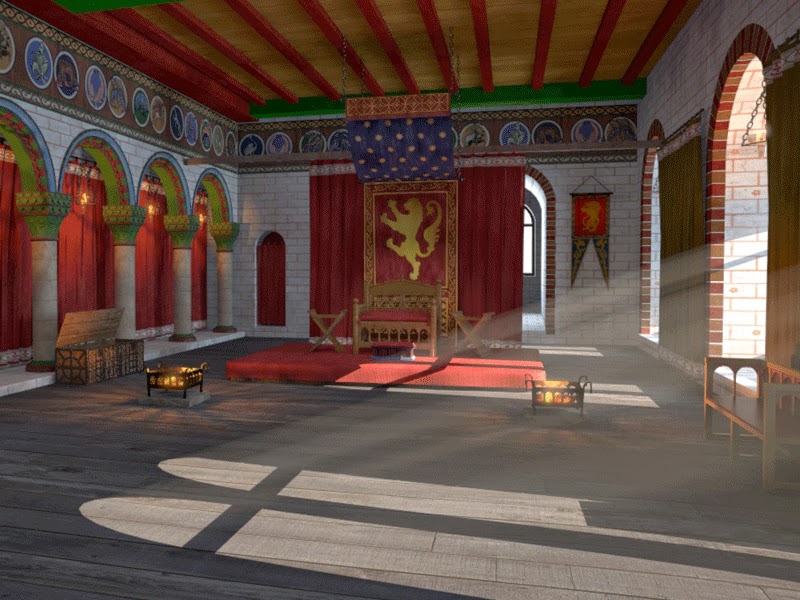
Lion of Rollo, Ruler of Normandy |
THE HISTORY of the Viking Age contains some gruesome reading.
Icelandic sagas tell
of a Viking hulk called Rolv Ganger (Rolv Walker), aka Rollo or Rollon.
He was too big for small horses to carry him, a saga tells. Viking
horses may not have been large.
Rolv killed many people and became an ancestor of the British monarchy, and he had
relatives . . . The main content that follows is from the Icelandic sagas.
- After once being made an outlaw and shooed from Viking Norway, the giant warrior
Rollo had to make it far away from home. He lived by the sword.
- After much turmoil he won a district large enough to feed
him, he got Normandy in
three strides from the French king Charles the Simple - and married
Poppa
(Papia), the daughter of a count, and later the king's daughter or
sister Giselle (Gizella). With Poppa he had four children, possibly.
Some details are hard to verify.
- From then on he and his family could rule what was to become the best part of
France for centuries. They also took over England and Wales - and Normans also conquered
the southern half of Italy, including Sicily, and several other tracts bordering on the Mediterranean Sea.
This is a basic "recipe" of success in later Scandianavian folktales,
where the hero conquers some and opposes others, and ends up reigning.
In other words, the life of Rollo conforms well to several types of plot
often expressed in Scandinavian folktales, such as
Strong John. The success tale of Rollo contains a fair amount of fairy tale motifs, but unlike
Scandinavian folktales - collected in the 1800s and into the early 1900s for most part -
the Rollo story is largely historical fact, according to the Icelander Snorre Sturlason in
Heimskringla, Book 3, section 24; Book 7, section 19, and other Icelandic sagas from medieval times, as the
Orkneyingers' Saga, section 4.
A brief look into the fairy tale build-up
 Several Scandinavian folktales are showing a similarity in their basic
"success recipes" with those of murderous Vikings. It suggests that
many folktale heroes walk in shoes like those of Rollo by degrees and
through much similar stages where success osften depends on combat and
getting valuables.
Several Scandinavian folktales are showing a similarity in their basic
"success recipes" with those of murderous Vikings. It suggests that
many folktale heroes walk in shoes like those of Rollo by degrees and
through much similar stages where success osften depends on combat and
getting valuables.
The saga writer Snorre mentions that Rolv Ganger - later called
Rollo and hailed as one ancestor of the British royal house - grew so
big that Viking horses (probably ponies) were unable to carry him.
In the course of centuries, myths and other tall stories may grow around
admired heroes for
wish-fulfilling reasons and some others. Fantasy unites with fact, much
as
with legends of King Arthur. Arthur's story is mainly composed of
folklore and literary invention. There is no clear historical evidence
that Arthur was a historical figure, but a whole lot of unproductive
speculation. Still he is very popular, for stories about him and his
court speak to the imagination of many. The fame of Arthur and his men
rests in part on Norman bards. Normans developed romances, and those of
King Arthur - blending old Celtic myth and perhaps a skinny core of
actual persons at times - were gratefully received in Great Britain and
northern France too.
Contrary to what many may imagine, having a king is not a great good,
according to Samuel 1:8 in the Old Testament: the king is portrayed as
the enemy on top there. Royalty may breed dependence and un-normal
subservience with or without near-symbiotic and half-neurotic servility.
|
Was Rollon really Norwegian? A Snapshot
An announced project in search of the origin of Rollon by gene technology
Advanced gene technology may soon be applied to confirm or kill old
Saga stories about Rollon. Rollo carries the title of Duke of Normandy
and Count of Rouen, and was the great-great-great-grandfather of the
ancestor of the English royal house, William the Conqueror. Was Rollo
the Norwegian Viking Gange-Rolv?
The origin of Rollo is disputed. Norman and Norse sources contain in
part conflicting information. From medieval times Norwegian and
Icelandic historiy writers have agreed that Gange-Rolv and Rollo is one
and the same person, the Viking chieftain Gange-Rolv who in time came to
France after being exiled from Norway by King Harald Prettyhair, as
some of the medieval sagas tell. The Norwegian-Icelandic version has
been challenged by Danish historians, who have claimed that Rollo was
originally Danish. And Norwegian, Icelandic, French and British experts
have considered that he most probably was Norwegian. "But we have no
definitive evidence," says Claus Krag, who is an expert on medieval
Norwegian history and professor of ancient history at Telemark
University College.
Sturla Ellingvåg of the research foundation Explico, has announced he
will try to use the latest technology in an effort to disclose the
origin of Rollo by a DNA hunt in the fall of 2010. He has been joined by
Professor Per Holck of anatomy and biology professor Erika Hagel Berg
at the University of Oslo. In addition, a French archaeologist,
historian and language professor is involved in the project.
There are no remnants of Rollo that are usable for DNA testing. But it
may be possible to get the DNA profiles of his grandson and great
grandson Richard I and Richard II by opening their stone coffins. They
are in a crypt in the town of Fécamp, 40 miles north of Le Havre, and
scheduled to be opened during the fall of 2010.
Previous gened tests of remains from the Viking Age have revealed DNA
differences between Danish and Norwegian Vikings. If any of these
differences can be traced in the Rollo-Descendants DNA, it may be
possible to substantiate that Rollo was Norwegian.
|
"History has many cunning passages". - T. S. Eliot
"History . . . the
portrayal of crimes and misfortunes." - Voltaire.
The Medieval
Chronicle of the Kings of Norway (online)
contain sagas that teem with descriptions of how Norwegians flocked abroad as pillaging
murderers and traders. We also find suggestive mentions on how to survive and accommodate
in barbarian settings. Norse sagas inculcate certain norms, and some of them suit persons still. [Nok]
Below is information from some of the Norwegian-Icelandic sagas.
The wicked won . . . It was an evil age.
"A time of . . . trolls, gnomes and goblins". - Per Simonnæs,
preface. [Noko]

Once King Harald Harfager moved out with his army from Trondheim and
went southwards to More. Hunthiof was the king who ruled over the
district
of More. Solve Klove was his son, and both were great warriors. There
was a great battle.
King Harald won (AD 867?). (10)
Two kings were slain, but Solve escaped by flight; and King Harald
laid both districts under his power. Ragnvald Earl of More, a son of Eystein Glumra, had
the summer before become one of Harald's men; and the king set him as chief over these two
districts, North More and Raumsdal. Ragnvald was propped up with men of might and bondes
and called Ragnvald the Mighty, or the Wise; and people said both names suited him well.
This was the father of Rollon according to the Icelander Snorre who flourished in the
first half of the 1200s. (10)
The following spring (AD 868?) King Harald raised a great force and gave out that
he would proceed to South More. Solve Klove had passed the winter in his ships of war,
plundering in North More, and had killed many of King Harald's men; pillaging some places,
burning others, and making great ravage. But sometimes during the winter Solve had been
with his friend King Arnvid in South More. Now he gathered people, and was strong in
men-at-arms; for many thought they had to take vengeance of King Harald. Solve
said:
"it is now clear that we all have to rise against King Harald, for we have
strength enough; for becoming his servants, that is no condition for us, who are not less
noble than Harald."
King Harald won, but Solve escaped. Solve became afterwards a great
sea-king. He often did great damage in King Harald's dominions. They were many around the
northern sea. (11)
Harald subdued South More; but Vemund, King Audbjorn's brother, still
had Firdafylke. It was now late in harvest, and King Harald's men gave
him the counsel not to proceed
south-wards round Stad. the weather-beaten West Cape of Norway. Then
King Harald set Earl
Ragnvald over South and North More and also Raumsdal, and he had many
people about him.
The same winter (AD 869) Ragnvald went over Eid, and southwards to the
Fjord district.
There he heard news of King Vemund, and came by night to a place called
Naustdal, where
King Vemund was living in guest-quarters.
Earl Ragnvald surrounded the house in which they were quartered, and
burnt the king in it, together with ninety men. The berserk Berdlukare came to Earl
Ragnvald with a complete armed long-ship and joined forces, and they both returned to
More. The earl took all the ships Vemund had, and all the goods he could get hold of.
(12)
A LITTLE NOTE:

(1) The war-ships of the fierce Vikings were called
dragons, from being
decorated with the head of a dragon, serpent, or other wild animal; and the word "draco"
was adopted in the Latin of the Middle Ages to denote a ship of war of the larger class.
The
snekke was the cutter or smaller war-ship.
(2) The shields were hung over the side-rails of the ships.

(3) The wolf-skin pelts were nearly as good as armour against the sword.

AFTER many harsh battles King
Harald's greatest enemies were cut off. But a great multitude fled out of the country, and
by that great districts were peopled. Jemtaland and Helsingjaland (now: vast parts of
Western Sweden) were peopled then.
Very severe discontent with the brutal tyranny of King Harald led many
to settle elsewhere too - not only in distant parts of Norway, but also
the out-countries of Iceland and the Faroe Isles. They were discovered
and peopled - in part by Celtic women, as genetic studies of Icelanders
document.
The Northmen had also a great resort to Hjaltland (Shetland Isles) and
many men left Norway, flying the country on account of King Harald, and went on Viking
cruises into the West sea. In winter they were in the Orkney Islands and Hebrides; but
marauded in summer in Norway, and did great damage.
Many were also the mighty men who took service under King Harald and
became his flock in the land with him. (20)
KING HARALD heard that the Vikings who were in the West sea in winter, plundered far
and wide in the middle part of Norway; and therefore every summer he made an expedition to
search the isles and out-skerries on the coast. (Skerries are uninhabited dry or halt-tide
rocks of a coast.) Later he sailed with his fleet right out into the West sea. He came to
Hjaltland (Shetland), and he slew all the Vikings who could not save themselves by flight.
Then to the Orkney Islands, and cleared them all of Vikings. After that he proceeded to
the Sudreys (Hebrides).
Many a battle was fought, and King Harald was always victorious. He then
plundered far and wide in Scotland itself, and had a battle there. When he was come
westward as far as the Isle of Man, the report of his exploits on the land had gone before
him; for all the inhabitants had fled over to Scotland, and the island was left entirely
bare.
In this war fell Ivar, a son of Ragnvald, Earl of More; and King Harald
gave Ragnvald, as a compensation for the loss, the Orkney and Shetland isles.
Ragnvald immediately gave both these countries to his brother Sigurd, he got the earldom
of them. Thorstein the Red, a son of Olav the White and of Aud the Wealthy, entered into
partnership with him; and after plundering in Scotland, they subdued Caithness and
Sutherland, as far as Ekkjalsbakke. Earl Sigurd killed Melbridge Tooth, a Scotch earl.
Many Vikings set themselves down then in those countries.
After King Harald
had subdued the whole land, he was one day at a feast in More. Then King Harald went into
a bath, and had his hair dressed. Earl Ragnvald now cut his hair. They were best friends.
Earl Ragnvald gave him the distinguishing name - Harald Harfager (i.e., fair hair); and
all who saw him agreed he had the most beautiful and abundant head of hair. (23)
 |
|
Some European Viking routes
|
EARL RAGNVALD was King Harald's dearest friend, and the king had the greatest
regard for him. He was married to Hild, a daughter of Rolf Nefia, and their sons were Rolf
and Thorer. Earl Ragnvald had also three sons by concubines, - the one called Hallad, the
second Einar, the third Hrollaug; and all three were grown men when their brothers born in
marriage were still children. Rolf became a great Viking, and was of so stout a growth
that no horse could carry him. Wherever he went he must go on foot; and therefore he was
called Rolf Ganger. (Later Rollon)
He plundered much in the East sea. One summer, as he was coming from the
eastward on a Viking's expedition to the coast of Viken, he landed there and made a cattle
foray. As King Harald happened, just at that time, to be in Viken, he heard of it, and was
in a great rage; for he had now forbid the plundering within the bounds of the country.
The king assembled a Thing, and had Rolf declared an outlaw over all Norway.
When Rolf's mother heard of it she hastened to the king, and entreated
peace for Rolf; but the king was so enraged that here entreaty was of no avail. Then she
spoke up:
"Do you think, King Harald, in your anger,
To drive away my
brave Rolf Ganger
Like a mad wolf, from out the land?
Why is your cruelty so
fell?
Think twice, king, it is ill
With such a wolf at wolf to play,
Who,
driven to the wild woods away
May make the king's best deer his prey."
Rolf Ganger went afterwards over sea to the West to the Hebrides, or Sudreys; and
at last farther west to Valland, where he plundered and subdued for himself a great
earldom, which he peopled with Northmen, from which that land is called
Normandy.
Rolf Ganger's son was William, father to Richard, and grandfather to another
Richard, who was the father of Robert Longspear, and grandfather of William the Bastard,
from whom all the following English kings are descended. From Rolf Ganger also are
descended the earls in Normandy. (24)
Rögnvald, Earl of Mæri, son of Eystein Glumra, the son of Ivar, an Earl
of the Upplendings, the son of Halfdan the Old, had for wife Ragnhild,
the daughter of Hrolf the Beaked; their son was Ivar, who fell in the
Hebrides, fighting with King Harald Fairhair. Another son was
Gaungu-Hrolf who conquered Normandy; from him are descended the Earls of
Rouen and the Kings of England. (Part 4, ch. 7)
R. Allen Brown [Cf. Tnn] has written extensively about Normans and the
Norman conquest. I render him in the following:
"NORMANDY was created by the three consecutive
grants of 911, 924 and 933". [Tnn 20] Especially in Lower Normandy the Scandinavian
influences and custom remained rather strong. [Cf. Tnn 21 and 41n] Normandy was in part
colonised. Rollo and his successors, as rulers of Normandy, obtained the title of count
and valuable rights from before, along with widespread domains. [Cf. Tnn 22]
Their buildings seem to document remarkable strength or solidity. The
churches were much like bastions. But the duke of Rouen controlled the whole church and
his bishops owed him military service for their lands - [Cf. Tnn 32]
"From (their) Scandinavian inheritance the Normans derived their sea-faring, much
of their trade and commercial prosperity which they shared with the Nordic world, their
love of adventure, their wanderlust which led to the great period of Norman emigration in
the eleventh century, their dynamic energy, and above all perhaps, their powers of
assimila
(In AD 911) Charles the Simple, king of the west Franks, granted to a band of
Vikings, operating in the Seine valley under Rollo their leader, territory corresponding
to Upper or Easter Normandy. [Tnn 20] To this was subsequently added by two further
grants, first the district of Bayeux, and the districts of Exmes and Seez in 924, and
second the districts of Coutances and Avranches in 933 in the time of William Longsword,
son and successor of Rollo. [Tnn 20] (2)
And from the French Histoire de la Normandie (1862) we find, in
the fourth chapter, how Rollo, son of the Norwegian Rognevald, was made
an outlaw by the Norwegian tyrant king Harald Harfager.
He arrived at Rouen with his companions. The inhabitants spontaneously
submitted to the
giant. King Charles at first wanted to fight the Viking, but dropped it.
Instead they
bargained - Rollo won, he got land and permanent welcome. [Hnam 80 pp]
The historian R. Brown puts the matter into relief: "Normans were pagans when they
came (and they continued to come long after 911)." [Tnn 30] But their leader, the Viking
Rollo, said yes to getting
◦baptised, and many
others followed. More surprisingly, "Rollo . . . is (also - later) said to have wanted to
become a monk (at Jumieges). That could have been due to a genuine flame deep inside. [Cf.
Tnn 26]
In short time the Normans got the back-up of their astute
castles and strongholds, helped themselves to most of it - often they were served by
ditches and stockades too. [Cf. Tnn 44-5]
Their treaty at St.
Claire-sur-Epte became a fact, and Rollo got baptised and married Gisele.
[It is thought that Rollo showed exceptional skills in navigation, warfare,
leadership, and administration. He abdicated to his son Guillame (William) and died in a
monastery in 933. Among his people he was for hundreds of years the personification of
justice and good government under law. Others, who thought differently, found him cruel
and arrogant.]
His son Guillame Longue-Epee (William Longsword) succeeded him.
The third duke was Richard sans Peur (the Fearless), and there were many intrigues and
hard fights. This Richard died and was succeeded by Richard 2 who massacred Saxons in
England at war. The French king Robert became the ally of Richard 2. After his death,
Richard 3 succeeded him and died prematurely. Robert le Diable succeeded him and, before
he died in Terre-Sainte, became the father of Guillame le Conquerant: William the
Conqueror. [Hnam 80 pp]
WE FIND the family tree of William the Conqueror in the book of the historian R.
Brown. It looks like this:
Richard 1 (ruled: 942-96)
Richard 2 the Good (ruled: 996-1026)
Richard 3 (ruled: 1026-27)
Robert 1 the Magnificent (ruled: 1027-35)
William the Bastard or the Conqueror (ruled: 1035-87).
Rollo's great-granddaughter, Emma married two kings of England, Æhelred the Unready and
Knut who was also king of Norway and Denmark. Her son, Edward the Confessor, from the
first marriage, was King of England from 1042-1066.
A few more dukes of Normandy may be added for the sake of survey of that dynasty
line that ruled over Normandy and its English (British) domain:
Robert 2
(ruled from 1087)
Henry 1 (ruled from 1106, King of the English (1100-35)
Henry II, 1135, King of the English (1135-) [◦Source]
"It was a direct result of the Viking onslaught upon Western Europe . . . tidy and precise."
[Tnn 20]
"The Norman monasteries were, by and large,
distinguished . . . new . . . vibrant with . . . careless rapture of
spiritual endeavour". The (Normans) became great spirituals - intensely
aristocratic. [Tnn 28, 30]
Master builders in a very short time, (Normans) restored and built on monasticism
in outstanding degrees. [Tnn 25-6]
Normans from the next century
left grand architectural monuments, and some are still there, more or less intact. The
Tower of London is a very Norman building, for example. King William had much of it built.
[Cf. Tnn 25 pp]
"The tower at Rouen was built by Richard 1
(943-96) and is glimpsed from time to time in the reign of his successor and thereafter
. . .. It may have been the prototype for the great Norman towers at Colchester and London. [Tnn 44n] (4)
Normans went on and built very monastic churches at
such places as Jumieges [one still stands there] and lots of other places. "They added
their cathedrals at Rouen, Bayeux [etc.] Many of these major works of Norman Romanesque
architecture survive in whole or part". [Tnn 31-2]
Formerly hostile Scandinavians . . . became converted [in that way]. [Tnn 13]
"SOME (including Norman clergy) were patrons of the arts and scholarship
. . . and almost all of them were mighty builders." [Tnn 31]
French version
In 820 peasants . . .along the Seine saw in the distance ten or so
curious war ships called—Drakkar because of the animal sculpted into the prow or the
stern, which was actually a dragon—the men from the North didn't travel with their women
as they could easily find them on the spot!
Swearing by the names of Thor and Odin—Vikings plundered, pillaged, raped and
slaughtered up until 911 when the famous treaty of Saint Clair sur Epte was signed between
the Frank king Charles the Simple and Rollon or Rolf, chief of the men from the
North.
On the whole our invaders calmed down, adopting a somewhat bourgeois attitude to
life in this beautiful region which was to become Normandy.
Soon it was the time for William the Conqueror who, on October 14th, 1066 won the
battle of Hastings along with a kingdom—William's heirs were known as the Plantagenets,
and they reigned over Normandy and England. In 1189, Richard the Lionheart divided the
double crown. [ Source]
|
| Here is more about the father and brothers of Rolf Ganger. The story starts somewhere
during the reign of King Harald Fairhair. The Orkneyingars' Saga tells of these happenings too.
|
EARL RAGNVALD in More heard of the death of his brother Earl Sigurd, and that the
Vikings were in possession of the country. He sent his son Hallad westward, who took the
title of earl to begin with, and had many men-at-arms with him. But the Vikings cruised
about the isles plundering the headlands, and committing depredations on the coast. Then
Earl Hallad grew tired of the business, resigned his earldom, and afterwards returned
eastward into Norway.
When Earl Ragnvald heard of this he was ill pleased, and said his Hallad
was very unlike their ancestors.
Then said his other son, Einar, one more brother of Rolf Ganger, "I have
enjoyed but little honour among you, I'll go west to the islands. You will never see me
again."
Earl Ragnvald replied he would be glad if he never came back; "For
there is little hope," he said, "that you will ever be an honour to your friends."
Einar got a vessel and sailed into the West sea at autumn. When he came
to the Orkney Isles, two Vikings were in his way with two vessels. He attacked them
instantly and slew the Vikings and their boatmen. He was called Torfeinar, he cut peat for
fuel where there was no firewood, as in Orkneys.
He afterwards was earl over the islands, a mighty man, very
sharp-sighted. (27)
WHEN King Harald was forty, two of his sons set off one spring with a
great force, and
came suddenly on Earl Ragnvald, earl of More, and surrounded the house
[no castle] in which he was, and burnt him and sixty men in it.
When King Harald heard this he set out with a great force against one
son, who had no other way left but to surrender, and he was sent to Agder.
King Harald then set Earl Ragnvald's son Thorer over More, and gave him
his daughter Alof, called Arbot, in marriage. Earl Thorer, called the Silent, got the same
territory his father Earl Ragnvald had possessed. (30)
HALFDAN, the other son who
had murdered Earl Ragnvald, came unexpectedly to Orkney where Rolf Ganger's brother, Earl
Einar, was in charge. Einar fled at once; but came back soon after about autumn,
unnoticed. They met and after a short battle Halfdan fled the same night. As soon as it
was light, Einar and his men searched the whole island and killed every man they could lay
hold of.
Then Einar said, "What is that I see on the isle of Rinansey? A man or a
bird? Sometimes it raises itself up, and sometimes lies down again." They went to it, and
found it was Halfdan Haleg, and took him prisoner. Earl Einar sang this verse the evening
before he went into this battle:
"Einar won't spare revenge
against his
father's murderers."
After that Earl Einar went up to Halfdan and struck his
sword through his back into his belly, dividing his ribs from the backbone down to his
loins, and tearing out his lungs. Yes, Halfdan died from that one. Einar then
sang:
"For Ragnvald's death my sword is red:
Now, brave boys, let's raise
a mound."
Then Earl Einar took
possession of the Orkney Isles as before. Now when these tidings came to Norway, Halfdan's
brothers took it much to heart, and Einar heard of it. He sang:
"Before they lay
Earl Einar low,
Before this stout heart betrays its cause." (31)
KING
HARALD now ordered a levy, and gathered a great force. He proceeded westward to Orkney
with it; and when Earl Einar heard that he was come, he fled over to Caithness. He made
the following verses:
"Sing,
'Do your worst! - I defy you, king!
-"
But men and messages passed between the king and the earl, and at last it
came to a conference; and when they met the earl submitted the case altogether to the
king's decision, and the king condemned the earl Einar and the Orkney people to pay a fine
of sixty marks (15 kg) of gold. Earl Einar paid the whole fine to the king, who returned to
Norway. The earls for a long time afterwards possessed all the udal lands in Orkney. (32)
Source: [Nbl 350-53]
Rollo was the son of Earl Ragnvald of More, say Norse sagas. Two of
his brothers were Ivar and Tore. Three more were Hallad, Einar and
Rollaug. Hallad and
Einar in due time became earls of the Orkneys, each in his turn. [eg,
Harald Fairhair's Saga]
After being made an outcast by the tyrant king Harald Harfager, Rolf
voyaged to the western isles. Obviously he could count on support from
relatives. The earl
of the Orkneys was his paternal uncle, succeeded by that uncle's son,
that is, his cousin, and later again by his own brothers Hallad and
Einar.
The old sources hold that Rolv took his residence in certain tracts of
what today is the domain of Scotland. The Landnamaboka mentions Rolv got a
daughter, Kathleen:
Helgi . . . harried Scotland, and took thence captives, Midbjorg, the
daughter of Bjolan the King, and Kadlin, the daughter of Gaungu Hrolf or
Rolf the Ganger; he married her. (Part 2, ch. 11).
Before Helgi had harried and married, Rolv of the Sagas had travelled
from Scotland and the isles near it, to Valland, near the English
Channel. The Vikings' Valland consisted of the southern
Netherlands, Belgium and parts of Normandy, roughly said. He took over
Normandy in
three steps. The Sagas identify him with the Rollo that the Frank king
Charles the
Simple bestowed it on.
Spread over the plentiful space from the Danube to the neighborhood of
the Scythian Black Sea, do there inhabit fierce and barbarous nations,
which are said to have burst forth in
manifold variety like a swarm of bees from a honeycomb or a sword from a
sheath, as is the
barbarian custom, from the island of Scania, surrounded in different
directions by
the ocean. For indeed there is there a tract for the very many people of
Alania, and the
extremely well-supplied region of Dacia, and the very extensive passage
of Greece. Dacia
is the middle-most of these. Protected by very high alps in the manner
of a
crown and after the fashion of a city. - [From chapter 2, second
paragraph in Gesta Normannorum by the chronicler Dudo ca. 1015]
Extracts from Dudo of St. Quintin's work is here.
Three things stand out from Dudo's obscure and glorifying marvel. They are:
- If what is called Dacia is surrounded by very high alps, it isn't Denmark.
- Scandia (Scandinavia) is not an island.
- From Dudo's blurred description, Dacia stands out as some very fertile, southern
Alp tract (Balcanlike), and also one that is closely tied in with sailing and ships, as seen
from other passages in Dudo.
To add to Dudo's "back-up of Denmark":
The Dacians are called by their own people Greeks or Danes, and they
boast that they are descended from Antenor. He entered with his
followers the Illyrian borders, having slipped
away from the midst of the Achaeans who pillaged Troy. [Gesta Normannorum,
Chapter 2, paragraph 5]
Dudo's work has the nature of a romance, and has been regarded as
untrustworthy on this ground by such competent critics as Ernst Dümmler
and Georg Waitz. The Danish Johannes Steenstrup, on the other hand,
while admitting the legendary element in the work, regards the book as
of considerable value for the history of the Normans. Further, Leah
Shopkow has more recently argued that Carolingian writing, particularly
two saints' lives, the ninth-century
Vita S. Germani by Heiric of Auxerre and the early tenth-century
Vita S. Lamberti by Stephen of Liége, provided models for Dudo's work. [Wikipedia, s.v., "Dudo of Saint-Quentin"]
There are differences of opinion. The Danish
scholar Johannes Steenstrup wrote in favour of Dudo's version back in
1876. But it is not very clear what that version is or implies. For
judged from Dudo, Dacia is not Denmark [Norsd 30, 31] - the descriptions
of the terrain and the geographic position do not fit.
Most historians have settled on the
presentation of the Icelandic sagas. That position is held by many Icelandic, French,
British and Norwegian historians. They have supported the Sagas of Icelandic origin.
Some Danes love to think that Rollo was Danish, without much valuable
evidence that it was so. There is not a single mention of Rollo in the
classical Danish
sources, and it is often pointed out that a huge, vastly successful
marauder from Scandinavia at that time would not go unmentioned in the
country he came
from - such a "prominent man". The Danish historian Saxo Grammaticus
from
about 1200, has no mention of any Danish Rollo in
◦The Danish History.
But there is mention of Gange-Rolf in several Icelandic sagas, and the
Orkneyingar Saga, and in the Chronicle of the Kings of Norway.
Vikings launched many attacks in France and elsewhere in Europe in
times long gone. For example, a vast Viking army attacked Paris in 885.
It was a huge army
equipped for bombarding and breaking down huge walls - the king came to
the aid and bought
Paris back. [Noko 40] (6)
Sagas tell that Rollo the Walker took part in similar activities, and
that this Hrolf (Rolv, Rollo) was the son of the Viking Ragnvald from
Trondelag, a marauder that was granted the title Earl of More for
helping Harald Fairhair. Sagas tell that Ragnvald's son Rolv was tall
and heavy, and that the region he left when he sailed away as a Norse
outlaw, was More.
Many Danes will disagree with many Icelandic sagas on the basis of a
Norman chronicler's obscure tales about a tract he calls "Dacia," with
key descriptions that do not fit the Danish geography at all, and
despite the fact that the medieval Danish History of Saxo has no mention
of the notable Rollo. [Noko 39]
Norwegian and other historians on the other hand have not swerved from
the view that the Viking Rollo was Rolv, the son of Earl Ragnvald of
More in Norway. And as it also shows up, Danes have changed their views. In short:
- First they stuck to the presented views of the Norse sagas.
However, after Norway and
Denmark were split in 1814, Danish historians said Rollo was a Dane on
the basis of Dudo of St. Quentin's tales of "Dacia" and a nobleman
there, at loggerheads with the Danish king. According to Dudo, the
nobleman had two sons, Gurim and Rollo; Rollo was expelled and Gurim
killed. William of Jumièges, the original compiler of the history known
as ◦The Gesta Normannorum Ducum
("Deeds of the Dukes of the Normans"), written in about 1070, states
Rollo was from the Danish town of Fakse. William built his version on
his forerunner Dudo. [Wikipedia, s.v. "William of Jumièges"]
- Swedes supported the Norwegian view, as rooted in several
medieval, Icelandic sagas and findings in Normandie - until the union
between Norway and Sweden broke in
1905. After that, the Sweden launched their own candidate, but without
much success.
- In Normandy Rollo is celebrated as a real Viking from More on the west coast of Norway [Cf. Noko 35]
- International scholars or researchers stick to Icelander sagas
and Snorre Sturlason as the more plausible source; Snorre says Rollo
and Rolv Ganger are one and the same. [Cf. Noko 35]
This pinpointing more than suggests that political interests may interfere with and/or colour versions and views.
Be that as it may, after Rollo and his companions
settled in Normandy, they most likely kept the ties with their kin,
according to Norse customs at the time. Rolv Ganger converted and wed
according to Frank fashion and settled in Rouen.
Next he granted many of his Viking companions ample landed property. It
is likely that kin from up north came to join them in such a fine
country as well. It was feasible to go north and fetch one's women and
children and kin to the new land, for the soil was fit, there was much
fish, and as members of the ruling class they were much safer or freer
than those who submitted to the tyranny of Harald Harfager and his
family in Norway and its colonies in several western islands. [Cf. Noko
43]
Normans built fortresses
on strategic places, and many rustic castles were to come along with
them in a short time. All able men had to serve in the Norman military
forces. And the formerly ruined, marauded region was turned into one of
the foremost in France, and Rouen became the second largest city in
France, and Rolv became the originator of the Norman duchy. [Noko 39,
45-46]
 |
|
The Rollo statue in Fargo, North Dakota
|
In 1911, during the Norman Millennium celebrations, the city of Rouen in
Normandy decided
to create two copies of its Rollo statue. One replica was sent as a gift
to Rollo's
putative birthplace somewhere around Ålesund, Norway. The earls of Moere
were headquartered somewhere nearby Ålesund, it is estimated.
The other replica went to Fargo in North Dakota. The two
bronze statues were copied from an original stone statue sculpted in 1863 by Arsene
Letellier, erected in Rouen in 1865.
In Fargo, the dedication ceremony in 1912 included
a speaker from the French embassy in Washington. A proclamation by the mayor of Rouen,
bound in leather with gold seal of the city, gold leaf and other ornamentation, read in
part,
"Since these ancient times, these fierce warriors have populated and have become a
hard-working people whose importance is shown by the powerful association of the Sons of
Norway which has preserved the cult of memory, and which participated last year in the
celebrations in the ancient Duchy of Normandy."
The celebrations were concluded with a parade down Broadway. The Rollo statue
was relocated in the 1980s and now stands in a little park.
And the other copy of the now war-damaged statue in Rouen is in a small park in
Aalesund, Norway. [Noko 39, 48, 40]
Norse Viking Rollo, Rolf Ganger, Norman history




.jpg)


